
How I'm Learning to Budget My Energy
After I was in a car accident many years ago, I started having debilitating migraines about 18 days out of every month. I was already dealing with chronic pain from injuries I'd sustained in the Army, along with other health issues, and right around that same time, I started my Tarot business.
This created a fairly obvious problem: I never knew when I was going to be able to work.
I could make an appointment with a client for Thursday at 2:00, but I had no way of knowing whether Thursday would be a perfectly functional day or whether I'd wake up with a migraine and have to cancel everything. So I did something that felt risky at the time: I told people the truth.
When clients booked appointments with me, they knew there was a possibility I would have to cancel at the last minute. I couldn't give them more warning because I didn't have more warning. If I woke up sick, we'd simply have to reschedule.
And you know what? Almost nobody cared.
Over the years, I only had three people complain about cancelled appointments. Meanwhile, I discovered that I could get a surprising amount done during the hours and days when I did feel well. I built my business, worked with clients, created courses and other resources, and eventually built a six-figure business - not because I'd figured out how to push through pain, but because I'd learned to work with the energy I actually had.
That distinction became even more important about ten years later, when my health had improved considerably. But then I decided to do something counterintuitive to the Hustle Culture everyone was espousing at the time. I cut my hours to around 24 a week - and my income more than doubled.
Back then, I talked about this a LOT because I worked with so many people who were burning themselves out on their businesses. Working less had helped me earn more.
Reducing my working hours forced me to become much more intentional about what I did with them. I couldn't treat every task as equally important, fill my calendar simply because there was an empty space, or assume that more hours automatically meant more results. I had to pay attention to which work actually mattered, what was worth my time and energy, and what wasn't.
For a while, I thought I had gotten pretty damn good at it.
Then my health changed again.
When the Old Math Stops Working
Over the past several years, new medical complications have changed what my body can do and how much things cost me physically. I'm still learning exactly where those boundaries are.
And one of the hardest parts has been realizing that the cost of something isn't necessarily obvious while I'm doing it.
I might technically be able to do something today and discover afterward that I borrowed heavily from tomorrow. An outing that seemed perfectly reasonable might require a recovery day. Several stops that individually weren't particularly difficult could become exhausting when I stacked them together. Something I used to be able to do without thinking about it might now have a completely different cost.
That meant I needed to rethink energy management yet again.
I've tried different ways of tracking energy over the years, and most of them haven't worked particularly well for me. Spoon Theory, for example, is an incredibly useful metaphor for a lot of people with chronic illness and disability, but I have absolutely no idea how many spoons I have. 🤣
If I have ten spoons, how many is Walmart? What if Walmart unexpectedly includes a long checkout line? What if I add lunch? What if I need to stop at Food Lion because I almost never actually go to Wal-Mart?
I needed something that required much less calculation and made a LOT more sense, at least to me. Spoons are for eating peas, not measuring energy, at least in my World.
Eventually I realized that I don't need to quantify my energy perfectly. I need enough information to make a good decision.
That's how my Green, Yellow, and Red Day system developed.
Green, Yellow, and Red Days
Instead of trying to assign a numerical value to my energy, I start by checking three things: how my body is doing, how my mind is doing, and what tomorrow looks like.
Then I decide what kind of day I'm actually having.
A Green Day is a good-energy day. That's when bigger adventures, more involved projects, shopping, focused work, or several stops might make sense.
A Yellow Day means I'm okay, but I need to pace myself. I can still work, go somewhere, create something, or enjoy a short adventure, but I need to be more selective about what I choose.
And a Red Day is a recovery day. Sometimes that means staying home, reading, watching TV, drinking tea, and snuggling cats. Sometimes it means staying in bed with a washcloth over my head and having absolutely no expectations for myself.
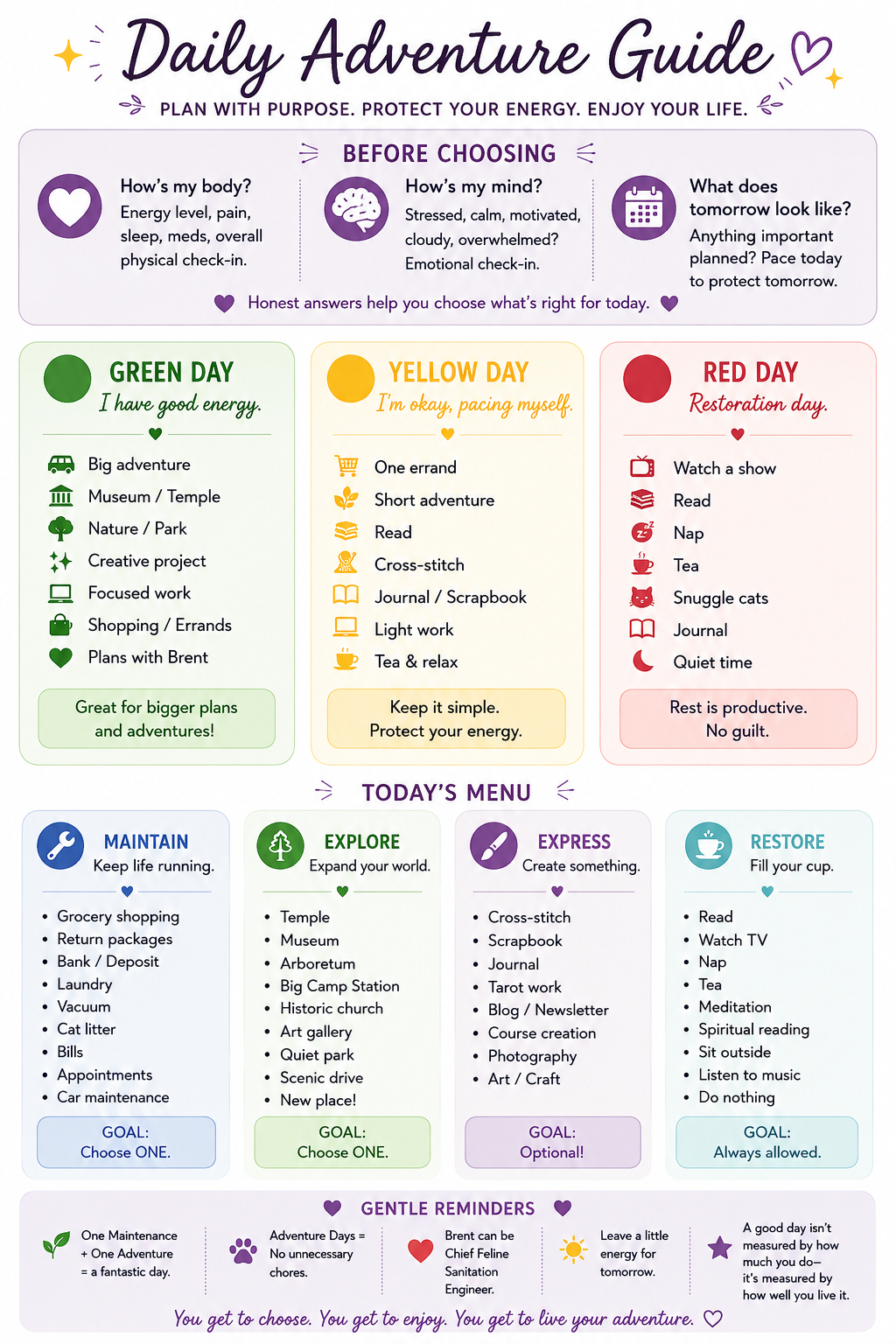
The important thing is that these aren't grades.
A Green Day isn't a good day because I accomplished more, and a Red Day isn't a bad day because I accomplished less. The colors simply give me information I can use to decide what makes sense.
And I've realized that there's another question that's just as important as Can I do this today?
Am I willing to spend tomorrow on this?
Sometimes the Answer Is Absolutely
This may be the most useful thing I've learned through all of this: managing my energy isn't about conserving as much of it as possible.
I'm trying to spend it intentionally.
There are things I will happily spend tomorrow on. A special adventure with my husband, somewhere I've really wanted to go, or an experience that matters to me might absolutely be worth a recovery day afterward.
Walmart probably isn't. 🤣
That distinction has changed the way I think about my limitations. Instead of asking only whether I'm physically capable of doing something, I can think about what it costs and decide whether that cost is worth paying.
Sometimes the answer is, “Absolutely.”
Other times it's, “Nah. I'll save Walmart for another day.”
Neither answer means I've failed.
The Energy Budget I've Been Building for 25 Years
Eventually, all of these lessons became the two guides I've been using now: my Daily Adventure Guide and Energy Budget.
The Daily Adventure Guide helps me figure out what kind of day I'm having before I start making plans. But, after my first day using it I realized that I needed to go even deeper, specifically by figuring out what tasks or how many could fit in different levels of Green, Yellow, and Red Days.
So the Energy Budget was born.
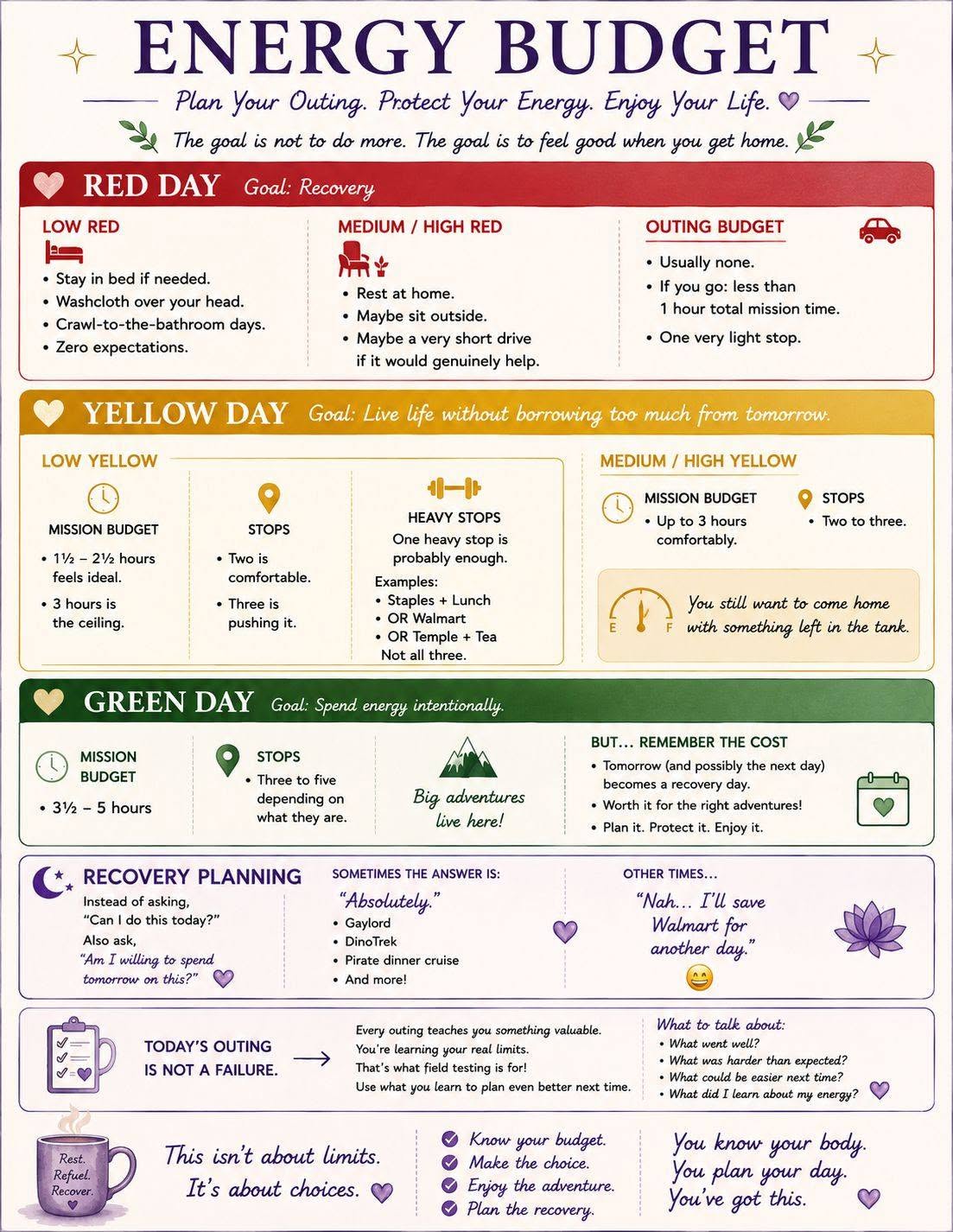
The Energy Budget goes further by helping me think about how much outing time I can realistically handle, how many stops make sense, whether one particularly demanding stop is enough, and what I'm likely to need afterward.
And after decades of trying to figure this out, I think one sentence on the Energy Budget may sum up the entire system:
The goal is not to do more. The goal is to feel good when you get home.
I'm also using the same approach as I begin working on my business again. My circumstances aren't the same as they were when I first started my business, and they're not the same as they were when I was working 24 hours a week. So I'm not trying to recreate either version of my life.
I'm figuring out what works now.
That's really what an energy budget is.
And yes, I sometimes still get it wrong.
Me? Stop working? It's tough.
Everyone Has an Energy Budget
I created this system because I live with chronic pain, disability, and energy that isn't always predictable. But I don't think you have to be disabled or chronically ill to benefit from it.
Everyone has an energy budget.
Stress affects it. Sleep affects it. Work affects it. Caregiving affects it. Emotional overload affects it. Getting older affects it. Sometimes you simply have a crappy Tuesday and don't have as much to work with as you thought you would.
Your Green, Yellow, and Red Days may look completely different from mine. In fact, they probably should.
The point isn't to adopt my limits. It's to identify your own.
Instead of asking yourself how much you should be able to accomplish, you can look at the energy you actually have and decide what you want to do with it.
You can spend some of it maintaining your life. You can spend it on work. You can spend it creating something, seeing people you love, going somewhere you've never been, sitting outside, reading a book, or doing absolutely nothing while your body recovers.
And sometimes you may intentionally spend more than you have today because the experience is worth borrowing a little from tomorrow.
The important part is that you made the choice.
After 25 years, that's what I've finally figured out about managing my energy. It was never really about finding the perfect productivity system or determining exactly how many metaphorical spoons I have.
It's about knowing my budget well enough to make choices about the life I want to live.
And lately, for the first time in a while, this system is helping me do exactly that.
At least, when I stop being stubborn and pay attention to it.
I'm a work in progress. 🤣
To make something like this, you can snag these images as an example and ask AI to make your own version or use these as a guide to put something together in Canva.
The important thing is to learn YOUR energy, your tasks, and how your days work.
And if this helps even one person, my work here is done.

Accessible Text Versions
The following section contains complete text versions of the Daily Adventure Guide and Energy Budget graphics above.
Daily Adventure Guide - Accessible Text Version
Plan with purpose. Protect your energy. Enjoy your life.
Before Choosing
Before deciding what to do today, check in with yourself.
How’s my body?
Consider your energy level, pain, sleep, medications, and overall physical condition.
How’s my mind?
Are you stressed, calm, motivated, cloudy, or overwhelmed? Consider your emotional state as part of your decision.
What does tomorrow look like?
Do you have anything important planned? Pace yourself today to help protect your energy for tomorrow.
Honest answers help you choose what’s right for today.
Green Day - I Have Good Energy
Green Days are great for bigger plans and adventures.
Possible activities include:
-
Big adventure
-
Museum or Temple
-
Nature or park
-
Creative project
-
Focused work
-
Shopping or errands
-
Plans with Brent
Yellow Day - I’m Okay, Pacing Myself
Keep it simple and protect your energy.
Possible activities include:
-
One errand
-
Short adventure
-
Read
-
Cross-stitch
-
Journal or scrapbook
-
Light work
-
Tea and relax
Red Day - Restoration Day
Rest is productive. No guilt.
Possible activities include:
-
Watch a show
-
Read
-
Nap
-
Tea
-
Snuggle cats
-
Journal
-
Quiet time
Today’s Menu
You can also think about your day in terms of four categories: Maintain, Explore, Express, and Restore.
Maintain - Keep Life Running
Possible activities:
-
Grocery shopping
-
Return packages
-
Bank or deposit
-
Laundry
-
Vacuum
-
Cat litter
-
Bills
-
Appointments
-
Car maintenance
Goal: Choose ONE.
Explore - Expand Your World
Possible activities:
-
Temple
-
Museum
-
Arboretum
-
Big Camp Station
-
Historic church
-
Art gallery
-
Quiet park
-
Scenic drive
-
New place
Goal: Choose ONE.
Express - Create Something
Possible activities:
-
Cross-stitch
-
Scrapbook
-
Journal
-
Tarot work
-
Blog or newsletter
-
Course creation
-
Photography
-
Art or craft
Goal: Optional!
Restore - Fill Your Cup
Possible activities:
-
Read
-
Watch TV
-
Nap
-
Tea
-
Meditation
-
Spiritual reading
-
Sit outside
-
Listen to music
-
Do nothing
Goal: Always allowed.
Gentle Reminders
One Maintenance + One Adventure = a fantastic day.
Adventure Days = No unnecessary chores.
Brent can be Chief Feline Sanitation Engineer.
Leave a little energy for tomorrow.
A good day isn’t measured by how much you do - it’s measured by how well you live it.
You get to choose. You get to enjoy. You get to live your adventure.
Energy Budget - Accessible Text Version
Plan Your Outing. Protect Your Energy. Enjoy Your Life.
The goal is not to do more. The goal is to feel good when you get home.
Red Day - Goal: Recovery
Low Red
-
Stay in bed if needed.
-
Washcloth over your head.
-
Crawl-to-the-bathroom days.
-
Zero expectations.
Medium / High Red
-
Rest at home.
-
Maybe sit outside.
-
Maybe a very short drive if it would genuinely help.
Outing Budget
-
Usually none.
-
If you go: less than 1 hour total mission time.
-
One very light stop.
Yellow Day - Goal: Live Life Without Borrowing Too Much From Tomorrow
Low Yellow
Mission Budget
-
1½–2½ hours feels ideal.
-
3 hours is the ceiling.
Stops
-
Two is comfortable.
-
Three is pushing it.
Heavy Stops
One heavy stop is probably enough.
Examples:
-
Staples + Lunch
-
OR Walmart
-
OR Temple + Tea
-
Not all three.
Medium / High Yellow
Mission Budget
-
Up to 3 hours comfortably.
Stops
-
Two to three.
Remember: You still want to come home with something left in the tank.
Green Day - Goal: Spend Energy Intentionally
Mission Budget
-
3½–5 hours.
Stops
-
Three to five, depending on what they are.
Big adventures live here!
But... Remember the Cost
-
Tomorrow, and possibly the next day, becomes a recovery day.
-
Worth it for the right adventures!
-
Plan it. Protect it. Enjoy it.
Recovery Planning
Instead of asking:
“Can I do this today?”
Also ask:
“Am I willing to spend tomorrow on this?”
Sometimes the answer is:
“Absolutely.”
Examples:
-
Gaylord
-
DinoTrek
-
Pirate dinner cruise
-
And more!
Other times:
“Nah... I’ll save Walmart for another day.” 😁
Today’s Outing Is Not a Failure
Every outing teaches you something valuable.
You’re learning your real limits. That’s what field testing is for! Use what you learn to plan even better next time.
What to talk about:
-
What went well?
-
What was harder than expected?
-
What could be easier next time?
-
What did I learn about my energy?
This Isn’t About Limits. It’s About Choices.
-
Know your budget.
-
Make the choice.
-
Enjoy the adventure.
-
Plan the recovery.
You know your body.
You plan your day.
You’ve got this.