
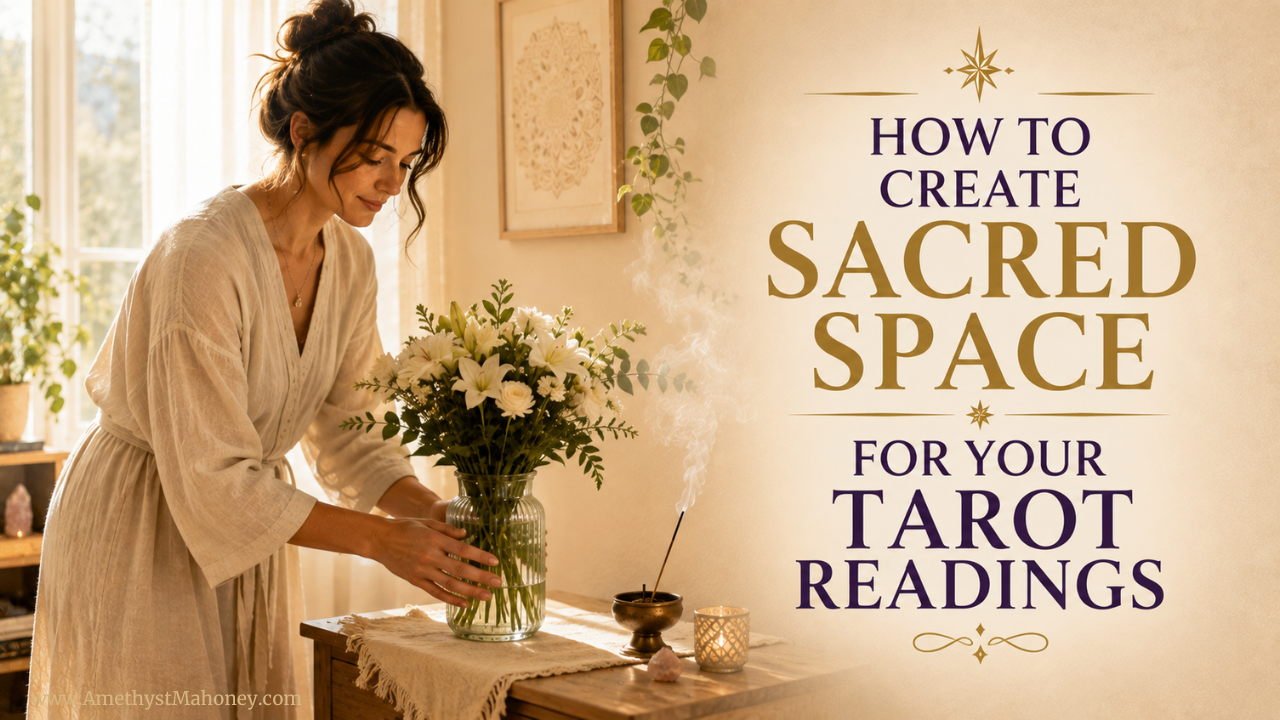
How To Create Sacred Space For Your Tarot Readings
Creating Sacred Space can transform the way you experience your Tarot practice. It gives you an intentional place to step away from the noise and distractions of everyday life and spend time with your cards, your intuition, and your spiritual practice.
Sacred Space is simply space that you intentionally set apart for spiritual work. It might be an entire room, a small altar in the corner of your bedroom, a particular chair where you always read your cards, or the dining room table for the next thirty minutes. What makes the space sacred isn't its size or how elaborate it is. It's the intention, energy, ritual, and meaning you bring to it.
Over time, returning to Sacred Space can become a ritual of its own. Lighting the same candle, sitting in the same chair, saying a familiar prayer, or simply placing your Tarot cards on the table can signal that you're leaving ordinary activity behind for a little while and entering a space you've set aside for something meaningful.
And yes, if your version of Sacred Space includes seventeen candles, incense, crystals, flowers, statues, sacred books, and an altar that requires its own furniture, you're among friends here. We like to embrace the Woo.
Creating the Energy of Your Sacred Space
If you have the room, you may enjoy dedicating a particular place to Tarot and other spiritual practices. It could be a desk where you read your cards and journal, an altar in the corner of your bedroom, a favorite chair where you meditate, or even an entire room if you're lucky enough to have the space.
As you return to that place again and again, it can begin to feel different from the other spaces around you. The objects become familiar, the rituals become familiar, and you may begin to associate simply being there with reflection, intuition, prayer, spiritual connection, and Sacred Work. For people who believe that places can hold or accumulate energy, regularly working in the same place may also become part of the energetic character of the space itself.
You can use your Sacred Space for Tarot readings, meditation, prayer, ritual, spiritual study, or journaling. It doesn't necessarily have to be reserved exclusively for Tarot, either. The important distinction is that you've intentionally created a place where you can turn your attention toward the Sacred.
Of course, not everyone has enough room to dedicate a permanent space to spiritual work. Your dining room table might need to handle bills, dinner, somebody's abandoned mail, and a Tarot reading all in the same day. That's fine. You can intentionally transition an ordinary space into Sacred Space whenever you need it.
Clear away whatever is distracting you, bring out your cards and any sacred objects you want to use, and do something that marks the transition for you. You might light a candle, say a prayer, ring a bell, burn incense, or simply take a moment to declare that for this time, this space is sacred.
Prepare Yourself for Sacred Work
Creating Sacred Space isn't only about changing the environment around you. Part of the ritual is also preparing yourself to enter it.
You may want to take a few moments to ground and center yourself before beginning. You might pray or meditate, call upon your Guides or Ancestors, connect with God, Gods, Goddesses, or another Divine presence, or simply sit quietly with your cards until you feel ready to begin. Your spiritual practice gets to determine what that transition looks like.
Physical rituals can be especially helpful because they give your mind and body something tangible to associate with Sacred Work. Lighting a particular candle, ringing a bell, washing your hands, burning a favorite incense, or slowly shuffling your cards can become a familiar signal that you're entering a different kind of space and turning your attention toward something deeper.
You don't have to enter that space feeling perfectly calm, spiritually centered, or cleansed of every unpleasant emotion, either. In fact, I often take difficult emotions and problems into Sacred Space with me because that's where I want to work with them.
If you're angry, grieving, frightened, confused, or struggling with something you can't stop thinking about, you don't have to get rid of those feelings before you're allowed to begin. Sacred Space can be somewhere you bring those experiences so that you can sit with them intentionally, explore them through Tarot, prayer, journaling, meditation, or ritual, and perhaps begin to understand them differently.
Sometimes the problem is the entire reason you're entering Sacred Space in the first place.

Bring Your Tarot Journal
I also like to keep a Tarot journal nearby whenever I'm reading. Writing down the cards you draw, the deck you're using, your initial interpretation, and anything unusual that catches your attention gives you a record you can return to later.
That return can be just as valuable as the original reading. Something that didn't make sense when you pulled the cards may become obvious several days later, or you may notice that a particular card keeps appearing around the same kind of question or situation. Your journal gradually becomes a record not just of your readings, but of the way you have learned to work with Tarot.
If you'd like to begin keeping one, How to Start Your Tarot Journal walks you through creating a Tarot journaling practice that works for you.
Use the Elements to Create Sacred Space
One of my favorite ways to create Sacred Space is to bring in representations of the five elements: Earth, Air, Fire, Water, and Spirit. You certainly don't need to have all five present every time you read, but working with the elements can give you a wonderful framework for choosing objects for your altar or reading space.
Earth might be represented by crystals, stones, plants, herbs, flowers, soil, or jewelry containing stones that are meaningful to you. For Air, you might use incense, feathers, bells, wind chimes, or something else you associate with breath, wind, thought, or communication.
Fire is usually the easiest one for me because I will take almost any excuse to light a candle. Candles can bring warmth and beauty to your space while also marking the beginning and end of your ritual.
Water might be represented by a small bowl or glass of water, seashells, rainwater, or water you've collected from a place that has spiritual or personal meaning for you.
For Spirit, choose something that represents the Sacred or Divine according to your own beliefs. That could be a sacred text, a Tarot card, statue, icon, photograph, symbol of the Universe, or representation of a God, Goddess, Saint, Guide, Ancestor, or other spiritual presence with whom you work.
You can create a complete elemental altar if that appeals to you, or you might discover that you're particularly drawn to one or two elements and want to emphasize those. You can also change your altar according to the season, moon phase, ritual you're performing, question you're exploring, or simply what feels meaningful to you at that particular moment.
There isn't a required formula.
This is your Sacred Space, and it should reflect your spirituality.
Make Your Sacred Space Somewhere You Want to Be
Sacred doesn't have to mean formal, austere, or uncomfortable. Your Sacred Space should feel like somewhere you actually want to spend time.
Keep a blanket nearby if you tend to get cold. Make yourself tea or coffee. Bring water. Find a chair that won't make your back hate you twenty minutes into a reading. Adjust the lighting. Put your phone somewhere it won't constantly pull your attention away from what you're doing.
Beauty can be part of the spiritual experience, too. Flowers, artwork, fabrics, plants, crystals, photographs, statues, candles, seasonal decorations, or objects you've collected during meaningful experiences can all help make the space feel like yours. Some of those things may be sacred because of what they represent, while others may gradually become sacred because they've simply been there with you through years of readings, prayers, rituals, questions, discoveries, and changes.
You aren't trying to build the objectively perfect altar. You're creating an environment that helps you feel comfortable, connected, and ready to do Sacred Work.
You Can Create Sacred Space Anywhere
Once you've developed your own rituals for entering Sacred Space, you may find that you can create it almost anywhere. A permanent altar is wonderful if you have one, but the Sacred isn't confined to a particular desk or room.
You can make a small traveling altar, carry a few meaningful objects with your Tarot deck, or use a familiar prayer, candle, gesture, or ritual to mark whatever place you happen to be using. A hotel room can become Sacred Space. A picnic table can become Sacred Space. A quiet place beneath a tree can become Sacred Space. Your kitchen table can become Sacred Space after you move yesterday's mail out of the way.
What matters is the intentional transition between ordinary activity and Sacred Work. You're creating a boundary around this particular moment and saying, in whatever way makes sense within your spiritual practice:
This time matters. This space matters. The work I am about to do here matters.
Your ritual might take thirty seconds or thirty minutes. Your altar might fill an entire room or fit inside a little bag you carry with your Tarot deck. You might connect with the Divine through elaborate ritual, a simple prayer, or by sitting quietly for a moment and acknowledging that you're entering Sacred Space.
There isn't one correct way to do it. Create a space and a practice that help you connect with your cards, with yourself, with your spirituality, and with whatever you understand as Sacred.
Keep Exploring