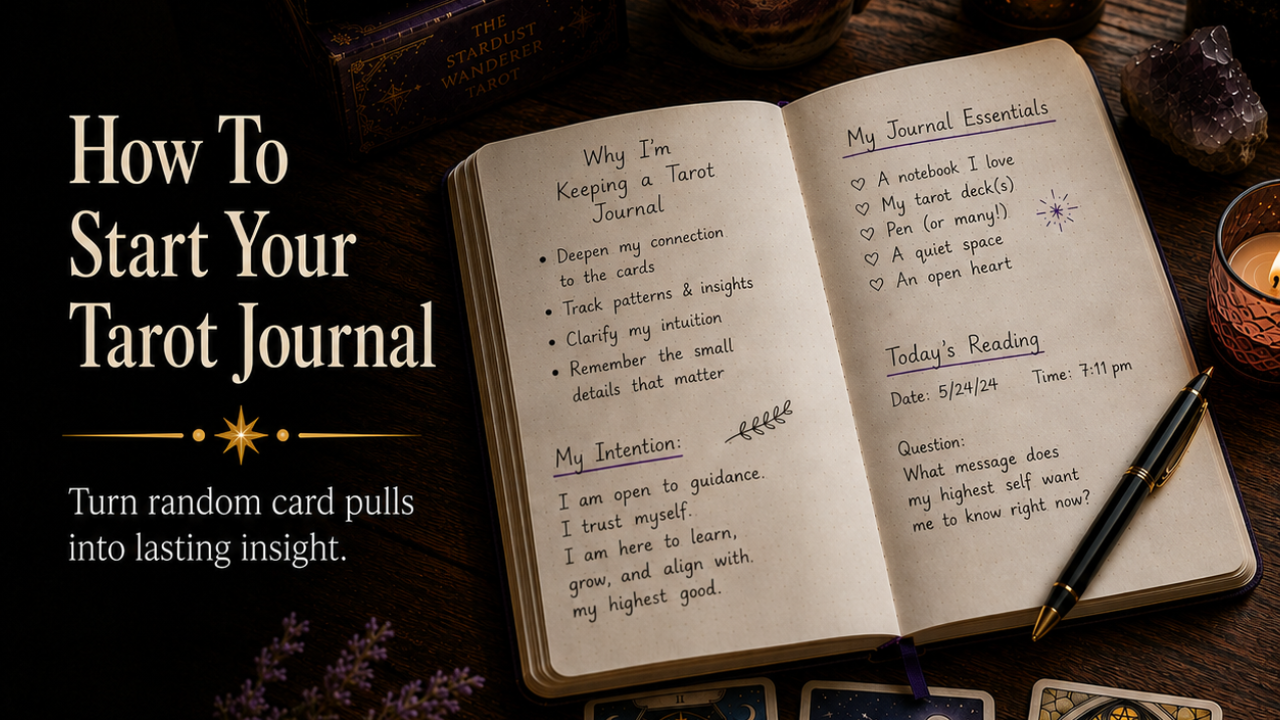
How To Start Your Tarot Journal
Starting a Tarot journal is one of the best ways to deepen your relationship with your cards and become a more confident Tarot reader.
And you don't need a complicated system to do it.
Your Tarot journal can be as simple or elaborate as you want. You can use it to record readings, explore individual cards, collect interesting ideas, experiment with different interpretations, and—perhaps most importantly - keep track of what you discover about Tarot along the way.
Over time, your journal becomes more than a collection of Tarot meanings. It becomes a record of how you actually read the cards.
Choosing Your Tarot Journal
You don't need a special journal to get started.
You can use a beautiful notebook reserved specifically for Tarot if having something special makes you excited to use it. You can also use a binder, a basic notebook, a digital document, or whatever else works for you.
The best Tarot journal isn't the prettiest or most elaborate one.
It's the one you'll actually use.
If you're someone who loves beautiful journals, stickers, colored pens, and making every page into a tiny work of art, have fun with it.
If you're someone who wants to scribble down three sentences before you forget what you were thinking, that works too.
Your Tarot journal is there to support your practice, not become another project you're somehow doing wrong.
What Should You Put in a Tarot Journal?
There really aren't any rules.
Your Tarot journal can include anything that helps you explore the cards, remember what you've learned, or understand your readings more deeply.
For example, you might record:
- Tarot readings you've done for yourself or others
- Your first impressions of individual cards
- Symbols or details that stand out to you
- New or unusual card meanings you encounter
- Meanings from Tarot books, classes, or articles that you want to remember
- Questions you want to explore later
- Tarot spreads you've created or want to try, like the Choice Tarot Spread or the Life Map Tarot Spread
- Meditations or other exercises involving your cards
- Differences you notice between Tarot decks
- Songs, movies, characters, or stories that remind you of particular cards
You don't have to do all of these things. In fact, please don't turn this into a checklist of seventeen things you must dutifully record every time you touch your Tarot deck.
Use what helps you.
Ignore what doesn't.
Record Your Tarot Readings
One of the simplest ways to use your Tarot journal is to keep a record of your readings.
You might include the date, the question you asked, the deck you used, the cards you drew, and the spread or card positions if you used them.
It’s important to remember not to just copy what you find in books and courses, or what other people tell you a card is supposed to mean.
Those can all be valuable resources, especially while you're learning. But your Tarot journal is also a place to record what connects with you when you look at the card.
Maybe a particular symbol catches your attention. Maybe one interpretation makes much more sense to you than another. Maybe a card reminds you of something you've experienced before. Or maybe you get an impression that you can't quite explain yet.
Write it down.
You don't have to decide immediately whether it's "right," and you certainly don't need to turn every observation into a new definition for the card. You're simply keeping a record of what came up during the reading so you can return to it later.
There's also one thing most people leave out, but you should always include in your Tarot journal.
Over time, you may even notice that certain cards develop very specific associations for you - or that a particular card seems to communicate differently in one deck than it does in another.
That's where keeping a Tarot journal can get really interesting.
The 8 of Wands and...Plumbing Issues?
Years ago, I had a friend who discovered that whenever she drew the 8 of Wands from one particular deck, plumbing problems had a strange tendency to follow.
Kitchen pipes. Bathroom pipes. Plumbing.
Every. Single. Time.
You're probably not going to find "Check your pipes" listed under the 8 of Wands in a Tarot book.
It was an association she developed through experience with one particular card in one particular deck.
More importantly, she was able to recognize the pattern because she had been paying attention to her readings and what happened afterward.
That's the kind of information a Tarot journal can help you discover.
But there's another side to this.
Not every unusual interpretation needs to become a permanent new meaning for a card. Sometimes a meaning belongs to one particular reading - or even one particular day.
The Knight of Swords and Going Back to College
Once, while I was reading Tarot at a fair in a small college town, the Knight of Swords kept appearing in readings for people who were going to college.
After seeing the same connection over and over throughout the day, I started associating the Knight of Swords with going back to school.
Then an older gentleman sat down for a reading.
He was in his early 90s, had lived in the town for decades, already had a degree, and had enjoyed a successful career.
And, of course, up came the Knight of Swords.
Going back to college didn't seem like the most obvious interpretation.
But given everything I'd experienced with that card throughout the day, I asked.
His eyes filled with tears.
Going back to school was exactly what he had been thinking about. He wanted to study archaeology - the subject he had truly loved rather than the safer path he had chosen when he was younger - but he wasn't sure whether pursuing another degree at his age was ridiculous.
I've never routinely interpreted the Knight of Swords as "going back to college."
At no point before or since has the Knight of Swords come up for me to specifically mean that someone was going back to school. That meaning was for that day only, and I believe that it come up over and over again throughout the day so that I would have the exact information and experience to be prepared for that one reading with the man who really needed to hear it.
That's an important distinction.
Your journal can help you discover meanings that become part of your ongoing relationship with a card. It can also help you recognize those strange, wonderful moments when a card seems to be speaking very specifically about what's happening right now.
You don't have to turn every insight into a permanent definition.
Just record what happened.
Come Back and Read Your Old Tarot Readings
This may be the most valuable part of keeping a Tarot journal, and it's the part that's easiest to forget.
Go back and read it.
A few weeks or months after a reading, look at what you originally wrote.
What happened?
What did you understand correctly?
What did you completely misunderstand?
Did something you couldn't make sense of at the time become obvious later?
Would you interpret any of the cards differently now?
Sometimes you'll look back and think, Holy shit. I can't believe I saw that.
Other times you'll wonder what in the world you were thinking.
Both are useful.
The purpose isn't to prove that you're always right.
Looking back helps you develop discernment. You begin learning which impressions tend to be useful, where your assumptions can creep in, how different decks speak to you, and how your understanding of the cards changes with experience.
You also get something that's very difficult to see while you're learning:
evidence of your own progress.
A reading that feels difficult today may look completely different to you six months from now.
Your Tarot Journal Should Grow With You
There isn't a correct way to keep a Tarot journal because there isn't one correct way to learn Tarot. Your journal might begin as a simple record of the cards you pull each day.
Later, it might become a place where you explore symbols, experiment with spreads, record rituals, compare decks, study individual cards, or work through questions in your own life.
It doesn't need to be perfect. It doesn't even need to be consistent.
It just needs to be useful to you.
Start where you are. Write down what you notice.
Pay attention to what happens.
Then come back later and see what you've discovered.
Want Something New to Explore in Your Tarot Journal?
Inside The Library, you'll find Tarot spreads, rituals, exercises, and other resources you can use to explore your cards and deepen your practice.
Choose something that interests you, try it with your cards, record what you discover in your journal - and see where it takes you.