The 8 Card Life Map Tarot Spread
Sometimes the thing demanding the most attention in your life isn't necessarily the thing that needs your attention first. You may be worried about money while your health is quietly affecting your ability to work. You may think your relationship is the problem when you've actually been running on empty for months. Or everything may feel vaguely off, and you can't quite tell where to begin.
That's one of the reasons I created the Life Map.
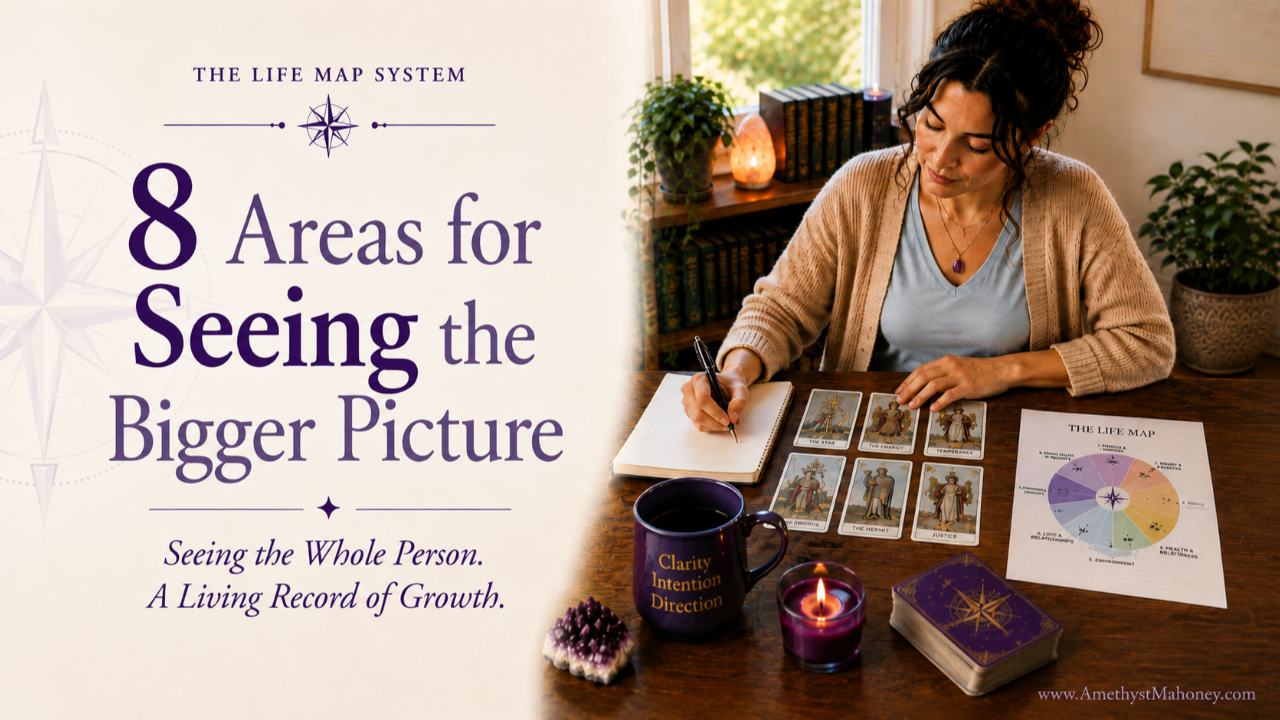
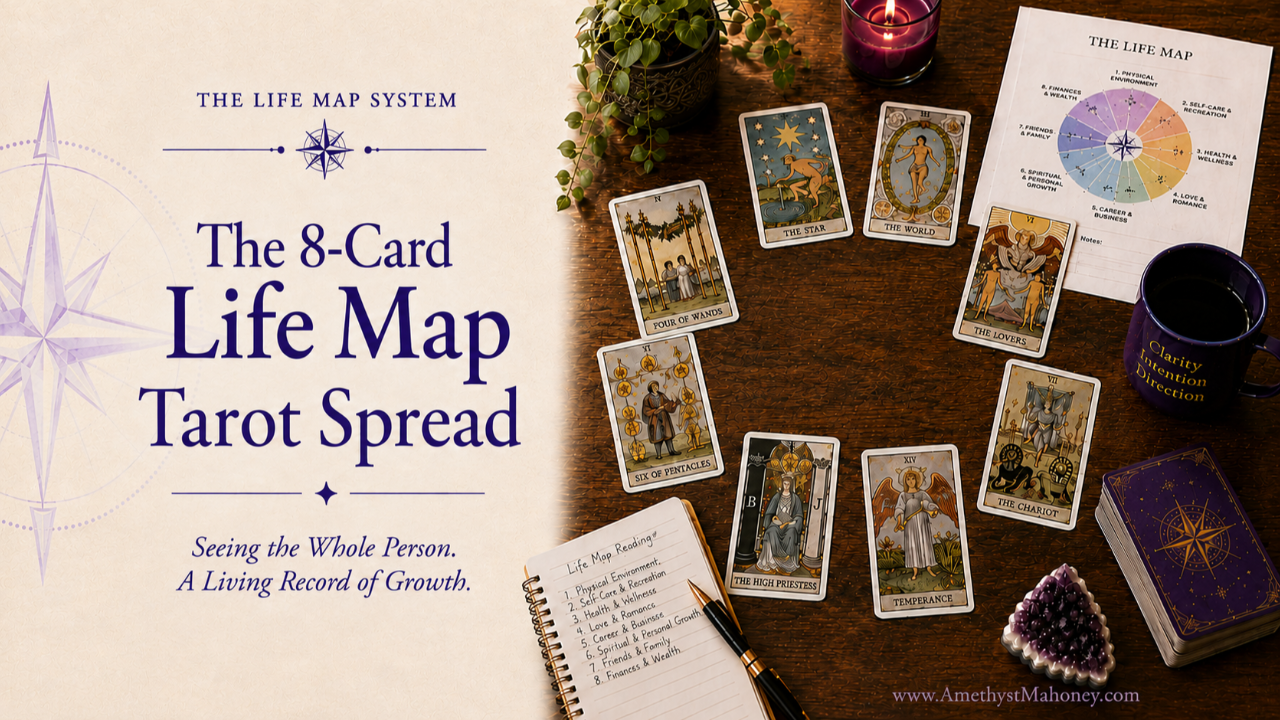
The Life Map looks at eight interconnected areas of life instead of treating every problem as though it exists by itself. The 8-Card Life Map Tarot Spread takes that framework and adds Tarot, giving you one card for each area so you can look across your life, notice patterns and connections, and decide what deserves deeper exploration.
In Tarot Therapy, the Life Map can also be used as part of the intake and assessment process, but you don't need to be a Tarot Therapy Practitioner to use this spread. You can use it with your own cards whenever you want a broader look at what's happening in your life.
The Eight Areas of the Life Map
The Life Map looks at eight areas that together give us a broader picture of what's happening in our lives.
Physical Environment includes your home, neighborhood, workspace, transportation, and daily surroundings.
Self-Care & Recreation includes rest, relaxation, hobbies, creativity, play, boundaries, and personal renewal.
Health & Wellness includes your physical and emotional well-being, energy, sleep, nutrition, stress, and the ways you care for your body.
Love & Romance includes romantic relationships, intimacy, trust, communication, partnership, and emotional connection.
Career & Business includes work, purpose, professional growth, leadership, business, and financial contribution.
Spiritual & Personal Growth includes beliefs, meaning, purpose, learning, inner wisdom, personal development, and connection to something greater.
Family & Friends includes family relationships, friendships, community, support systems, boundaries, and belonging.
Finances & Wealth includes income, spending, saving, debt, financial habits, goals, beliefs about money, and your sense of financial security.
If you'd like to explore these areas in more depth or learn more about the framework before adding Tarot, read our blog post The Life Map System: 8 Areas for Seeing the Bigger Picture.
The important thing to remember is that these aren't eight separate boxes. They affect one another constantly. Your health can affect your work. Your finances can affect your relationships and environment. Your family can affect your spiritual growth. Your career can affect how much time and energy you have for self-care. Those connections are part of what we're looking for when we eventually lay all eight cards on the table together.
Before You Draw Your Cards
Give yourself enough time to do this reading without feeling rushed. You don't need a perfect ritual or a spiritually approved room full of candles, but those things are fine if you want them. Light the candle. Burn the incense. Put on music. Make tea. Sit on the floor surrounded by seventeen crystals. Or shuffle your cards at the kitchen table while wearing yesterday's pajamas. What matters is creating enough space and attention to engage with what comes up.
You'll need your Tarot deck and somewhere to record what you discover. A Tarot journal is particularly useful because this is a reading worth returning to later. One of the strengths of the Life Map is that it can become a living record of growth. A card or pattern that seems insignificant today may look very different three months from now.
Before you begin, take a moment to settle yourself in whatever way works for you. You might take a few slow breaths, ground and center, pray, meditate, or simply sit quietly for a minute. Then bring your attention to your life as it actually is right now - not the life you think you should have, and not the version you wish you could report to somebody else. This one.
How to Do the 8-Card Life Map Tarot Spread
You'll draw one card for each area of the Life Map. Begin with Physical Environment and ask:
What is most important for me to understand about my Physical Environment right now?
As you shuffle, hold that area of your life in mind and pay attention to what comes up before you even draw a card. Maybe you immediately think about the clutter in your bedroom. Maybe you picture your favorite chair. Maybe you're suddenly annoyed about your commute, worried about moving, or reminded how much you love where you live. You can jot those thoughts down or simply notice them as they arise. Your reaction to the question is information, too.
When you're ready, draw one card and place it in the first position. Then move through the remaining seven areas, asking the same basic question each time:
What is most important for me to understand about my [Life Map area] right now?
The eight positions are:
-
Physical Environment
-
Self-Care & Recreation
-
Health & Wellness
-
Love & Romance
-
Career & Business
-
Spiritual & Personal Growth
-
Family & Friends
-
Finances & Wealth
You can interpret each card as you draw it, or you can lay out all eight cards first and then begin your interpretation. Neither approach is inherently better. Use whichever one helps you stay curious and engaged instead of turning the reading into a race to get through eight cards.
If you're using the Amethyst Tarot Method, work through the card in front of you before reaching for additional meanings. Pay attention to what stands out, what appears to be happening in the card, and how that might apply to this particular area of your life.
The question and position matter. The same Tarot card appearing in Health & Wellness may tell a very different story than it would in Career & Business. You aren't trying to determine what a card means in some universal vacuum. You're asking what this particular card means here, in this position, in this reading, for you.
Don't Just Look at Eight Individual Cards
Once you've explored each card individually, take some time to look at the spread as a whole. This is where the Life Map reading gets especially interesting, because you can stop thinking about eight separate cards and begin looking for the relationships between them.
Notice whether several cards seem to be pointing toward the same issue. Look for repeating suits, numbers, symbols, people, environments, or themes. Pay attention to areas that seem to support one another as well as areas where there appears to be tension or contradiction. You may discover that something happening in one part of your Life Map seems closely connected to something happening somewhere else.
You may also find that the area you expected to be the biggest problem isn't where your attention keeps going. That's useful information.
The purpose of the Life Map isn't to identify the worst part of your life or automatically decide that the area with the greatest challenges deserves your attention first. It's to see enough of the picture that you can make a more informed decision about where you want to begin.
An area that appears to be doing well may be supporting several others. An area that feels difficult may be affected by something happening elsewhere. Occasionally, a card may draw your attention to something you hadn't consciously considered important until you saw the entire spread in front of you.
You Don't Have to Fix the Lowest Area First
If you're also using the Life Map Self-Assessment and rating your eight areas numerically, the lowest score does not automatically become your highest priority.
Imagine Family & Friends is currently a 3 because those relationships aren't especially satisfying, but nothing significant has recently changed.
Meanwhile, Career & Business is an 8 because you normally love your work. However, if you've just learned that you may lose your job tomorrow, this is going to become the priority or focus.
Clearly, the number alone doesn't tell you where your attention belongs.
Context matters.
Your ratings can help you see the state of your Life Map, and Tarot can give you another perspective on what's happening within it. Neither one needs to make the decision for you. You are still the person who gets to decide what matters, what you're ready to explore, and where you want to focus.
The cards don't create the map for you. You do.
If Eight Cards Starts Feeling Like Too Much
An eight-card reading can produce a surprising amount of information, particularly when one card opens a much bigger line of reflection. If you've been working for an hour and still have several areas left, you don't have to keep going simply because the spread contains eight positions.
Stop. Write down where you ended and come back another day. You can also intentionally divide the reading into two groups of four if you already know that a shorter session works better for you.
There is no prize for successfully enduring a Tarot reading until your brain turns to soup. The goal is to learn something useful, and sometimes giving yourself time to absorb the first part of a reading makes the second part considerably more useful anyway.
What Do You Do After the Life Map Reading?
When you've finished, resist the temptation to immediately create an eight-part plan for fixing your entire existence by Tuesday. Instead, spend some time looking back over the reading and noticing what remains with you.
What stands out most? Which areas seem connected? What surprised you? Where do you feel curious about going deeper? Did anything suddenly seem more important - or less important - than you expected?
Most importantly, ask yourself where you actually want to begin.
You might decide to do another Tarot spread focused specifically on one area, journal about what came up, make one practical change, bring an issue to therapy or another appropriate professional, or simply spend some time paying attention to what happens next. Insight doesn't always need to be followed immediately by a twelve-step action plan. Sometimes noticing something clearly for the first time is enough for today.
You can also return to the complete Life Map reading later. When you use the spread periodically, your Tarot journal becomes something incredibly valuable: a record of what was happening, what mattered to you, what you were noticing, and how your life changed over time.
That's one of the ideas at the heart of the Life Map System:
Seeing the Whole Person. A Living Record of Growth.
Using the Life Map in Tarot Therapy
The 8-Card Life Map Tarot Spread is also part of a much larger framework inside Tarot Therapy. When you're working with another person, however, the purpose isn't to look at eight cards and announce what is wrong with their life. The client remains the expert on their own experience. The Life Map gives the practitioner a structure for asking questions, listening, noticing connections, and helping the client determine what matters to them.
That's an important distinction between using this spread for your own Tarot reflection and learning to use the Life Map therapeutically with clients.
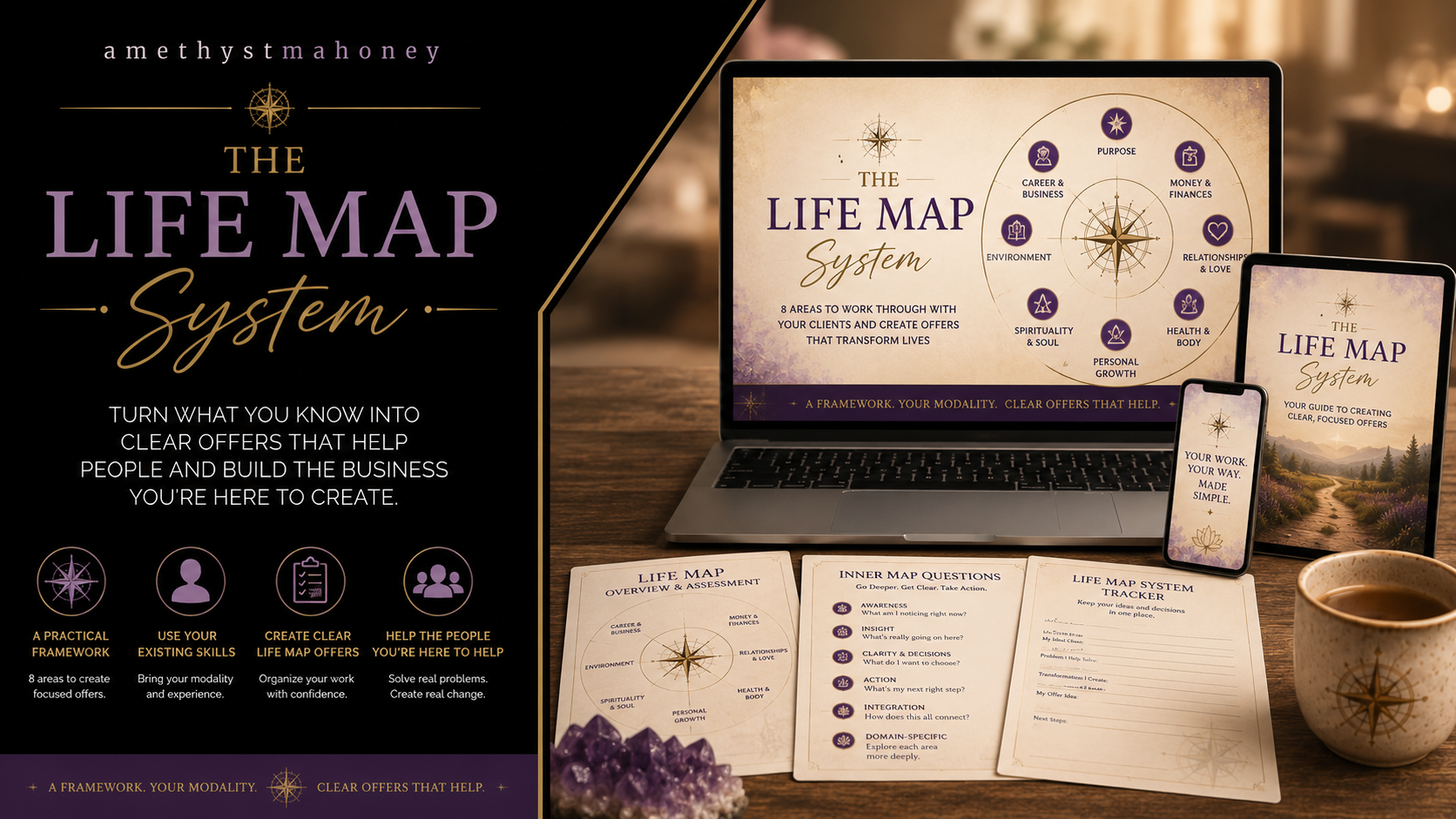
For Tarot Therapy Practitioners, TTU 102: Life Map for Tarot Therapy goes much deeper into using the Life Map professionally, including assessment, client conversations, identifying areas of focus, exploring connections between different parts of the client's life. You can find out how to use the Life Map as an ongoing framework for Tarot Therapy in the Tarot Therapy Certification Program.
If you're here because you simply wanted a Tarot spread that could help you get a better look at what the hell is going on in your life, though, you don't need to make it more complicated than that.
Eight cards. Eight areas. One much bigger picture.