Three of Swords Tarot Card Meaning
Image Description from the Unconquered Heart Tarot Card Above
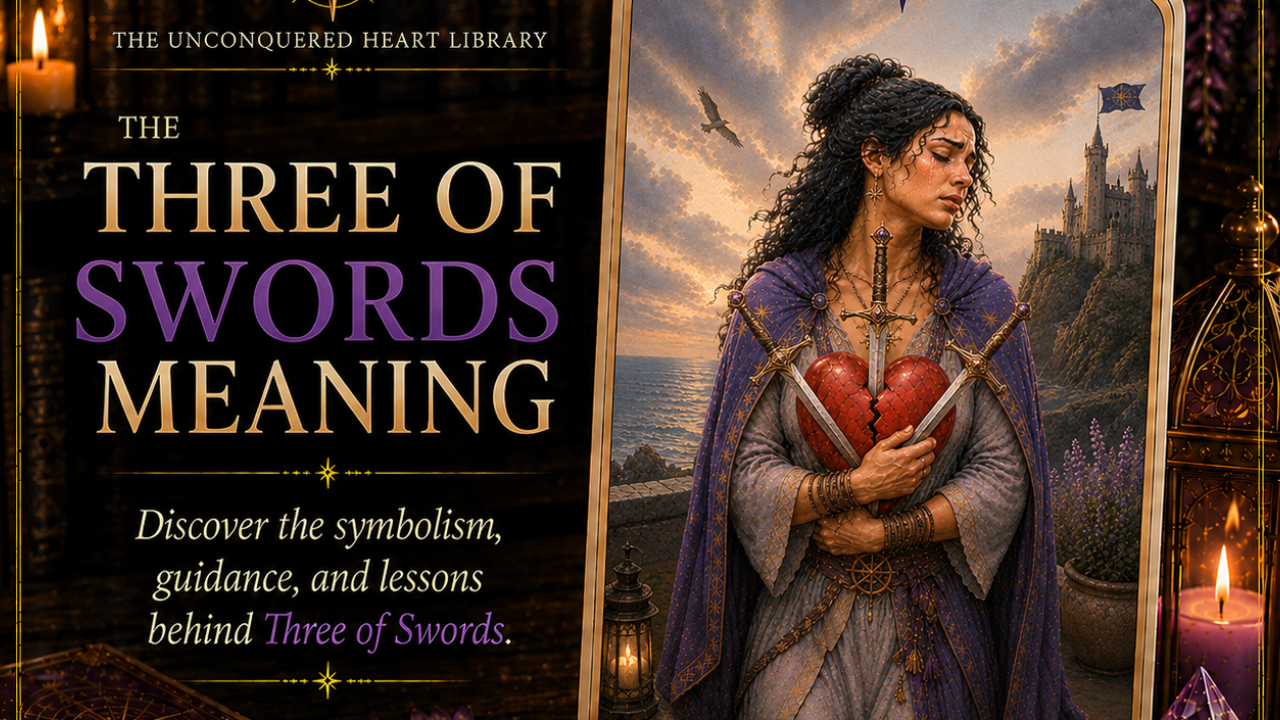
Three of Swords Tarot card showing a woman with long curly dark hair wearing a gray dress and a flowing purple cloak as she stands overlooking the sea. She cradles a large red heart against her chest with both arms while three silver swords pierce the heart from different directions. Tears stream down her face as she turns her head to one side.
A lantern glows on a stone ledge nearby, while purple flowers bloom in a large clay pot beside her. Behind her, waves roll across the sea toward rocky cliffs where a castle rises above the shoreline, with a flag bearing an eight-pointed compass flying from one of its towers. A bird soars through a sky filled with layered clouds and shafts of sunlight.
The Three of Swords
The Three of Swords represents heartbreak, grief, disappointment, painful realizations, and the emotional consequences of difficult experiences. Although Swords belong to the element of Air and are associated with thought, communication, and understanding, this card reminds us that what we learn, hear, believe, and communicate can have a profound emotional impact. The Three often appears when something has challenged our expectations, damaged an important relationship, or forced us to confront a truth we would rather had been different.
Whether you are experiencing a loss, navigating a painful disagreement, recovering from betrayal, or coming to terms with an unexpected change, the Three of Swords encourages you to acknowledge what has happened without demanding that you immediately feel better about it. Understanding an experience intellectually does not necessarily resolve its emotional impact. Sometimes we need time to recognize what something means to us before we can decide how we want to respond.
The Three of Swords in the Rider-Waite-Smith Tarot
In the Rider-Waite-Smith Tarot, a large red heart hangs suspended against a gray sky, pierced by three swords. Heavy clouds fill the background while rain falls around the heart. Unlike many Tarot cards, the Three of Swords contains no human figure, landscape, or elaborate setting. Its imagery is direct and unmistakable, drawing our attention immediately to the experience of emotional pain.
The heart represents love, attachment, vulnerability, and the things that matter deeply to us, while the swords connect that pain with the realm of thought, communication, and understanding. Words can wound, information can change how we perceive someone, and difficult realizations can challenge beliefs that once gave us comfort or security. The three swords suggest that emotional suffering is not always separate from intellectual experience. Sometimes what hurts most is what we have come to understand.
The rain and clouds reinforce the atmosphere of sadness and distress, but the simplicity of the image also leaves considerable room for interpretation. The card does not tell us what caused the heartbreak, whether someone acted intentionally, or how the situation will eventually unfold. It captures the experience of pain itself, reminding us that disappointment, grief, and emotional vulnerability are part of human life even when we cannot immediately explain or resolve them.
Upright Meaning
The Three of Swords is a card of heartbreak, grief, disappointment, painful communication, and difficult emotional experiences. It often appears when you are dealing with the end of a relationship, a betrayal of trust, an upsetting discovery, an important loss, or circumstances that have unfolded differently from what you hoped. The card may also represent the pain associated with acknowledging a difficult truth, particularly when that understanding changes how you see yourself, another person, or a situation that matters to you.
When the Three of Swords appears upright, it encourages you to recognize the emotional impact of what you are experiencing rather than dismissing it simply because you understand what happened. You may know why a relationship ended, recognize that a decision was necessary, or understand that someone acted according to their own priorities. None of those explanations automatically eliminates sadness, anger, disappointment, or grief. Our emotions do not always change at the same pace as our understanding.
This card also reminds us that emotional pain does not necessarily mean we made a mistake or that something has gone terribly wrong with our lives. We can experience disappointment after making a thoughtful decision, grieve something that needed to end, or feel hurt by circumstances no one could reasonably have prevented. The Three of Swords invites us to respond to those experiences with awareness and compassion, allowing ourselves to acknowledge what matters before deciding what we need next.
Reversed Meaning
Reversed, the Three of Swords can suggest difficulty processing emotional pain, lingering resentment, or an attempt to avoid feelings associated with a painful experience. You may be trying to move forward before you have fully acknowledged what happened, repeatedly revisiting an upsetting event, or struggling to separate a past disappointment from your expectations about the future. In other situations, the reversed card may indicate that the intensity of an earlier experience is beginning to change and that you are gradually finding ways to live with what happened.
The reversed Three can also point toward the stories we develop around painful experiences. After a betrayal, we may begin believing that nobody can be trusted. Following a rejection, we may conclude that we are inadequate or unworthy of connection. These interpretations can feel convincing when they emerge from genuine hurt, but they may extend far beyond what the experience itself establishes. The reversed card encourages us to consider whether the conclusions we have drawn are helping us understand what happened or creating additional suffering.
Rather than demanding forgiveness, closure, or a particular emotional outcome, the reversed Three of Swords invites you to examine what you need in order to respond to your experience more effectively. That may involve allowing yourself to grieve, establishing boundaries, seeking support, reconsidering an assumption, or recognizing that your feelings have changed over time. Healing does not have to follow a predetermined schedule, and moving forward does not require pretending that something important never happened.
The Three of Swords in The Unconquered Heart Tarot
In the Rider-Waite-Smith Tarot, the Three of Swords presents a heart suspended in the rain, pierced by three swords. The image communicates heartbreak directly, without showing the person experiencing it. The Unconquered Heart Tarot preserves the familiar wounded heart while introducing a woman who holds it close to her body. This change transforms the card from an image of pain alone into an exploration of our relationship with that pain.
The woman does not attempt to conceal the swords or pretend that her heart is undamaged. Tears run down her face, and her expression reflects the emotional weight of what she is experiencing. Yet she continues to hold the heart carefully against herself. There is something meaningful about this gesture because it suggests that acknowledging our pain and caring for ourselves can happen at the same time. We do not have to deny that something hurts in order to respond to ourselves with compassion.
The fact that the heart remains in her arms is also important. She has not discarded it because it has been wounded, nor does its damage make it less worthy of care. Painful experiences can sometimes lead us to become critical of our own vulnerability. We may wish we had not cared so much, trusted someone, hoped for a particular outcome, or allowed something to become important to us. The Three of Swords reminds us that the capacity to care is not a weakness simply because caring sometimes exposes us to disappointment.
The sea and clouds surrounding the woman reinforce the emotional atmosphere of the card, but the presence of sunlight adds another dimension. The sky is not entirely dark, and the world continues beyond the immediate experience of heartbreak. This does not mean that the woman should look on the bright side or search for a positive explanation for what happened. Instead, the landscape allows sadness to exist within a world that still contains beauty, possibility, and experiences she may eventually want to explore.
The lantern beside her also suggests that understanding remains available, even when emotions are intense. We may need time before we can examine a painful experience clearly, and we may discover that some questions cannot be answered to our satisfaction. Nevertheless, reflection can help us distinguish what happened from the meanings we have attached to it, recognize what we need, and determine how we want to respond. Intellectual understanding and emotional experience do not have to compete with one another. Both can contribute to the way we navigate difficult circumstances.
In The Unconquered Heart Tarot, the Three of Swords reminds us that heartbreak does not require us to abandon ourselves. We can acknowledge disappointment, experience grief, and recognize the significance of what we have lost without treating our vulnerability as a mistake. The woman does not need to remove the swords, repair the heart, or demonstrate that she has overcome anything before she is worthy of care. For now, she can simply hold what hurts and allow herself to feel what she feels.
Tarot Therapy Perspective
In Tarot Therapy, the Three of Swords invites us to explore how we understand and respond to emotionally painful experiences. Grief, disappointment, rejection, and betrayal can affect not only how we feel in the moment, but also the beliefs we develop about ourselves, other people, and the world. The card encourages us to recognize both the emotional experience and the interpretations that may emerge from it, without assuming that either tells the entire story.
One useful area of exploration involves distinguishing between pain and the conclusions we draw from it. Someone may experience the end of a relationship and feel deeply hurt, but the belief that they are unlovable is an interpretation rather than an established fact. A disappointing professional experience may produce genuine frustration without proving that someone lacks ability or will never succeed. The Three of Swords encourages us to acknowledge the reality of our feelings while remaining curious about the broader meanings we assign to what happened.
This card can also help us examine the expectations we place upon ourselves when we are hurting. We may believe that we should recover quickly, maintain a positive attitude, forgive someone, or find a valuable lesson in every difficult experience. These expectations can create additional pressure at precisely the time when we need greater understanding and flexibility. The Three of Swords offers permission to recognize that something was painful without requiring us to immediately transform it into an opportunity for growth.
Another important consideration is the difference between caring for ourselves and attempting to eliminate uncomfortable emotions. We can seek comfort, spend time with supportive people, establish boundaries, engage in meaningful activities, or give ourselves space to reflect without treating sadness as a problem that must be solved immediately. Emotional care does not necessarily mean making the feeling disappear. Sometimes it means creating conditions in which we can experience what we feel without allowing that experience to define every part of our lives.
Ultimately, the Three of Swords encourages us to approach emotional pain with both compassion and discernment. We can recognize what an experience meant to us, examine the beliefs that developed around it, and make thoughtful decisions about what comes next. We do not have to become grateful for what hurt us, and we do not have to prove that suffering made us stronger. We can simply acknowledge that something mattered, that it hurt, and that we remain worthy of care and meaningful experiences beyond it.
Want to learn how to use Tarot as a practical tool for insight and change - for yourself and others? Become a Certified Tarot Therapy Practitioner here.
Reflection Question
What painful experience am I still carrying, and how might I care for myself without judging the feelings that come with it?
Consider something that has caused disappointment, grief, or emotional pain. Reflect on what you experienced, what you may have come to believe because of it, and whether there are ways to offer yourself greater understanding, comfort, or support without demanding that you feel differently before you are ready.
Continue Your Journey
This page introduces the core meaning of The Three of Swords and the symbolism of the Rider-Waite-Smith Tarot.
If you'd like to explore this card in greater depth including advanced symbolism, colors, love and relationship readings, career and business interpretations, timing, associated crystals, and practical reading techniques, those topics are covered in Tarot Symbols & Meanings.