Ten of Swords Tarot Card Meaning
Image Description from the Unconquered Heart Tarot Card Above
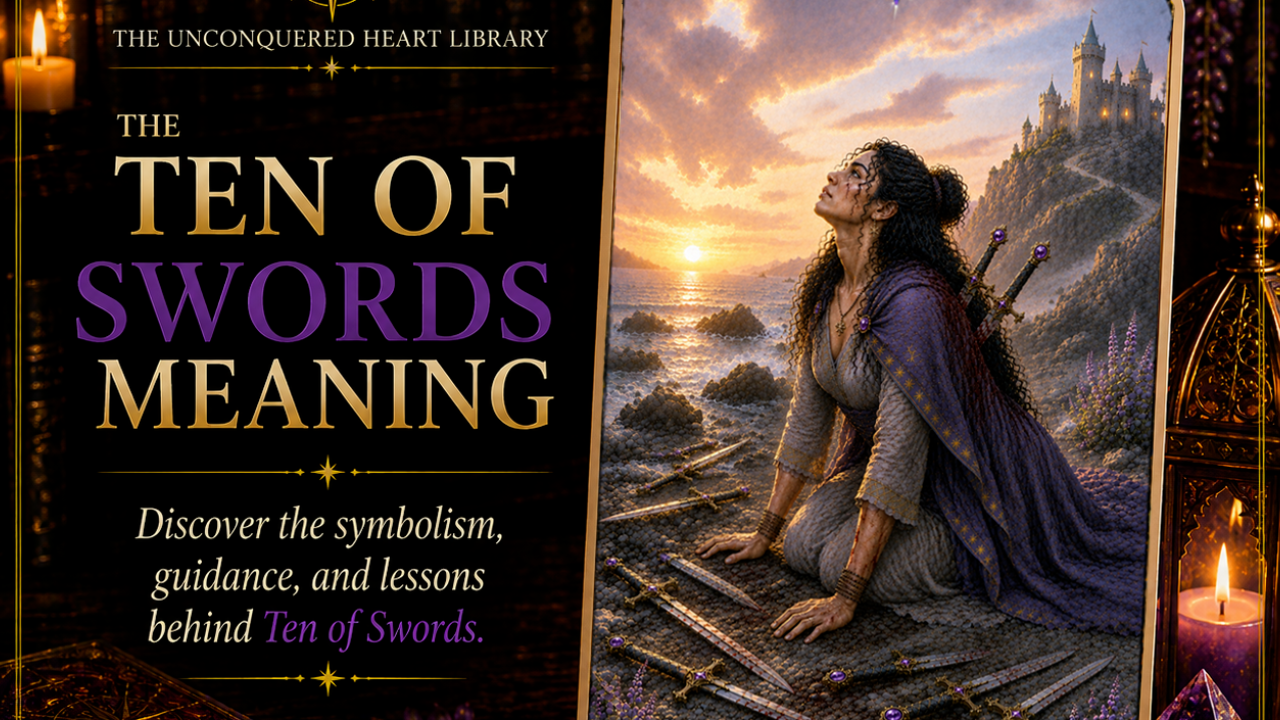
Ten of Swords Tarot card showing a woman with long curly dark hair wearing a gray dress and a flowing purple cloak as she kneels on a rocky shoreline, supporting herself with both hands as she lifts her face toward the sunrise sky.
Eight swords lie scattered across the ground around her, with two more still sheathed in her back. Fresh cuts and blood are visible on several of the swords, while scratches and blood mark her hands and forearms.
Waves break against dark rocks along the shoreline, and purple wildflowers bloom among the stones. A castle rises atop the cliffs in the distance, overlooking the sea beneath a glowing sunrise sky filled with dramatic clouds.
The Ten of Swords
The Ten of Swords represents painful endings, defeat, betrayal, exhaustion, and the point at which a difficult situation can no longer continue as it has. As the final numbered card in the suit of Swords, it often reflects the consequences of conflict, painful realizations, or circumstances that have reached an unavoidable conclusion. The experience may be deeply disappointing, and there may be little opportunity to change what has already happened.
Yet the Ten of Swords also represents the possibility of moving beyond what has ended. When something is over, we may still have to deal with its consequences, acknowledge our losses, and recover from the experience. The card does not promise that this process will be easy or immediate. Instead, it reminds us that reaching the end of a painful chapter is not necessarily the end of our story.
The Ten of Swords in the Rider-Waite-Smith Tarot
In the Rider-Waite-Smith Tarot, a figure lies face down on the ground with ten swords piercing their back. A red cloth covers the lower portion of the body, while the surrounding landscape appears dark and still. The image is one of the most dramatic in the Tarot, leaving little doubt that something devastating has occurred.
Behind the figure, dark clouds hang over the landscape, but a band of golden light stretches across the horizon. The water in the distance appears calm, creating a contrast between the violence of the foreground and the quiet environment beyond it. The rising light suggests that the darkness is not permanent, although the figure has not yet reached a point where they can respond to that possibility.
The ten swords emphasize the completeness of the ending. Whatever conflict, betrayal, defeat, or painful realization the card represents has reached a point where continuing in the same way may no longer be possible. The image can also reflect the tendency of the mind to interpret a painful experience as absolute or final. The situation may indeed be over, but that does not mean every possibility for the future has disappeared. The Ten of Swords asks us to distinguish between the ending of something significant and the belief that nothing meaningful can exist afterward.
Upright Meaning
The Ten of Swords is a card of painful endings, betrayal, defeat, disappointment, and emotional or mental exhaustion. It may appear when a relationship has ended, a business or project has failed, a difficult conflict has reached its conclusion, or circumstances have changed in ways that cannot easily be reversed. Sometimes the card represents a sudden and devastating experience, while at other times it reflects the final stage of a situation that has been deteriorating for some time.
When the Ten of Swords appears upright, it encourages you to recognize what has actually ended rather than continuing to struggle against a conclusion that may already be unavoidable. This does not mean that you must approve of what happened, immediately accept every consequence, or abandon efforts to protect your interests. There may still be important decisions to make, responsibilities to address, or practical steps required to manage the aftermath. However, recognizing that something has changed permanently can help you direct your attention toward what is still possible.
The Ten of Swords also reminds us that the experience of defeat does not make us defeated people. A painful ending may affect our confidence, expectations, relationships, resources, or sense of security, but it does not erase everything we have learned or everything we remain capable of doing. Recovery may require time, support, and a willingness to approach life differently than we did before. The card encourages us to acknowledge the reality of what has happened while remaining open to the possibility that something meaningful can still come next.
Reversed Meaning
Reversed, the Ten of Swords can suggest difficulty moving beyond a painful ending or beginning to recover from an experience that has already reached its conclusion. You may find yourself repeatedly reviewing what happened, imagining how things might have turned out differently, or struggling to accept that a relationship, opportunity, or important chapter of your life has ended. In other situations, the reversed card can indicate that you are starting to regain your footing and recognize possibilities that were difficult to see while the experience was still unfolding.
The reversed Ten can also appear when you are attempting to avoid an ending that has become increasingly difficult to prevent. You may continue investing energy in a situation because you have already invested so much, because the alternative feels frightening, or because acknowledging the outcome would require you to reconsider important plans or expectations. Sometimes persistence is valuable, but there are also circumstances in which continuing the same struggle only prolongs an experience that is no longer producing meaningful results.
Rather than treating the reversed Ten of Swords as either a promise of recovery or a warning of additional suffering, it invites you to examine your relationship with what has ended. Are you still attempting to change something that cannot be changed? Are there consequences that require your attention? Have you begun recognizing what remains available to you, even if you are not yet ready to pursue it? The reversed Ten encourages you to approach the aftermath with honesty, allowing recovery to develop without demanding that you immediately feel better or know exactly what comes next.
The Ten of Swords in The Unconquered Heart Tarot
In the Rider-Waite-Smith Tarot, the Ten of Swords presents the aftermath of a devastating experience through a figure lying motionless beneath ten swords. The Unconquered Heart Tarot preserves the severity of that experience while changing the moment we are invited to witness. Instead of seeing someone who has fallen and remains on the ground, we see a woman who is beginning to lift herself up.
This is not an image of someone who has escaped the experience unharmed. Eight swords lie scattered around her, while two remain in her back. The blood and injuries make it clear that whatever happened was real and consequential. The card does not attempt to transform suffering into something pleasant or suggest that every painful experience contains a hidden benefit. Sometimes terrible things happen, and the consequences deserve to be acknowledged.
The eight discarded swords introduce an important shift in the meaning of the card. Although the woman has not completely recovered, most of the swords are no longer lodged in her body. Something has changed between the moment of injury and the moment we are witnessing. She may have removed them herself, received assistance, or simply reached a point where she could begin responding to what happened. The image does not tell us how she arrived here, but it makes clear that the circumstances of her suffering are no longer exactly what they were.
The two remaining swords are equally significant. Recovery does not require every consequence of an experience to disappear before we can begin moving forward. We may still carry grief, disappointment, fear, practical difficulties, or unresolved questions long after the event itself has ended. Some injuries require additional attention, while others may leave lasting changes in how we understand ourselves and the world. The presence of those remaining swords acknowledges that getting back up and being fully recovered are not the same thing.
Her posture also changes the relationship between defeat and possibility. She is still on her knees, supporting herself with both hands, but her face is lifted toward the sky. She has not returned to standing, and there is no indication that she is ready to rush toward another challenge. Yet she is no longer positioned as someone whose entire experience is defined by what has happened to her. Even in this difficult moment, there is movement, awareness, and the possibility of choosing what comes next.
The sunrise reinforces this distinction. A new day is beginning whether or not the woman feels prepared for it. The world continues beyond the experience that brought her to the ground, and eventually she may discover opportunities, relationships, interests, or directions that were not available to her before. This does not mean the painful experience was necessary or that she should be grateful for it. It simply means that the future has not been completely determined by the past.
There is also something meaningful about the castle overlooking the shoreline. It remains standing, separate from the swords and the immediate aftermath of the conflict. Depending on the reading, it might represent stability, resources, responsibilities, or something the woman still hopes to reach. Whatever meaning we assign to it, the castle reminds us that the experience represented by the Ten of Swords has not necessarily destroyed everything else in her life. Other structures, relationships, and possibilities may remain even when one important part of life has fallen apart.
In The Unconquered Heart Tarot, the Ten of Swords becomes a reminder that being brought to your knees is not the same as being finished. We do not have to pretend that a painful ending was secretly wonderful, minimize the damage it caused, or rush to discover a positive lesson. We can acknowledge what happened, attend to what still needs care, and gradually discover what remains possible. The experience may have changed us, but it does not have to become the final definition of who we are.
Tarot Therapy Perspective
In Tarot Therapy, the Ten of Swords invites us to examine how we interpret painful endings and the conclusions we draw about ourselves when something important does not work out. A relationship ending, a professional setback, a betrayal, or the loss of an anticipated future can affect far more than the immediate circumstances. We may begin questioning our judgment, abilities, worth, or expectations for what is possible. The Ten encourages us to distinguish between what actually happened and the broader conclusions we may be drawing from that experience.
One useful area of exploration involves recognizing the difference between an event and an identity. Losing a job does not make someone a failure, just as experiencing betrayal does not mean they are incapable of recognizing trustworthy people. A painful experience may reveal something important about our circumstances, decisions, or relationships, but it rarely provides a complete assessment of who we are. The Ten of Swords encourages us to examine whether we have turned a particular outcome into a permanent judgment about ourselves.
The card can also help us explore the difficulty of accepting endings that we did not choose. We may continue reviewing the past because we hope to discover something that would have prevented the outcome, or because understanding exactly what happened feels like the only remaining way to regain a sense of control. Reflection can be valuable, particularly when it helps us recognize patterns or make informed decisions in the future. However, repeatedly revisiting an experience does not necessarily produce new understanding, and there may come a point when we have learned what we reasonably can.
Another important consideration is the pressure to recover quickly or transform suffering into personal growth. People are often encouraged to find the lesson, recognize the blessing, or become stronger because of what happened. While some people eventually discover meaningful changes following difficult experiences, that outcome should not be treated as an obligation. The Ten of Swords allows us to acknowledge that something was painful, unfair, disappointing, or damaging without requiring us to justify the experience by identifying a benefit.
The image in The Unconquered Heart Tarot also provides an opportunity to consider what recovery actually requires. The woman has begun lifting herself from the ground, but she is still injured. This distinction encourages us to think beyond the idea that recovery is simply a matter of deciding to move forward. Depending on the circumstances, we may need rest, practical resources, professional assistance, emotional support, changes to our environment, or time to adjust to a new reality. Recognizing these needs is not evidence that we are failing to recover. It is part of understanding what recovery involves.
The Ten of Swords can also help us recognize when continuing to fight for a particular outcome is no longer serving us. Persistence is often celebrated, but not every situation can be repaired through additional effort. Sometimes the most useful decision involves acknowledging that a particular approach, relationship, or opportunity has reached its end. That recognition may be painful, but it can also allow us to redirect our energy toward protecting what remains, addressing immediate needs, and eventually considering different possibilities.
Ultimately, the Ten of Swords invites us to develop a relationship with endings that allows both honesty and hope. We can recognize the seriousness of what happened without treating it as the entirety of our lives. We can take responsibility where appropriate without accepting blame for everything that went wrong. And we can begin moving forward without pretending that we are completely healed. Sometimes the first meaningful change is simply recognizing that, despite everything that has happened, we are still here.
Want to learn how to use Tarot as a practical tool for insight and change - for yourself and others? Become a Certified Tarot Therapy Practitioner here.
Reflection Question
What painful ending or difficult experience am I allowing to define me, and what might become possible if I recognized that it is part of my story rather than the whole of it?
Consider an experience that has significantly influenced how you see yourself or your future. Acknowledge what happened and any consequences that still require attention, while also noticing the abilities, relationships, resources, and possibilities that remain available to you. You do not have to erase the past to begin creating something beyond it.
Continue Your Journey
This page introduces the core meaning of The Ten of Swords and the symbolism of the Rider-Waite-Smith Tarot.
If you'd like to explore this card in greater depth including advanced symbolism, colors, love and relationship readings, career and business interpretations, timing, associated crystals, and practical reading techniques, those topics are covered in Tarot Symbols & Meanings.