Six of Swords Tarot Card Meaning
Image Description from the Unconquered Heart Tarot Card Above
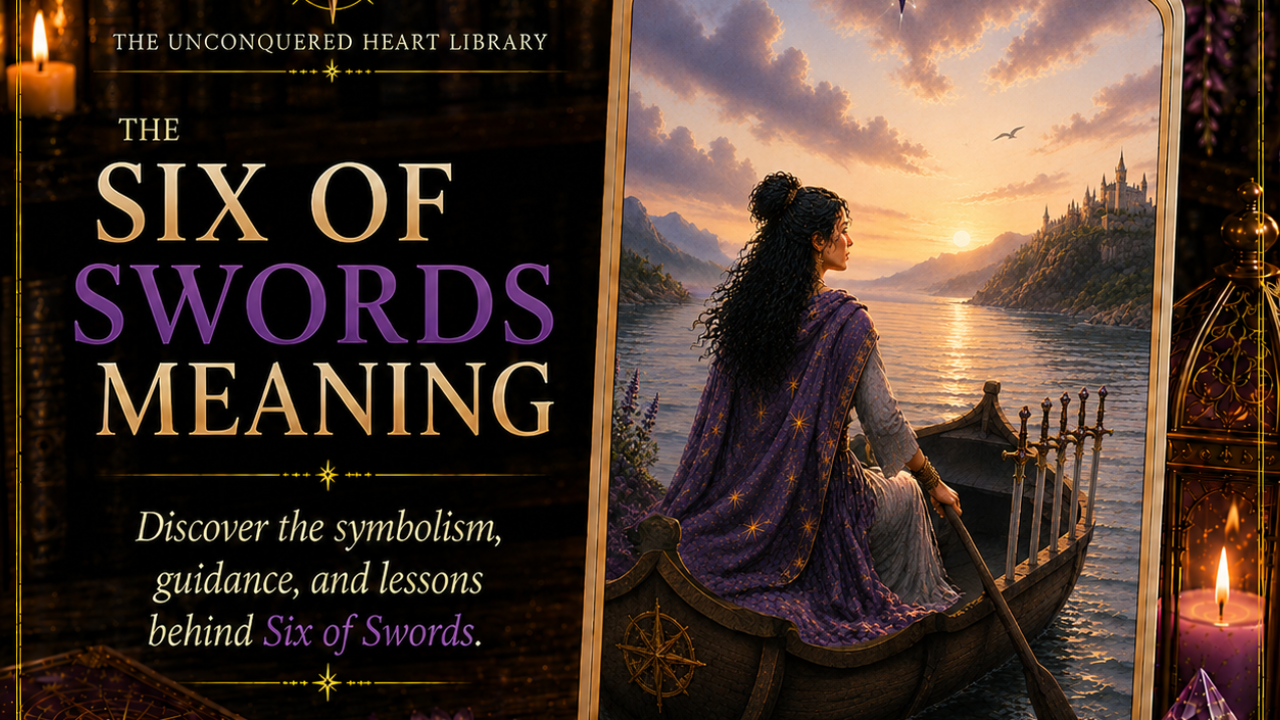
Six of Swords Tarot card showing a woman with long curly dark hair wearing a gray dress and a flowing purple cloak as she rows a wooden boat across calm water. She looks toward the distant shoreline while pulling an oar through the water beside the boat. Six swords stand upright near the bow of the boat, while a golden compass is carved into the side of the stern.
Purple wildflowers bloom along the rocky shoreline behind her. Across the water, a castle stands on a hillside overlooking the bay, with the sun shining low above the mountains and its reflection stretching across the water. Two birds glide through a sky filled with soft clouds as the shoreline curves into the distance.
The Six of Swords
The Six of Swords represents transition, moving forward, changing circumstances, and the process of leaving one situation behind in order to pursue another. As part of the suit of Swords, it emphasizes the role of thought, understanding, and decision-making in navigating change. The card often appears when we recognize that our current circumstances are no longer meeting our needs, or when new information and experiences have helped us identify a different direction worth exploring.
Whether you are moving to a new location, changing careers, leaving a difficult relationship, reconsidering a long-held belief, or simply approaching life differently than you once did, the Six of Swords encourages you to recognize that change can be both challenging and worthwhile. Moving forward does not require you to reject everything that came before. You can carry useful knowledge, meaningful experiences, and important parts of your identity into whatever comes next.
The Six of Swords in the Rider-Waite-Smith Tarot
In the Rider-Waite-Smith Tarot, a small boat travels across a body of water carrying three figures. A standing boatman uses a pole to guide the vessel, while a cloaked adult sits beside a smaller figure whose face is not visible. Six swords stand upright within the boat, positioned between the passengers and the front of the vessel. In the distance, a shoreline suggests that the journey has a destination, even though the travelers have not yet arrived.
The water surrounding the boat is divided between choppy waves on one side and calmer water on the other. This contrast is commonly interpreted as movement away from conflict, difficulty, or emotional disturbance toward more peaceful circumstances. The cloaked passenger's lowered posture suggests that the journey may involve sadness, uncertainty, or the weight of experiences that cannot simply be forgotten. Although the boat is moving forward, the travelers may still be processing what they have left behind.
The six swords are particularly significant because they remain aboard the vessel rather than being abandoned on the shore. They represent the thoughts, knowledge, memories, and experiences that accompany us through periods of change. Some of these may be useful, while others may require reconsideration as circumstances evolve. The boatman also reminds us that transitions sometimes involve guidance or assistance from others. The Six of Swords does not promise that every difficulty will disappear upon reaching a new destination, but it suggests that movement toward different circumstances is possible.
Upright Meaning
The Six of Swords is a card of transition, relocation, changing perspectives, moving away from difficulties, and making thoughtful decisions about the future. It often appears when you are leaving an uncomfortable situation, beginning a new chapter, recovering from conflict, or recognizing that a different environment or approach may better support your needs. The change may be physical, such as moving to another home or workplace, or it may involve changing your beliefs, habits, relationships, or expectations.
When the Six of Swords appears upright, it encourages you to consider what you want to move toward rather than focusing exclusively on what you are leaving behind. Sometimes change begins because a situation has become unsustainable, but it can also arise from curiosity, new opportunities, or the realization that your priorities have evolved. You do not need to wait until circumstances become unbearable before deciding that something different would be more fulfilling. The card reminds us that choosing a new direction can be an expression of thoughtful judgment rather than a reaction to failure.
The Six also emphasizes the importance of carrying useful experience into the future. A previous relationship may have taught you something about your needs, a difficult job may have helped you develop valuable skills, or an unsuccessful project may have provided information that improves your next attempt. You do not have to remain attached to the original situation in order to benefit from what you learned. The Six of Swords encourages you to recognize what is worth bringing along, what may no longer be useful, and how your understanding can help you navigate the journey ahead.
Reversed Meaning
Reversed, the Six of Swords can suggest resistance to change, difficulty leaving familiar circumstances, or a transition that feels more complicated than expected. You may recognize that a situation is no longer working but feel uncertain about what comes next, or find yourself returning to familiar patterns even after deciding to approach things differently. In other circumstances, the reversed card may indicate that practical obstacles, unfinished responsibilities, or a lack of information are making it difficult to move forward.
The reversed Six can also appear when we expect a change in circumstances to resolve problems that require additional attention. Moving to a new location, changing relationships, or beginning another project may offer valuable opportunities, but some habits, assumptions, and unresolved concerns can accompany us into the new situation. This does not mean that change was the wrong decision. It simply reminds us that external circumstances and our responses to them can influence one another, and both may deserve consideration.
Rather than assuming that you should push forward regardless of the difficulties or remain where you are because change feels uncomfortable, the reversed Six of Swords invites you to examine what is complicating the transition. You may need more preparation, additional resources, clearer priorities, support from someone else, or a different approach to the journey itself. Moving forward does not have to happen according to an arbitrary schedule, and reconsidering your route does not necessarily mean abandoning your destination.
The Six of Swords in The Unconquered Heart Tarot
In the Rider-Waite-Smith Tarot, the Six of Swords shows a boatman guiding two passengers across the water toward a distant shore. The Unconquered Heart Tarot preserves the journey and the six swords while making an important change: the woman is traveling alone and rowing the boat herself. Rather than being carried toward a new destination, she is actively participating in the process of getting there.
This shift places greater emphasis on personal agency and the decisions involved in navigating change. The woman may not control the weather, the movement of the water, or every circumstance she encounters, but she can choose how to use her oar and which direction to pursue. Her journey does not depend upon having complete control of the environment. It depends upon recognizing the possibilities available to her and taking an active role in determining what happens next.
The six swords remain upright in the boat, reinforcing the idea that moving forward does not require us to discard everything associated with the past. Our experiences contribute to the knowledge and judgment we bring into new situations. Even difficult experiences may have taught us something useful about our preferences, capabilities, boundaries, or the circumstances in which we thrive. We can acknowledge those lessons without believing that the experiences themselves were necessary, desirable, or worth repeating.
The compass carved into the boat adds another important dimension to the card. A compass provides orientation, but it does not choose our destination. Similarly, our values, priorities, and accumulated understanding can help us determine which direction makes sense without eliminating the need to make decisions along the way. We may discover that our original destination no longer appeals to us, or that new information suggests a more promising route. The ability to adjust our course can be an advantage rather than a sign that we have lost our way.
The calm water and warm sunlight also change the emotional atmosphere of the journey. In the Rider-Waite-Smith Tarot, the travelers appear to be moving away from troubled circumstances, and the cloaked passenger suggests that the transition may be accompanied by sadness or uncertainty. In The Unconquered Heart Tarot, the journey feels more open to possibility. The woman may have left something difficult behind, but she may also be traveling toward an opportunity she genuinely wants to explore. Not every transition has to begin with suffering.
The distant castle provides a visible destination without telling us exactly what awaits her there. It may represent security, opportunity, a new community, or simply a place she has decided to visit. What matters is that she has identified a direction and begun moving toward it. She does not need to know everything about the destination before beginning, just as she does not need to guarantee that her plans will remain unchanged throughout the journey.
In The Unconquered Heart Tarot, the Six of Swords represents the freedom to move toward circumstances that better reflect who we are and what we want from life. We can carry our knowledge and experiences with us, seek assistance when we need it, and change direction as new possibilities emerge. Moving forward does not erase the past, but neither does the past have to determine where we go next.
Tarot Therapy Perspective
In Tarot Therapy, the Six of Swords invites us to examine our relationship with change and the beliefs that influence our willingness to pursue new circumstances. Some people approach transitions with curiosity and excitement, while others experience uncertainty even when they genuinely want the change to occur. Our responses may be influenced by earlier experiences, practical responsibilities, available resources, and the expectations we have developed about stability and security. The Six encourages us to explore these factors without assuming that one response to change is inherently better than another.
This card can be particularly useful when examining the belief that we must have a compelling reason to leave something behind. We may remain in a job, relationship, community, or familiar routine because nothing is obviously wrong, even when we recognize that another possibility would better reflect our interests or priorities. The Six of Swords reminds us that dissatisfaction does not have to become a crisis before we are allowed to make a different choice. Wanting something new, more interesting, or better suited to our current needs can be a sufficient reason to explore change.
The Six can also help us distinguish between our experiences and the conclusions we have drawn from them. A previous unsuccessful attempt may lead us to believe that a particular goal is beyond our capabilities, while a difficult relationship may influence what we expect from future connections. These interpretations can feel convincing because they are connected to genuine experiences, but they may not account for changes in our knowledge, resources, circumstances, or abilities. The Six encourages us to consider what we have learned without assuming that the past provides a complete prediction of the future.
Another valuable application involves recognizing the resources available during a transition. Although the woman in this card is rowing her own boat, personal agency does not require complete independence. We may benefit from advice, financial assistance, practical support, education, or the experience of people who have navigated similar changes. Choosing our own direction can include deciding when to ask for help and which resources will make the journey more manageable.
Ultimately, the Six of Swords encourages us to approach transitions as opportunities to make intentional choices about our lives. We can appreciate what we have experienced, recognize what we want to preserve, and reconsider what no longer serves our priorities. We do not have to abandon our history or become entirely different people in order to pursue something new. Sometimes moving forward simply means recognizing that another possibility exists and deciding that we would like to see where it leads.
Want to learn how to use Tarot as a practical tool for insight and change - for yourself and others? Become a Certified Tarot Therapy Practitioner here.
Reflection Question
What experience, belief, or circumstance am I ready to move beyond, and what knowledge or resources can I carry with me into the next chapter?
Consider an area of your life where you are contemplating change or have already begun moving in a new direction. Reflect on what you have learned from your experiences, what you want your future circumstances to support, and which practical steps or resources could help you continue the journey.
Continue Your Journey
This page introduces the core meaning of The Six of Swords and the symbolism of the Rider-Waite-Smith Tarot.
If you'd like to explore this card in greater depth including advanced symbolism, colors, love and relationship readings, career and business interpretations, timing, associated crystals, and practical reading techniques, those topics are covered in Tarot Symbols & Meanings.