Seven of Swords Tarot Card Meaning
Image Description from the Unconquered Heart Tarot Card Above
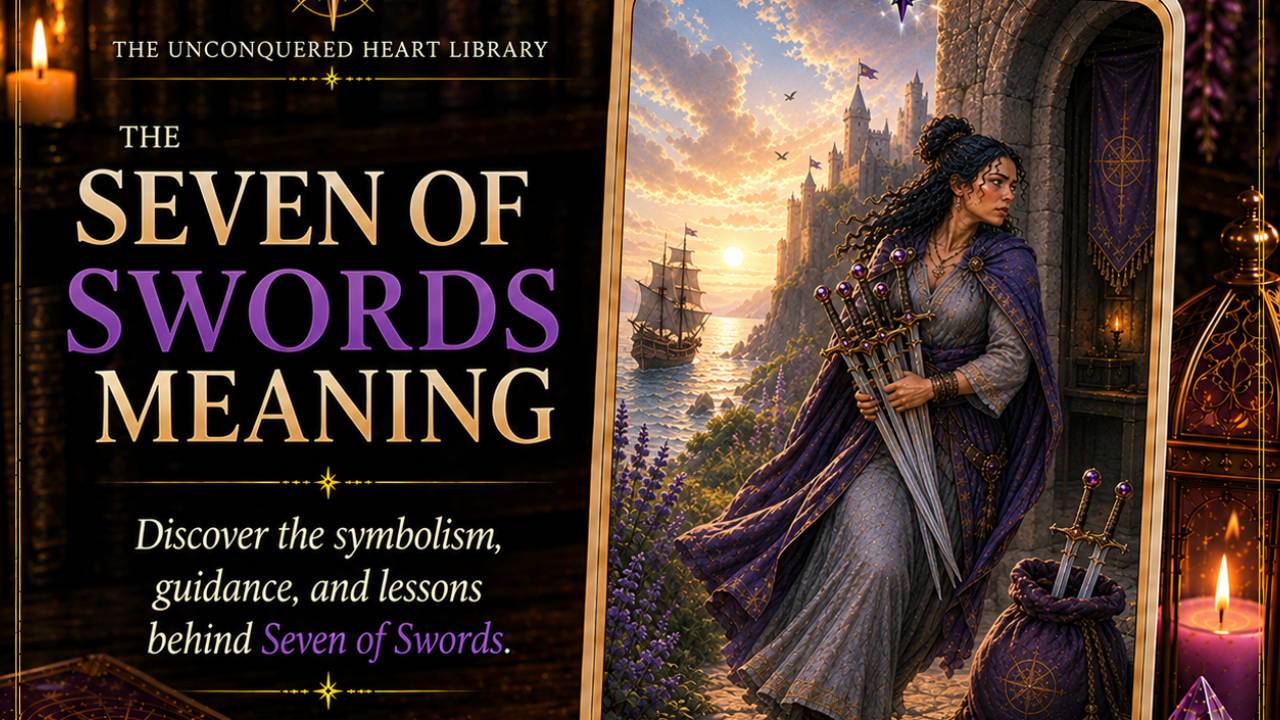
Seven of Swords Tarot card showing a woman with long curly dark hair wearing a gray dress, leather boots, and a flowing purple cloak as she walks along a cobblestone path carrying five swords in her arms. She looks over her shoulder while her cloak billows behind her.
Two more swords stand upright in a purple cloth bag resting beside the doorway of a stone building, where a lit candle glows on a table inside. A purple banner embroidered with a golden compass hangs beside the doorway.
Purple wildflowers bloom along the path, while a sailing ship crosses the water below a castle perched on the rocky cliffs. Birds fly across a sky filled with soft clouds as the sun hangs low above the horizon, reflecting light across the sea.
The Seven of Swords
The Seven of Swords represents strategy, discretion, independent thinking, secrecy, and the choices we make when deciding how much information to share with others. As part of the suit of Swords, it explores the relationship between our thoughts, intentions, communication, and actions. The card often appears when a situation requires careful planning, when someone is withholding information, or when the most effective approach may not be the most obvious or conventional one.
Whether you are developing a strategy, protecting your privacy, questioning someone's intentions, or considering an unconventional approach to a problem, the Seven of Swords encourages you to examine both your methods and your motivations. Acting independently is not inherently dishonest, and transparency is not always appropriate or necessary. The challenge is recognizing the difference between thoughtful discretion and deception that undermines trust or causes unnecessary harm.
The Seven of Swords in the Rider-Waite-Smith Tarot
In the Rider-Waite-Smith Tarot, a man moves away from a collection of tents while carrying five swords in his arms. He looks back over his shoulder with an expression that suggests amusement or satisfaction, while two additional swords remain standing upright in the ground behind him. Figures can be seen in the distance, suggesting that he is leaving an encampment or group of people without their immediate attention.
The man's unusual method of carrying the swords and his backward glance create an atmosphere of secrecy. He appears to be taking something away without openly announcing his intentions, although the image does not establish whether the swords belong to him or someone else. This ambiguity contributes to the card's association with deception, theft, hidden agendas, and attempts to gain an advantage through indirect methods. It also leaves room for interpretations involving cleverness, independent action, and strategic withdrawal.
The two swords left behind are equally important because they suggest that the man's plan may be incomplete or that he has deliberately chosen not to take everything available. He may be leaving evidence of his actions, overlooking something important, or making a calculated decision about what is worth carrying. The Seven of Swords reminds us that strategy involves choices about what to pursue, what to leave alone, and what information to reveal. Whether those choices are wise or ethical depends upon the circumstances and the intentions behind them.
Upright Meaning
The Seven of Swords is a card of strategy, discretion, careful planning, independent action, and sometimes dishonesty or deception. It often appears when you need to approach a situation thoughtfully rather than revealing every intention immediately. You may be developing a business plan, preparing for a negotiation, protecting confidential information, or choosing to work independently because involving other people would complicate your efforts. In these circumstances, the card can encourage resourcefulness and the ability to recognize options that others may overlook.
When the Seven of Swords appears upright, it can also suggest that someone is withholding important information, misrepresenting their intentions, or attempting to gain an advantage through dishonest methods. You may need to examine whether the information available to you is complete, whether someone's actions are consistent with their statements, or whether a proposed strategy depends upon misleading others. The card does not automatically establish that deception is occurring, but it encourages you to pay attention to discrepancies and avoid making assumptions simply because a situation appears straightforward.
The Seven also invites you to consider the difference between privacy and secrecy. You are not obligated to share every thought, plan, or personal detail with everyone around you, and some situations genuinely benefit from discretion. At the same time, withholding information can become problematic when another person reasonably needs that information to make an informed decision. The Seven of Swords encourages you to use your judgment, consider the consequences of your approach, and recognize that an effective strategy should account for more than simply getting what you want.
Reversed Meaning
Reversed, the Seven of Swords can suggest exposed secrets, ineffective strategies, self-deception, or difficulty trusting your own judgment about what to reveal and what to keep private. You may discover that someone has been dishonest, recognize that your own approach has created unnecessary complications, or find that a plan you expected to work is producing unexpected consequences. In other situations, the reversed card can indicate that information previously withheld is becoming available, allowing a situation to be understood more accurately.
The reversed Seven can also appear when excessive caution or suspicion is preventing you from acting effectively. You may be so concerned about other people's intentions that you struggle to collaborate, share ideas, or accept assistance. Alternatively, you may be revealing too much information to people who have not demonstrated that they will handle it responsibly. Neither complete secrecy nor complete openness is appropriate in every situation, and the reversed card may suggest that your current approach to trust and communication needs reconsideration.
Rather than assuming that every hidden detail represents dishonesty, the reversed Seven of Swords invites you to examine the relationship between your intentions, actions, and available information. You may need to acknowledge something you have been avoiding, revise an unsuccessful strategy, communicate more directly, or establish clearer boundaries around your privacy. The goal is to develop an approach that is both effective and consistent with your values, recognizing that circumstances sometimes require discretion while others benefit from greater transparency.
The Seven of Swords in The Unconquered Heart Tarot
In the Rider-Waite-Smith Tarot, the Seven of Swords shows a man carrying five swords away from an encampment while glancing back toward the people he is leaving behind. The Unconquered Heart Tarot preserves the central action but changes the surrounding circumstances. Here, the woman is moving away from a stone building beside the sea, carrying five swords while two remain behind. Her expression is serious and attentive rather than openly pleased with herself, making her intentions less immediately apparent.
This ambiguity is central to the card's interpretation. We can see what the woman is doing, but we cannot determine why she is doing it. She might be taking something that does not belong to her, removing weapons from a dangerous situation, recovering property, or carrying out a plan that requires discretion. The image encourages us to recognize how quickly we construct explanations for other people's behavior when we have only a portion of the relevant information.
Her backward glance can also be interpreted in several ways. She may be checking whether someone has noticed her actions, looking for signs of danger, or simply remaining aware of her surroundings. The same behavior can represent caution, guilt, vigilance, or strategic awareness depending upon the circumstances. This distinction matters because we sometimes treat particular behaviors as evidence of someone's intentions without considering the other explanations that may be equally plausible.
The two swords left behind introduce questions about what the woman has chosen to take and what she has deliberately or unintentionally abandoned. A successful strategy rarely involves pursuing every available opportunity or attempting to control every possible outcome. We make decisions about where to invest our attention, which resources are worth using, and which possibilities can be left unexplored. Her decision to carry five swords rather than all seven may represent practical judgment, an incomplete plan, or a limitation she has not fully considered.
The nearby ship expands the possibilities suggested by the scene. It represents movement, opportunity, and the existence of destinations beyond the immediate circumstances. The woman may be preparing to leave, carrying out a task before departure, or simply acting within a larger plan that we cannot see. Her actions make sense to her within some context, even though that context remains unavailable to us. The Seven of Swords encourages us to become curious about missing information before reaching definitive conclusions.
The compass imagery also connects strategy with direction and personal values. Being clever is not the same as being wise, and successfully carrying out a plan does not automatically make that plan worthwhile. We can use our intelligence to protect ourselves, solve problems, and pursue meaningful goals, but we can also use it to manipulate others or avoid responsibilities. The ability to think strategically becomes most valuable when we consider not only whether a plan will work, but whether its consequences are ones we are willing to accept.
In The Unconquered Heart Tarot, the Seven of Swords becomes an exploration of strategy, privacy, assumptions, and ethical decision-making. It reminds us that discretion can be appropriate, independence can be valuable, and unconventional methods can sometimes produce excellent results. At the same time, it encourages us to examine our intentions and recognize when secrecy or manipulation may create more problems than they solve. The question is not simply whether someone is being sneaky, but whether their choices make sense within the circumstances and reflect the kind of person they want to be.
Tarot Therapy Perspective
In Tarot Therapy, the Seven of Swords invites us to examine our relationship with trust, privacy, and the assumptions we make about other people's behavior. When information is incomplete, our minds naturally attempt to fill in the missing details. We may interpret someone's silence as disapproval, their independence as rejection, or their reluctance to share information as evidence that they have something to hide. These interpretations can feel convincing, particularly when they resemble situations we have experienced before, but they are not necessarily accurate.
The Seven encourages us to distinguish between what we actually know and what we believe might be happening. This can be especially useful when exploring interpersonal conflict, workplace concerns, or situations in which someone's intentions seem unclear. Rather than immediately accepting our first interpretation, we can consider what evidence supports it, what information is missing, and whether other explanations are possible. This does not require ignoring genuine warning signs or abandoning appropriate caution. It simply helps us make decisions based on a more accurate understanding of the circumstances.
The card can also help us examine the boundaries we maintain around personal information. Some people have learned that privacy is selfish or that refusing to answer a question means they must be hiding something. Others may have experienced situations in which sharing information led to criticism, manipulation, or unwanted interference, making secrecy feel necessary even when it is no longer useful. The Seven of Swords invites us to consider whether our current approach to disclosure reflects our actual preferences and circumstances or patterns developed in response to earlier experiences.
Another important application involves the relationship between strategy and personal integrity. We may sometimes believe that achieving an important goal justifies almost any method, particularly when we feel disadvantaged or believe the outcome is necessary. In other situations, we may reject perfectly reasonable strategic approaches because they feel too indirect or unconventional. The Seven encourages us to examine these assumptions and consider whether our methods are both effective and consistent with our values. We can be resourceful without becoming manipulative, and we can act ethically without revealing every detail of our plans.
Ultimately, the Seven of Swords reminds us that thoughtful decision-making requires attention to both information and intention. We can question appearances, protect our privacy, develop effective strategies, and recognize when something deserves closer examination. We can also acknowledge that our interpretations may be incomplete and remain willing to reconsider them when new information becomes available. The goal is not to become suspicious of everyone or to trust without discernment, but to develop the judgment necessary to navigate situations where not everything is immediately clear.
Want to learn how to use Tarot as a practical tool for insight and change - for yourself and others? Become a Certified Tarot Therapy Practitioner here.
Reflection Question
Where am I making assumptions about someone's intentions, including my own, and what information might help me understand the situation more accurately?
Consider a situation in which someone's actions seem unclear or you are deciding how much information to share. Reflect on what you actually know, what you are assuming, and whether your approach is helping you act effectively while remaining consistent with your values.
Continue Your Journey
This page introduces the core meaning of The Seven of Swords and the symbolism of the Rider-Waite-Smith Tarot.
If you'd like to explore this card in greater depth including advanced symbolism, colors, love and relationship readings, career and business interpretations, timing, associated crystals, and practical reading techniques, those topics are covered in Tarot Symbols & Meanings.