Queen of Swords Tarot Card Meaning
Image Description from the Unconquered Heart Tarot Card Above
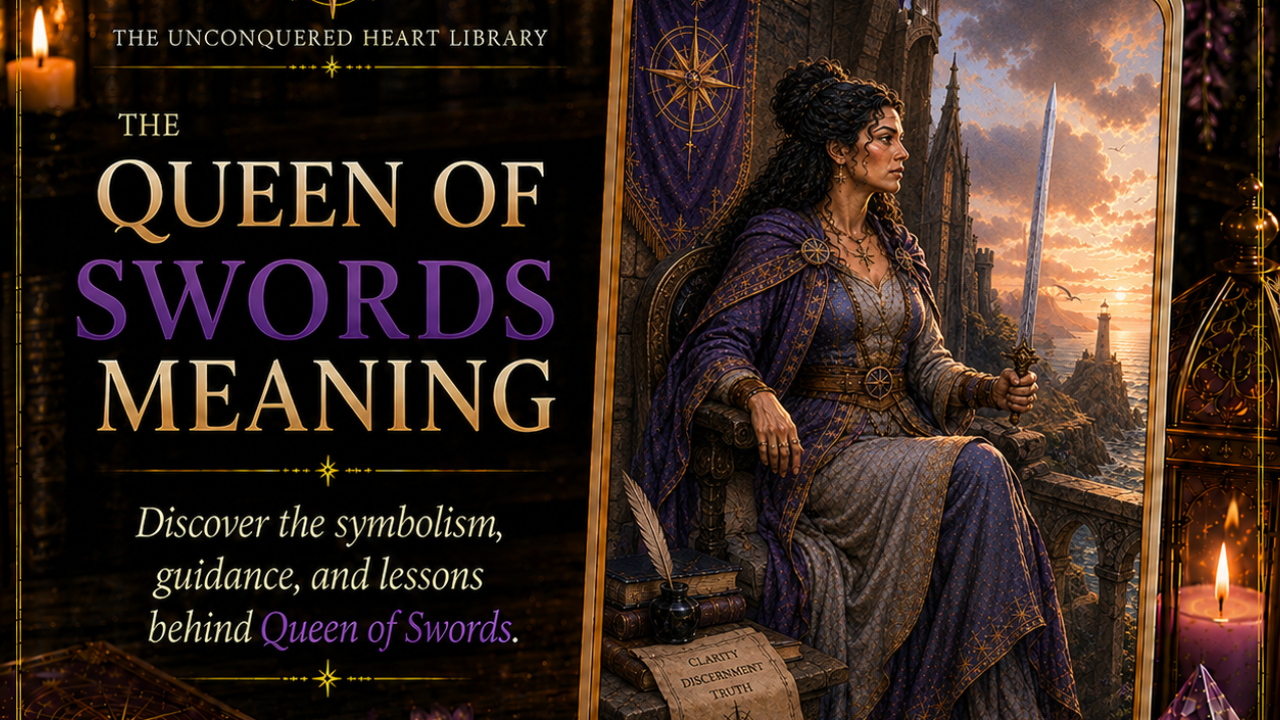
Queen of Swords Tarot card showing a woman with long curly dark hair wearing a gray embroidered gown and a flowing purple cloak fastened at her shoulders as she sits on a stone throne overlooking the sea. She holds a sword upright in one hand while her other arm rests along the arm of the throne, gazing thoughtfully toward the horizon.
A folded purple banner embroidered with an eight-pointed compass drapes over the side of the throne. Beside her, stacked books, a feather quill, an ink bottle, and a handwritten page labeled "Clarity," "Discernment," and "Truth" rest on a stone ledge.
A stone tower rises on the cliffs behind her with a purple banner flying overhead, while waves break against the rocky shoreline beneath a glowing sunrise sky filled with soft clouds and soaring seabirds.
The Queen of Swords
The Queen of Swords represents clarity, discernment, intellectual independence, honesty, and the ability to make thoughtful judgments based on experience and understanding. She combines the analytical qualities of the Swords suit with the maturity to recognize that situations are rarely as simple as they first appear. Rather than accepting information at face value or allowing strong emotions to determine her conclusions, she considers what she knows, evaluates what she hears, and makes decisions according to her understanding of the situation.
When the Queen of Swords appears in a reading, she may encourage you to examine a situation more objectively, communicate your thoughts honestly, establish appropriate boundaries, or trust your ability to make an informed decision. She reminds us that clear thinking does not require emotional detachment, and that wisdom involves more than simply being intelligent. It also requires the willingness to question our assumptions, recognize our limitations, and remain open to information that may change our perspective.
The Queen of Swords in the Rider-Waite-Smith Tarot
In the Rider-Waite-Smith Tarot, the Queen of Swords sits upon a stone throne decorated with images of butterflies and a cherub. She holds a sword upright in one hand while extending her other hand outward, as though inviting someone to approach or speak. Her expression is serious and attentive, and she appears prepared to consider whatever is brought before her.
The Queen's throne rises above a landscape of distant trees and mountains, while clouds gather behind her against a pale sky. The elevated position suggests perspective and the ability to consider circumstances from a broader vantage point. The butterflies carved into her throne are often associated with transformation, while the upright sword represents intellectual clarity, truth, communication, and the capacity to distinguish between competing ideas or claims.
Unlike the Knight of Swords, who charges forward with conviction and urgency, the Queen remains seated, suggesting that she does not need to respond immediately to everything she encounters. Her extended hand creates an interesting balance with the raised sword. She is willing to receive information, but she also possesses the discernment to evaluate it. The Queen of Swords represents the ability to listen without surrendering judgment, communicate directly without unnecessary aggression, and reach conclusions through thoughtful consideration rather than impulse.
Upright Meaning
The Queen of Swords is a card of clear thinking, honesty, independence, discernment, effective communication, and sound judgment. She often appears when you need to evaluate information carefully, make an important decision, establish boundaries, or approach a complicated situation without allowing assumptions or emotional reactions to obscure what is happening. She may also represent someone who is intelligent, perceptive, direct, experienced, and willing to ask difficult questions when necessary.
When the Queen of Swords appears upright, she encourages you to examine both the information available and the reasoning you are using to interpret it. You may need to distinguish facts from opinions, recognize inconsistencies, ask for clarification, or consider whether your existing beliefs are influencing what you are willing to accept as true. The Queen understands that experience can make us more perceptive, but she also recognizes that previous experiences can create expectations that do not necessarily apply to every new situation.
This card also emphasizes the importance of communicating clearly and maintaining appropriate boundaries. You can express disagreement without becoming hostile, decline a request without offering an elaborate justification, and ask questions without apologizing for wanting to understand. The Queen of Swords reminds you that honesty and compassion are not opposites. You can care about someone while recognizing that their perspective is incomplete, their behavior is unacceptable, or their expectations are not reasonable for you.
Reversed Meaning
Reversed, the Queen of Swords can suggest difficulty maintaining objectivity, communication problems, excessive criticism, or judgments that are being influenced by assumptions rather than evidence. You may be interpreting someone's actions through the lens of previous disappointments, becoming unusually defensive when your ideas are questioned, or reaching conclusions before you have enough information to understand the situation accurately.
The reversed Queen can also represent intellectual rigidity or the use of language as a means of control. Intelligence and verbal skill can become tools for dismissing other perspectives, winning arguments, or making someone else feel inadequate. In other situations, you may be on the receiving end of this behavior, dealing with someone whose confidence and forceful communication make it difficult to question their conclusions. The reversed Queen reminds us that being articulate, knowledgeable, or persuasive does not automatically make someone correct.
Alternatively, the reversed Queen of Swords may indicate that you are doubting your own judgment or struggling to communicate what you know and need. You may avoid expressing an opinion because you fear criticism, second-guess decisions you have already considered carefully, or allow someone else's certainty to outweigh your own understanding. Rather than encouraging greater suspicion or emotional distance, the reversed Queen invites you to examine how you arrive at conclusions, how you communicate them, and whether you are giving yourself and others a fair opportunity to be understood.
The Queen of Swords in The Unconquered Heart Tarot
In the Rider-Waite-Smith Tarot, the Queen of Swords sits upon an elevated throne with her sword raised and one hand extended, suggesting a balance between receiving information and exercising judgment. The Unconquered Heart Tarot preserves her intellectual authority while placing greater emphasis on the knowledge, experience, and thoughtful evaluation that make her judgment valuable.
The Queen's position overlooking the sea reinforces the importance of perspective. From her vantage point, she can observe a larger landscape than someone standing directly in the middle of an unfolding situation. This does not mean she knows everything or that distance automatically produces understanding. Instead, it suggests the value of considering circumstances beyond our immediate reactions. When we are deeply involved in a situation, it can be difficult to recognize patterns, competing interests, or alternative explanations that become more apparent when we allow ourselves room to reflect.
The upright sword remains a central symbol of her authority, but unlike the Knight of Swords, she is not using it to charge toward an objective. Her sword represents a capacity she has developed and can apply when necessary. She does not need to demonstrate her intelligence through constant debate or prove her independence by rejecting every suggestion. Her confidence allows her to evaluate information without treating every disagreement as a personal challenge.
The books and writing materials introduce an important distinction between possessing knowledge and developing wisdom. Knowledge can be acquired through study, observation, conversation, and experience, but the ability to use that knowledge effectively requires interpretation and judgment. The Queen understands that information does not become reliable simply because it appears in a book, comes from an authority figure, or confirms something she already believes. She must consider its source, relevance, accuracy, and limitations before deciding what conclusions it supports.
The words Clarity, Discernment, and Truth provide a useful framework for understanding the Queen's approach. Clarity involves understanding what is actually being communicated or observed rather than relying on vague impressions. Discernment involves evaluating the information available, recognizing meaningful distinctions, and considering whether a conclusion is justified. Truth represents a commitment to understanding reality as accurately as possible, even when that understanding challenges our preferences or requires us to reconsider something we previously accepted.
These qualities are related, but they are not interchangeable. Someone can communicate an idea clearly without that idea being accurate. We can carefully evaluate a claim and still reach the wrong conclusion because important information is missing. We can also sincerely value truth while allowing our assumptions to influence which evidence we notice or dismiss. The Queen of Swords encourages us to develop all three capacities together, recognizing that thoughtful judgment is an ongoing practice rather than a permanent state of being right.
The lighthouse in the distance adds another layer to this understanding. A lighthouse provides guidance by making something important visible, particularly when surrounding conditions make navigation difficult. In the same way, reliable principles, evidence, and carefully developed understanding can help us orient ourselves when circumstances are confusing or emotionally charged. The Queen does not need every situation to be simple before she can make a decision. She needs a trustworthy way to evaluate what matters.
The Queen's composure also challenges the assumption that rational thinking requires the absence of emotion. Feelings can provide important information about our experiences, needs, values, and relationships. They can alert us to problems, motivate us to investigate, or help us recognize what matters personally. However, the intensity of a feeling does not necessarily establish the accuracy of the conclusion we draw from it. The Queen encourages us to acknowledge emotional information while examining the interpretations and decisions that follow.
In The Unconquered Heart Tarot, the Queen of Swords represents the ability to think independently without becoming closed-minded, communicate honestly without becoming cruel, and exercise discernment without assuming that everyone must be approached with suspicion. Her authority comes not from claiming to possess every answer, but from developing the knowledge, experience, and intellectual integrity required to make thoughtful judgments. She reminds us that wisdom includes knowing when to trust our conclusions, when to ask better questions, and when new information gives us a good reason to change our minds.
Tarot Therapy Perspective
In Tarot Therapy, the Queen of Swords invites us to explore how we form judgments, interpret information, and decide what we believe. Our conclusions are influenced by many factors, including personal experiences, education, cultural expectations, emotional responses, and the information available to us at a particular moment. Some of these influences help us recognize important patterns, while others can lead us to make assumptions that deserve closer examination. The Queen encourages us to become more aware of these processes rather than assuming that our first interpretation of a situation must be the correct one.
One particularly useful application involves distinguishing between an observation and the meaning we assign to it. For example, someone may fail to respond to a message, and we may immediately conclude that they are angry, uninterested, or deliberately ignoring us. The unanswered message is an observation, but the explanation is an interpretation. There may be evidence supporting our conclusion, but there may also be possibilities we have not considered. The Queen of Swords encourages us to recognize this distinction so that we can respond to what we actually know rather than treating an assumption as an established fact.
The card can also help us examine how previous experiences influence our expectations. If we have encountered dishonesty, criticism, manipulation, or repeated disappointment, we may become especially alert to signs that something similar is happening again. That awareness can sometimes be protective and useful. However, it can also cause us to interpret unfamiliar situations through expectations that are not fully supported by the current evidence. The Queen encourages us to honor what experience has taught us while remaining willing to evaluate each situation on its own merits.
Another important area of exploration involves the relationship between honesty and communication. Some people avoid difficult conversations because they fear conflict or worry about disappointing others. Others pride themselves on being direct but may overlook how their words affect the people receiving them. The Queen of Swords invites us to consider whether we are communicating what we actually mean, whether our message is appropriate to the circumstances, and whether the way we express ourselves supports the outcome we want. Clear communication does not require unnecessary harshness, just as kindness does not require concealing important information.
The Queen can be especially helpful when examining personal boundaries. Establishing a boundary often involves recognizing what we are willing to participate in, what responsibilities belong to us, and what behavior we will or will not accept. These decisions do not always require proving that another person is wrong or persuading them to agree with our reasoning. We can recognize someone else's perspective while maintaining our own limits. The Queen encourages us to develop enough confidence in our judgment that we can make appropriate decisions without needing universal approval.
This card also provides an opportunity to examine our relationship with authority and expertise. We may defer to someone because they possess credentials, experience, confidence, or a position of influence, even when we have reasonable questions about their conclusions. Alternatively, we may reject useful information simply because we dislike the person presenting it. The Queen of Swords encourages a more thoughtful approach in which expertise is considered relevant without being treated as infallible, and claims are evaluated according to their evidence rather than accepted or rejected solely because of their source.
Finally, the Queen invites us to consider what happens when we discover that we have been mistaken. For some people, changing their minds feels embarrassing or threatening because they associate being wrong with being unintelligent, incompetent, or easily influenced. Yet the willingness to revise a conclusion when better information becomes available is an important part of sound judgment. The Queen of Swords reminds us that intellectual independence does not mean refusing to be influenced. It means developing the ability to decide which influences deserve our consideration.
Ultimately, the Queen encourages us to build a relationship with our own thinking that includes curiosity, honesty, confidence, and flexibility. We can trust our ability to evaluate information without expecting ourselves to know everything. We can express our conclusions clearly while remaining open to questions. And we can recognize that changing our minds in response to better evidence is not a failure of judgment, but one of the ways good judgment develops.
Want to learn how to use Tarot as a practical tool for insight and change - for yourself and others? Become a Certified Tarot Therapy Practitioner here.
Reflection Question
Where might I be treating an assumption as a fact, and what information would help me understand the situation more clearly?
Consider a situation in which you have formed a strong opinion, reached a conclusion, or made a judgment about someone or something. Reflect on what you actually know, what you have inferred, and whether your previous experiences or expectations may be influencing your interpretation. What questions could help you develop a more complete understanding?
Continue Your Journey
This page introduces the core meaning of The Queen of Swords and the symbolism of the Rider-Waite-Smith Tarot.
If you'd like to explore this card in greater depth including advanced symbolism, colors, love and relationship readings, career and business interpretations, timing, associated crystals, and practical reading techniques, those topics are covered in Tarot Symbols & Meanings.