Page of Swords Tarot Card Meaning
Image Description from the Unconquered Heart Tarot Card Above
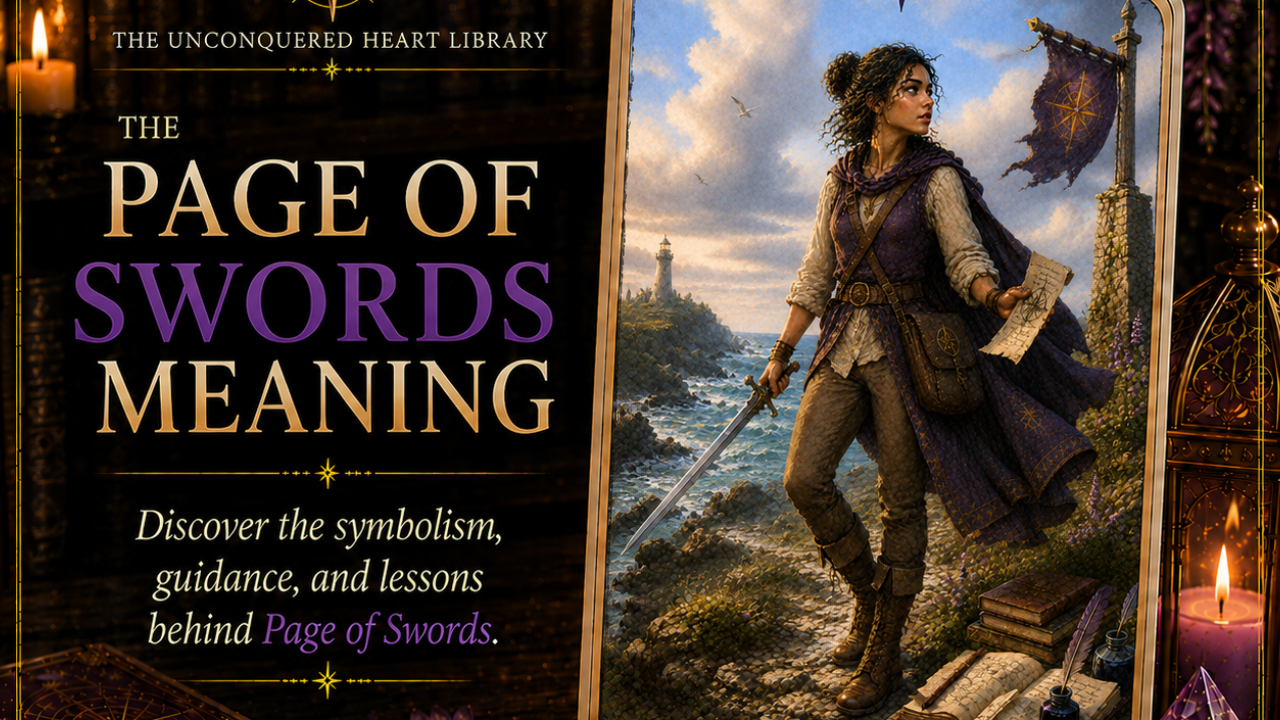
Page of Swords Tarot card showing a young woman with long curly dark hair tied back in a loose bun wearing a cream-colored tunic, brown trousers, tall lace-up boots, and a flowing purple cloak as she strides along a rocky coastal path. She holds a sword in one hand while extending an aged parchment marked with a compass design in the other, looking alertly over her shoulder.
A leather satchel decorated with an eight-pointed compass hangs at her side. A weathered stone flagpole displays a tattered purple banner overlooking the shoreline, while a lighthouse stands on a rocky point in the distance.
Open books, stacked journals, an unfurled map, quill pens, and ink bottles rest beside the path among blooming purple wildflowers. Waves crash against the rocky coastline beneath a bright sky filled with towering clouds as seabirds soar overhead.
The Page of Swords
The Page of Swords represents curiosity, intellectual exploration, critical thinking, communication, and the desire to understand how things work. As a Page, she approaches the world as a student, while the suit of Swords directs her attention toward ideas, information, reasoning, language, and the ways we interpret our experiences. She is interested not only in what people believe, but also in how they arrived at those beliefs and whether the available evidence supports them.
Whether you are researching an unfamiliar subject, questioning an assumption, preparing for an important conversation, or trying to make sense of conflicting information, the Page of Swords encourages you to remain curious and mentally engaged. She reminds us that asking questions is not a sign of ignorance or disrespect. Questions are among the most important tools we have for developing understanding, recognizing possibilities, and making informed decisions.
The Page of Swords in the Rider-Waite-Smith Tarot
In the Rider-Waite-Smith Tarot, a young figure stands on uneven ground holding a raised sword with both hands. The Page's body faces one direction while the head turns toward another, creating an impression of alertness and readiness to respond. Wind moves through the figure's hair and clothing, while clouds stretch across the sky and birds gather in the distance.
The elevated landscape provides a broad view of the surrounding countryside, suggesting the Page's interest in observing and understanding what is happening beyond the immediate environment. The wind and clouds reinforce the connection between Swords and the element of Air, traditionally associated with thought, communication, intellect, and the movement of ideas. The Page appears attentive to the changing conditions, as though gathering information before deciding how to respond.
The sword represents the developing ability to think critically, distinguish between competing ideas, and communicate with clarity. Unlike the Queen or King of Swords, who represent more established intellectual authority, the Page is still learning how to use these abilities effectively. Curiosity and alertness are valuable qualities, but they also require discernment. The Page must learn when to question, when to listen, when to speak, and when additional information is needed before reaching a conclusion.
Upright Meaning
The Page of Swords is a card of curiosity, learning, research, investigation, communication, and intellectual development. It often appears when you are exploring a new subject, gathering information before making a decision, developing your communication skills, or beginning to question beliefs and assumptions you previously accepted without much examination. The card can also represent important news, new ideas, stimulating conversations, or opportunities to approach a familiar situation from a different perspective.
When the Page of Swords appears upright, it encourages you to become an active participant in your own understanding. Rather than accepting information simply because it comes from an authority, a familiar source, or someone who speaks confidently, you can ask how the conclusion was reached and what evidence supports it. This does not mean treating every statement as suspicious or assuming that expertise has no value. It means learning to distinguish between reliable information, reasonable interpretations, unsupported assumptions, and personal opinions.
The Page also reminds us that good communication involves more than having something to say. Listening carefully, asking useful questions, considering different perspectives, and choosing words that accurately express what we mean are all skills that improve through practice. You may not yet have enough information to form a confident conclusion, and that is perfectly acceptable. The Page of Swords encourages you to remain curious, continue learning, and allow your understanding to develop as new information becomes available.
Reversed Meaning
Reversed, the Page of Swords can suggest difficulty evaluating information, communicating effectively, or managing an active and questioning mind. You may be jumping to conclusions before gathering enough evidence, becoming distracted by conflicting opinions, or spending so much time researching a subject that you struggle to determine what is actually relevant. In other situations, you may be reluctant to ask questions because you worry about appearing inexperienced or challenging someone else's authority.
The reversed Page can also point toward communication that has become unnecessarily confrontational, defensive, or careless. You may be more interested in proving that you are correct than understanding another person's perspective, or you may speak before considering how your words will be received. Alternatively, you may encounter someone who uses questions to challenge or undermine others rather than to develop genuine understanding. Critical thinking is valuable, but it becomes less effective when curiosity is replaced by the assumption that everyone else must be wrong.
Rather than asking you to stop questioning or become less intellectually engaged, the reversed Page of Swords encourages you to examine how you are using your curiosity and communication skills. Are you gathering information that helps you understand the situation, or simply collecting more reasons to support a conclusion you have already reached? Are your questions opening a conversation or shutting one down? The reversed Page reminds us that intellectual development requires not only the courage to question others, but also the willingness to reconsider our own assumptions.
The Page of Swords in The Unconquered Heart Tarot
In the Rider-Waite-Smith Tarot, the Page stands on elevated ground with a sword raised, appearing alert to the movement of the wind and the world around her. The Unconquered Heart Tarot preserves that sense of curiosity and readiness while giving the Page a more deliberate relationship with learning, investigation, and the search for understanding.
Here, the Page carries both a sword and a parchment marked with a compass. These objects represent two abilities that are especially important to the suit of Swords: the capacity to evaluate information and the ability to determine what direction that information might suggest. The sword can help her distinguish between competing ideas, while the compass reminds her that having information is not the same thing as knowing what to do with it. She needs both discernment and direction.
The books, maps, journals, and writing instruments nearby expand the Page's intellectual world beyond whatever she can observe in a single moment. She has access to accumulated knowledge, recorded experiences, and tools that can help her investigate unfamiliar territory. This matters because curiosity does not require us to discover everything independently. We can learn from people who have already explored a subject, examine their conclusions, compare different sources, and use what we discover to develop our own understanding.
At the same time, the Page is not sitting still with her books. She is moving along a coastal path, suggesting that learning is connected to experience and exploration. Some questions can be answered through study, while others require us to observe what happens when ideas encounter the world outside our own thoughts. We may begin with a map, but eventually we have to discover how accurately that map represents the territory we are trying to navigate.
The lighthouse in the distance adds another dimension to the card. A lighthouse does not eliminate the dangers of a rocky coastline or make every navigational decision for the person traveling through it. Instead, it provides information that can help someone recognize their position and make better choices. Knowledge can serve a similar purpose. It does not remove uncertainty from every situation, but it can help us identify risks, recognize opportunities, and make decisions with a clearer understanding of what we are facing.
The Page's alert posture is also significant. She is looking over her shoulder rather than focusing exclusively on the direction she is traveling. This suggests an awareness that relevant information can come from unexpected places and that circumstances may change as we move forward. However, it also raises an important question about the difference between attentiveness and constant vigilance. Being observant can help us respond intelligently to new information, but attempting to monitor every possible development can eventually become exhausting or distracting.
The tattered banner introduces another interesting possibility. The compass symbol remains visible even though the fabric has been worn by the elements. Ideas, beliefs, and systems of knowledge can remain useful while still requiring revision. We do not have to discard everything we have learned simply because some part of our understanding proves incomplete. We can preserve what remains valuable, reconsider what no longer fits, and continue developing a more accurate picture of the world.
In The Unconquered Heart Tarot, the Page of Swords becomes a celebration of intellectual curiosity guided by discernment. She does not need to know everything before beginning her exploration, nor does she need to accept every explanation she encounters along the way. Her task is to remain curious enough to ask meaningful questions, thoughtful enough to evaluate the answers, and flexible enough to change direction when new information gives her a better understanding of where she wants to go.
Tarot Therapy Perspective
In Tarot Therapy, the Page of Swords invites us to examine how we develop beliefs, interpret information, and communicate our understanding to others. Much of what we believe about ourselves and the world comes from experiences, relationships, cultural expectations, education, and messages we have encountered throughout our lives. Some of these beliefs are supported by considerable evidence, while others may have been accepted so early or repeated so frequently that we rarely think to question them.
The Page encourages us to become curious about the assumptions that influence our decisions and expectations. For example, someone who believes they are terrible at learning new things might begin exploring where that belief originated, what experiences seem to support it, and whether other experiences suggest a more complicated picture. The purpose is not to replace every uncomfortable belief with a more flattering one. It is to develop a more accurate understanding that allows us to respond to our circumstances with greater flexibility.
This card can also help us distinguish between questioning an idea and attacking the person who holds it. When our beliefs are closely connected to our identity, values, or important relationships, disagreement can feel surprisingly personal. We may become defensive, dismiss information that challenges us, or interpret another person's questions as an attempt to undermine our intelligence or judgment. The Page of Swords encourages us to approach these moments with curiosity, recognizing that disagreement can sometimes provide an opportunity to examine ideas more carefully.
Another important application involves our relationship with uncertainty and incomplete information. We may feel pressure to form an opinion immediately, especially when a subject is emotionally significant or other people expect us to take a position. Yet the ability to say that we do not know enough to reach a conclusion is an important intellectual skill. The Page reminds us that uncertainty does not always represent confusion or weakness. Sometimes it reflects an accurate recognition of the limits of our current knowledge.
The Page of Swords also invites us to examine the difference between gathering information and using it. Research can help us make informed decisions, but it can also become a way of postponing action when we are uncomfortable with uncertainty. We may continue looking for additional opinions, explanations, or evidence long after we have enough information to make a reasonable choice. The Page encourages us to recognize when further investigation is likely to be useful and when it may be time to apply what we have learned.
Finally, the Page offers an opportunity to develop more intentional communication. We can practice asking questions that encourage understanding rather than defensiveness, listening without immediately preparing a response, and expressing disagreement without treating the conversation as a competition. We can also become more aware of how our words influence the relationships and situations in which we participate. Communication is not simply the transmission of information. It is an interaction in which curiosity, clarity, timing, and respect can make a meaningful difference.
The Page of Swords reminds us that intellectual growth is an ongoing process. We do not have to defend every belief we have ever held, possess an answer to every question, or prove our intelligence through argument. We can continue learning, reconsidering, and refining our understanding as we encounter new information and experiences.
Want to learn how to use Tarot as a practical tool for insight and change - for yourself and others? Become a Certified Tarot Therapy Practitioner here.
Reflection Question
What belief or assumption have I accepted without questioning, and what might I discover if I became genuinely curious about whether it is accurate?
Consider something you believe about yourself, another person, or the world around you. Reflect on where that belief originated, what evidence supports it, and whether there are perspectives or experiences you have not yet considered. You do not have to abandon your current understanding, but you can give yourself permission to examine it.
Continue Your Journey
This page introduces the core meaning of The Page of Swords and the symbolism of the Rider-Waite-Smith Tarot.
If you'd like to explore this card in greater depth including advanced symbolism, colors, love and relationship readings, career and business interpretations, timing, associated crystals, and practical reading techniques, those topics are covered in Tarot Symbols & Meanings.