Nine of Swords Tarot Card Meaning
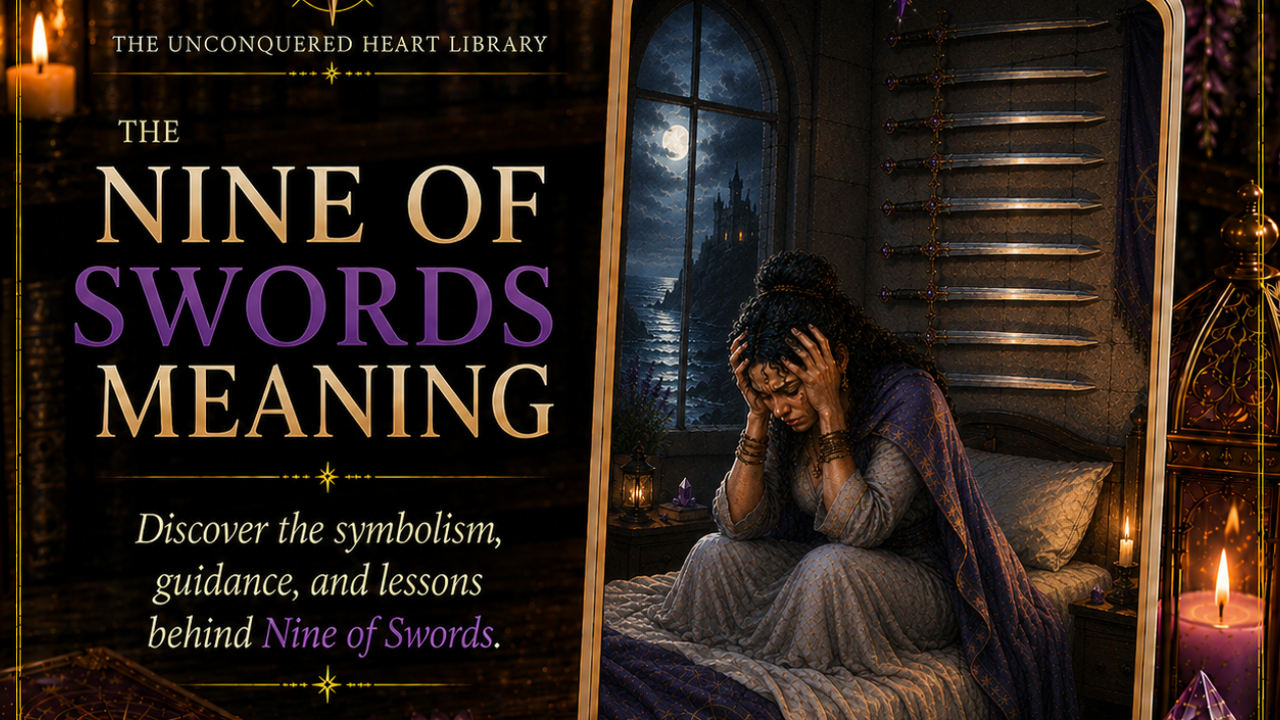
Image Description from the Unconquered Heart Tarot Card Above
Nine of Swords Tarot card showing a woman with long curly dark hair wearing a gray dress and a flowing purple cloak as she sits on the edge of a bed with her head hanging down and both hands pressed against the sides of her head, elbows resting on her knees. Nine swords are mounted horizontally on the stone wall above the bed.
Moonlight shines through a tall arched window overlooking the sea, rocky cliffs, and a castle in the distance beneath a full moon and cloud-filled sky. A lantern, purple crystal, and small stack of books rest on a table beside the window, while a lit candle glows on the bedside table.
A purple banner embroidered with a golden compass hangs on the wall, and a purple blanket decorated with golden compass designs is draped across the bed.
The Nine of Swords
The Nine of Swords represents anxiety, worry, fear, regret, and the mental distress that can arise when our thoughts become difficult to manage. As part of the suit of Swords, it explores how our interpretations, expectations, and internal conversations influence our emotional experiences. The card often appears when we are preoccupied with something troubling, repeatedly imagining negative outcomes, or struggling to find relief from thoughts that seem to demand our constant attention.
Whether you are worried about an uncertain future, replaying a difficult conversation, regretting a past decision, or dealing with circumstances that genuinely deserve concern, the Nine of Swords encourages you to examine the relationship between what is happening and what you are thinking about it. Our distress may be connected to real problems, imagined possibilities, or a combination of both. Understanding that distinction can help us determine whether we need practical action, additional information, support, or simply an opportunity to rest from the demands of our own thoughts.
The Nine of Swords in the Rider-Waite-Smith Tarot
In the Rider-Waite-Smith Tarot, a figure sits upright in bed with their face buried in their hands. Nine swords hang horizontally against a dark background above the bed, creating an imposing arrangement that dominates the upper portion of the card. The figure appears overwhelmed, as though awakened from a nightmare or unable to find relief from troubling thoughts.
The bed is decorated with carved figures, while the quilt features astrological symbols and patterned squares. These details contrast with the figure's distress, suggesting that the surrounding environment may be relatively secure even while the person's internal experience feels frightening or overwhelming. The swords themselves do not physically touch the figure. Instead, their presence emphasizes the mental and psychological dimensions of suffering associated with the suit.
The Nine of Swords is frequently associated with sleepless nights, nightmares, guilt, anxiety, and the tendency to imagine worst-case scenarios. However, the card does not establish whether the person's concerns are justified or exaggerated. It simply presents the experience of someone whose thoughts have become deeply distressing. The distinction matters because worry can arise from genuine circumstances, inaccurate assumptions, or uncertainty about events that have not yet occurred. The card encourages us to consider both the concerns themselves and the effect that repeatedly thinking about them may be having on our well-being.
Upright Meaning
The Nine of Swords is a card of anxiety, worry, fear, regret, sleeplessness, and mental distress. It often appears when you are preoccupied with a difficult situation, anticipating an unpleasant outcome, or repeatedly reviewing something that has already happened. You may be concerned about relationships, finances, health, work, responsibilities, or decisions whose consequences remain uncertain. The card can also represent guilt, embarrassment, or self-criticism that makes it difficult to move beyond a past experience.
When the Nine of Swords appears upright, it encourages you to examine whether your thoughts are helping you understand or respond to the situation. Concern can be useful when it alerts us to a problem that deserves attention, but repeatedly imagining the same negative outcome does not necessarily provide additional insight. You may be reviewing possibilities without gaining new information, attempting to anticipate every conceivable difficulty, or treating an uncertain outcome as though it has already occurred. Recognizing these patterns can help you distinguish between productive consideration and mental activity that is increasing your distress.
The Nine also reminds us that we do not have to resolve every concern through thinking alone. Some situations benefit from practical action, additional information, a conversation with someone involved, or assistance from a qualified professional. Others involve uncertainty that cannot currently be eliminated, no matter how thoroughly we analyze it. The card encourages you to recognize what is within your ability to address, what remains unknown, and when continued mental effort may be less useful than rest, support, or a different approach.
Reversed Meaning
Reversed, the Nine of Swords can suggest a changing relationship with anxiety, regret, or troubling thoughts. You may be beginning to recognize patterns that contribute to your distress, gaining perspective on a situation that previously felt overwhelming, or finding ways to respond to concerns without becoming consumed by them. The reversed card can indicate that you are developing a clearer understanding of what is happening and discovering approaches that help you manage uncertainty more effectively.
The reversed Nine can also represent distress that has become difficult to acknowledge or discuss. You may be minimizing your concerns, attempting to push uncomfortable thoughts aside, or feeling pressure to appear calm when you are struggling internally. In other situations, you may recognize that your thinking is contributing to your distress but feel uncertain about how to change the pattern. Awareness can be valuable, but it does not automatically make difficult thoughts or emotions disappear.
Rather than interpreting the reversed Nine of Swords as a guarantee that your worries are ending, it invites you to examine what has changed and what kind of support or response might be useful. You may benefit from addressing a practical concern, reconsidering an assumption, talking with someone you trust, or seeking professional assistance when distress is persistent or interfering with daily life. The goal is not to eliminate every uncomfortable thought, but to develop ways of responding that help you navigate difficulties without adding unnecessary suffering to the experience.
The Nine of Swords in The Unconquered Heart Tarot
In the Rider-Waite-Smith Tarot, the Nine of Swords shows a figure sitting upright in bed beneath nine swords, apparently overwhelmed by distressing thoughts. The Unconquered Heart Tarot preserves this central experience while placing the woman in a room illuminated by moonlight and the warm glow of candles. The swords remain mounted on the wall, but the surrounding environment offers several reminders that her immediate experience is only one part of a larger reality.
The woman's posture makes her distress unmistakable. She is holding her head in both hands, absorbed in whatever thoughts or emotions have brought her to this moment. Yet the image does not reveal what she is thinking about, and that uncertainty is important. She may be worrying about something that has not happened, regretting something that already has, or attempting to understand circumstances that genuinely threaten her well-being. We cannot determine the accuracy of her concerns simply by observing how distressed she appears.
The nine swords mounted above the bed reinforce the relationship between thought and suffering. They are not physically attacking her, but their presence dominates the space in which she is trying to rest. This can reflect the way a particular concern occupies our attention until it begins to influence everything else we experience. A problem that might otherwise receive a limited amount of consideration can become the subject of hours of repeated analysis, imagined conversations, and anticipated consequences.
The nighttime setting adds another dimension to the card. When the day's activities have ended and external distractions become less available, unresolved concerns can seem especially prominent. We may find ourselves thinking about things we had little time to consider earlier, or interpreting situations more negatively when we are tired and have fewer opportunities to gather information or take action. The Nine of Swords reminds us that the intensity of a thought at a particular moment does not necessarily indicate its accuracy or importance.
The books, lantern, and candlelight introduce the possibility of resources beyond the woman's immediate thoughts. Knowledge, perspective, and practical assistance may help her understand what is happening, although none of these guarantees an immediate solution. Sometimes we need additional information to evaluate a concern accurately. At other times, we already have enough information and would benefit more from setting the problem aside until we are better able to engage with it. Recognizing the difference is an important part of responding effectively.
Beyond the window, the moonlit sea and distant castle continue to exist independently of the woman's distress. This contrast does not diminish what she is experiencing or suggest that she should simply appreciate the scenery and stop worrying. Instead, it reminds us that our attention can become so concentrated on a particular concern that we temporarily lose awareness of other aspects of our lives. The problem may be important, but it is not necessarily the only thing that exists or the only thing that deserves our attention.
The Nine of Swords also encourages us to consider the difference between responsibility and self-punishment. When we regret something we have done, reflecting on our choices can help us understand what happened, make amends where appropriate, and decide how we want to behave in the future. However, repeatedly criticizing ourselves does not automatically produce greater understanding or better decisions. There is a point at which continued mental punishment may no longer serve any constructive purpose.
In The Unconquered Heart Tarot, the Nine of Swords invites us to recognize mental distress without assuming that every thought contributing to it is accurate, useful, or deserving of unlimited attention. Our concerns may be legitimate, our feelings may be intense, and our circumstances may require meaningful action. At the same time, we can learn to distinguish between understanding a problem and repeatedly suffering through our thoughts about it. The card reminds us that we deserve care and support even when we cannot immediately resolve what is troubling us.
Tarot Therapy Perspective
In Tarot Therapy, the Nine of Swords invites us to examine the relationship between our thoughts, emotions, and interpretations of difficult experiences. We often respond to distressing situations by trying to think our way toward certainty, particularly when the outcome matters to us and we have limited control over what happens next. This can lead to repeated analysis, imagined conversations, and attempts to anticipate every possible consequence. Although these efforts may begin as reasonable attempts to understand a problem, they can become exhausting when they no longer produce useful information.
One valuable area of exploration involves distinguishing between facts, possibilities, and predictions. We may know that a particular event has occurred, recognize several possible consequences, and then begin treating the outcome we fear most as though it is inevitable. The Nine of Swords encourages us to notice when our thoughts move from considering possibilities to assuming that something terrible will happen. This does not mean dismissing genuine risks or refusing to prepare for difficult circumstances. It means evaluating concerns according to the information available rather than allowing fear alone to determine what we believe.
The card can also help us examine our relationship with uncertainty. Some situations cannot be resolved immediately because we are waiting for information, another person's decision, or circumstances that remain outside our control. We may continue thinking about the situation because doing so creates a temporary sense of engagement, even when our thoughts cannot influence the outcome. The Nine encourages us to recognize when further analysis is useful and when we may need to tolerate uncertainty without repeatedly attempting to eliminate it.
Another important application involves guilt, regret, and self-criticism. Reflecting on a mistake can help us understand our choices, acknowledge responsibility, and make changes when appropriate. However, some people come to believe that continuing to feel terrible is necessary to demonstrate remorse or prove that they understand the seriousness of what happened. The Nine of Swords invites us to question whether prolonged self-punishment is accomplishing anything constructive. Taking responsibility and treating ourselves with compassion are not mutually exclusive.
The Nine can also encourage us to examine the practical circumstances that influence our mental well-being. Lack of sleep, ongoing stress, illness, isolation, excessive responsibilities, and limited access to support can all affect how difficult thoughts and emotions feel. Not every distressing experience can be resolved by reconsidering a belief or changing a thinking pattern. Sometimes the most useful response involves addressing an external problem, reducing demands, seeking appropriate care, or receiving assistance from someone with relevant knowledge and experience.
Ultimately, the Nine of Swords reminds us that our thoughts deserve attention, but they do not always deserve unquestioned authority. We can take our concerns seriously while examining whether our interpretations are supported by the available evidence. We can acknowledge regret without turning it into endless punishment, prepare for possible difficulties without treating them as certainties, and recognize when thinking has stopped helping us move forward. The goal is not to become incapable of worry, but to develop a more supportive and discerning relationship with our own minds.
Want to learn how to use Tarot as a practical tool for insight and change - for yourself and others? Become a Certified Tarot Therapy Practitioner here.
Reflection Question
What concern am I repeatedly thinking about, and is that thinking helping me understand or address the situation, or simply making it more difficult to experience?
Consider something that has been occupying your thoughts. Reflect on what you know, what remains uncertain, and whether there is a practical action, useful resource, or different perspective that might help. If no action is currently available, consider what might allow you to give yourself some relief from repeatedly revisiting the same concern.
Continue Your Journey
This page introduces the core meaning of The Nine of Swords and the symbolism of the Rider-Waite-Smith Tarot.
If you'd like to explore this card in greater depth including advanced symbolism, colors, love and relationship readings, career and business interpretations, timing, associated crystals, and practical reading techniques, those topics are covered in Tarot Symbols & Meanings.