Four of Swords Tarot Card Meaning
Image Description from the Unconquered Heart Tarot Card Above
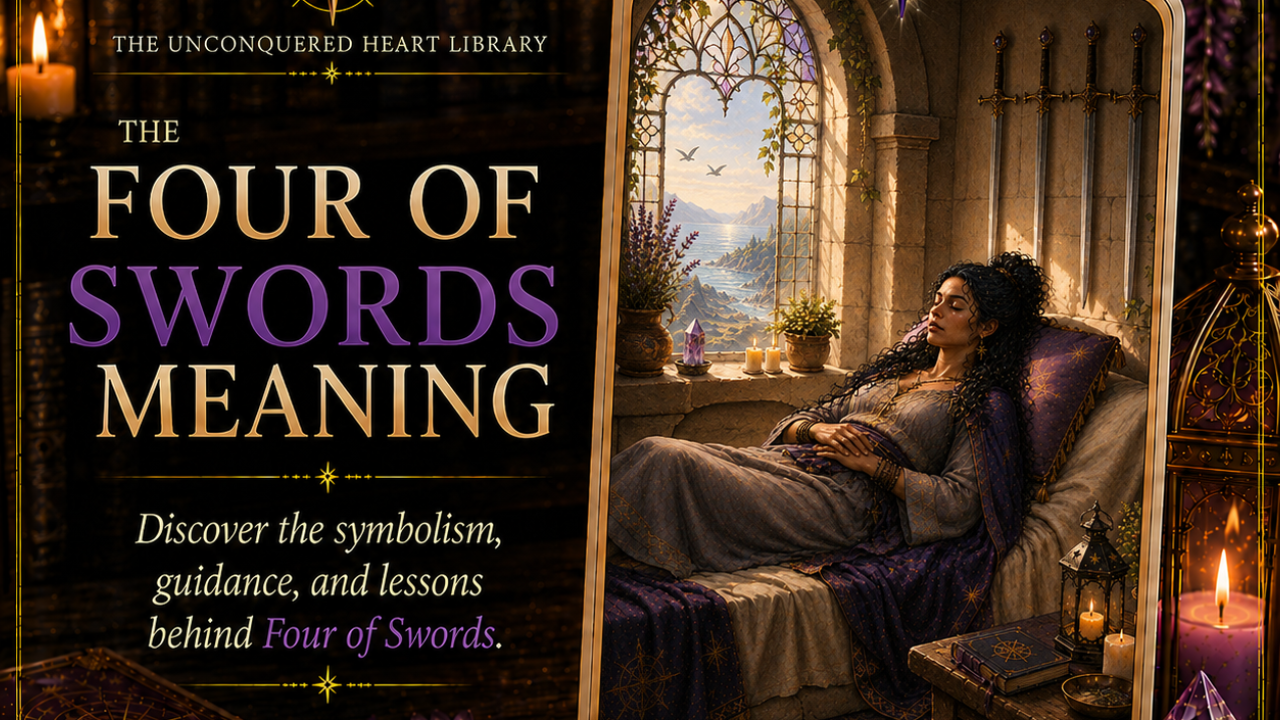
Four of Swords Tarot card showing a woman with long curly dark hair wearing a gray dress and a flowing purple cloak as she rests on a bed with her hands folded across her waist. Her eyes are closed as her head rests on a purple pillow beneath four silver swords mounted on the stone wall above her.
Sunlight streams through a tall arched stained-glass window overlooking the sea, rocky cliffs, and distant mountains, while two birds fly across the sky outside. Purple flowers, potted plants, glowing candles, and a purple crystal decorate the windowsill. A lantern, lit candle, closed book with an eight-pointed symbol on its cover, and a shallow bowl rest on a wooden table beside the bed.
Purple blankets embroidered with golden compass designs drape across the bed, while a matching cushion rests on the floor below.
The Four of Swords
The Four of Swords represents rest, recovery, contemplation, mental stillness, and the importance of stepping away from activity when we need time to restore ourselves. Following the emotional pain and difficult realizations associated with the Three of Swords, this card introduces a period of quiet in which we can allow our minds and bodies to recover from the demands placed upon them. It reminds us that constant activity is not necessary for meaningful progress and that sometimes the most appropriate response to a situation is to stop engaging with it for a while.
Whether you are recovering from a difficult experience, feeling overwhelmed by responsibilities, working through a complicated decision, or simply recognizing that you need a break, the Four of Swords encourages you to make room for rest without treating it as a failure of discipline or ambition. You do not have to earn the right to pause by reaching a particular level of exhaustion. Rest is a normal and necessary part of living, and it can be valuable even when there is nothing specific you are trying to recover from.
The Four of Swords in the Rider-Waite-Smith Tarot
In the Rider-Waite-Smith Tarot, a figure lies upon a stone tomb inside what appears to be a church or chapel. The figure's hands are folded in a position resembling prayer, while three swords hang on the wall above and a fourth sword is carved into the side of the tomb. A stained-glass window illuminates the space, depicting figures within a religious scene. The setting is quiet and removed from the activity of the outside world.
The tomb imagery can initially appear unsettling, but the Four of Swords is generally understood as representing temporary withdrawal, rest, and contemplation rather than literal death. The reclining figure has stepped away from ordinary activity, while the swords remain present without being actively used. This arrangement suggests that the concerns, decisions, or intellectual demands associated with the suit of Swords have not necessarily disappeared. Instead, the figure is taking time away from engaging with them.
The stained-glass window introduces a contemplative or spiritual dimension to the card. The quiet environment creates space for reflection, prayer, meditation, or simply being still without external demands. Following the conflict and emotional pain of the Three of Swords, the Four offers an opportunity to recover before returning to the challenges of everyday life. Its message is not that every problem has been resolved, but that we do not have to remain actively engaged with every problem at every moment.
Upright Meaning
The Four of Swords is a card of rest, recovery, relaxation, contemplation, and temporarily withdrawing from demanding situations. It often appears when you have been dealing with stress, conflict, emotional difficulties, illness, or sustained mental effort and would benefit from reducing your responsibilities or allowing yourself time to recover. The card may also suggest taking a break from an ongoing project, postponing a nonessential decision, or creating quiet space in which you can think without constant interruptions.
When the Four of Swords appears upright, it encourages you to recognize the value of stepping away rather than continually pushing yourself to accomplish more. Rest can take many forms, including sleep, quiet reflection, enjoyable activities, time away from stressful environments, or simply having fewer demands placed upon your attention. What feels restorative will depend on your circumstances, and the card does not suggest that everyone needs the same kind of rest. Sometimes recovery involves stillness, while at other times it may involve spending time doing something entirely different from what has been exhausting you.
The Four of Swords also reminds us that rest does not have to be justified by future productivity. You may return to your responsibilities with greater clarity or energy, but that is not the only reason to take a break. Your comfort, health, and well-being matter independently of what you accomplish afterward. The card encourages you to recognize your own needs and make thoughtful choices about how you use your time and energy, including when those choices involve doing less.
Reversed Meaning
Reversed, the Four of Swords can suggest difficulty resting, ongoing mental exhaustion, or a period of withdrawal that is no longer serving its intended purpose. You may recognize that you need a break but struggle to disengage from responsibilities, worries, or expectations. Even when you have an opportunity to rest, your thoughts may remain occupied with everything you believe you should be doing, preventing you from fully enjoying the time available.
The reversed Four can also appear when rest has become difficult to distinguish from avoidance or isolation. You may have stepped away from a challenging situation for understandable reasons but now feel uncertain about how or when to reengage. In other circumstances, you may be returning to activity before you have had enough time to recover, particularly if external demands or personal expectations make it difficult to acknowledge your limits. The card can represent either extreme, depending on the circumstances.
Rather than assuming that you should immediately become more active or withdraw further, the reversed Four of Swords invites you to examine what kind of restoration you actually need. You may benefit from stronger boundaries, fewer obligations, more satisfying forms of rest, additional support, or a gradual return to activities that matter to you. The goal is not to achieve a perfect balance between activity and inactivity, but to develop a relationship with rest that responds to your circumstances rather than being governed entirely by guilt, fear, or external expectations.
The Four of Swords in The Unconquered Heart Tarot
In the Rider-Waite-Smith Tarot, the Four of Swords presents a reclining figure upon a stone tomb, surrounded by swords and religious imagery. The setting emphasizes withdrawal from ordinary activity and the quiet contemplation that can follow a difficult experience. The Unconquered Heart Tarot preserves the resting figure and the presence of four swords while replacing the tomb with a comfortable bed in a peaceful room overlooking the sea.
This change makes the experience of rest feel more accessible and inviting. The woman is not lying upon a monument associated with death or sacrifice. She is resting in a space designed for comfort, surrounded by soft fabrics, warm light, and familiar objects. Her surroundings suggest that rest can be something we intentionally create room for rather than something that happens only when circumstances force us to stop.
The four swords mounted on the wall are particularly meaningful because they are no longer being carried or used. The woman has not lost her ability to think, analyze, communicate, or make decisions. Those abilities remain available to her, but she has temporarily set them aside. This distinction matters because we sometimes behave as though every problem requires our constant attention. The Four of Swords reminds us that stepping away from a concern does not necessarily mean abandoning it.
The closed book beside her reinforces the same idea. Learning, planning, researching, and seeking understanding can all be valuable activities, but there are times when we have absorbed enough information for the moment. We do not always need another explanation, another strategy, or another attempt to make sense of what happened. Sometimes the most useful thing we can do is allow ourselves to stop thinking about a subject for a while, even if we have not reached a satisfying conclusion.
Beyond the window, the sea, mountains, birds, and sunlight create a world that continues without requiring the woman's participation. She does not need to monitor everything happening outside, respond to every development, or make herself available simply because other people are active. The world remains there, and she can return to it when she chooses or when her circumstances require it. For now, she is allowed to experience the quiet of her own space.
The candles, flowers, and other objects surrounding her also suggest that rest can be an enjoyable experience rather than merely the absence of work. Comfort, beauty, warmth, and peaceful surroundings can contribute to our quality of life without needing to accomplish anything beyond making the present moment more pleasant. The Four of Swords invites us to consider whether we have made room for these experiences or have come to regard them as rewards that must be earned through productivity.
In The Unconquered Heart Tarot, the Four of Swords represents the freedom to pause without losing our sense of purpose or personal worth. The woman has not surrendered her abilities, responsibilities, or connection to the world. She has simply chosen not to engage with them at this moment. The card reminds us that rest is not the opposite of living fully. It is one of the ways we participate in a life that includes comfort, recovery, enjoyment, and care for ourselves.
Tarot Therapy Perspective
In Tarot Therapy, the Four of Swords invites us to examine our beliefs about rest, productivity, and personal worth. Many people grow up receiving messages that being busy is admirable, that effort should be constant, or that time spent doing nothing is somehow wasted. These beliefs can become so familiar that we no longer recognize them as assumptions. The Four encourages us to consider whether our relationship with rest reflects our actual needs or expectations we have absorbed from other people and environments.
This card can be especially useful when exploring the difference between rest and the pressure to recover quickly. After a stressful experience, illness, loss, or period of sustained effort, we may expect ourselves to return to our usual level of activity according to a schedule that has little to do with how we actually feel. We may become frustrated when recovery takes longer than anticipated or interpret a continuing need for rest as evidence that we are not trying hard enough. The Four of Swords encourages us to approach these experiences with greater flexibility and recognize that our needs may change from one day to another.
Another important consideration involves the ways we attempt to rest. Some people find quiet environments restorative, while others enjoy music, conversation, entertainment, creative activities, or time outdoors. A person may need physical rest while still enjoying intellectual stimulation, or may have enough physical energy for an activity but feel mentally overwhelmed by additional decisions. The Four invites us to become curious about what actually restores us rather than assuming that rest must look a particular way.
The card can also help us recognize when guilt or anxiety prevents us from enjoying the time we have set aside. We may stop working but continue mentally reviewing unfinished tasks, anticipating future demands, or criticizing ourselves for not accomplishing more. In these situations, the challenge is not simply finding time to rest. It may also involve reconsidering the beliefs that make rest feel undeserved or unsafe. Exploring those beliefs can help us develop more supportive expectations around our time and energy.
Ultimately, the Four of Swords reminds us that our lives are not measured solely by what we produce, solve, or accomplish. Rest can be necessary for recovery, but it can also be pleasurable, peaceful, and worthwhile for its own sake. We are allowed to create space for comfort and stillness without turning every moment into preparation for the next responsibility.
Want to learn how to use Tarot as a practical tool for insight and change - for yourself and others? Become a Certified Tarot Therapy Practitioner here.
Reflection Question
Where in my life am I treating rest as something I have to earn, and what might change if I recognized it as a worthwhile part of living?
Consider the expectations you place upon yourself around productivity, responsibility, and taking breaks. Reflect on what genuinely helps you feel restored and whether there are ways to make more room for those experiences without requiring yourself to justify them through future accomplishments.
Continue Your Journey
This page introduces the core meaning of The Four of Swords and the symbolism of the Rider-Waite-Smith Tarot.
If you'd like to explore this card in greater depth including advanced symbolism, colors, love and relationship readings, career and business interpretations, timing, associated crystals, and practical reading techniques, those topics are covered in Tarot Symbols & Meanings.