Five of Wands Tarot Card Meaning
Image Description from the Unconquered Heart Tarot Card Above
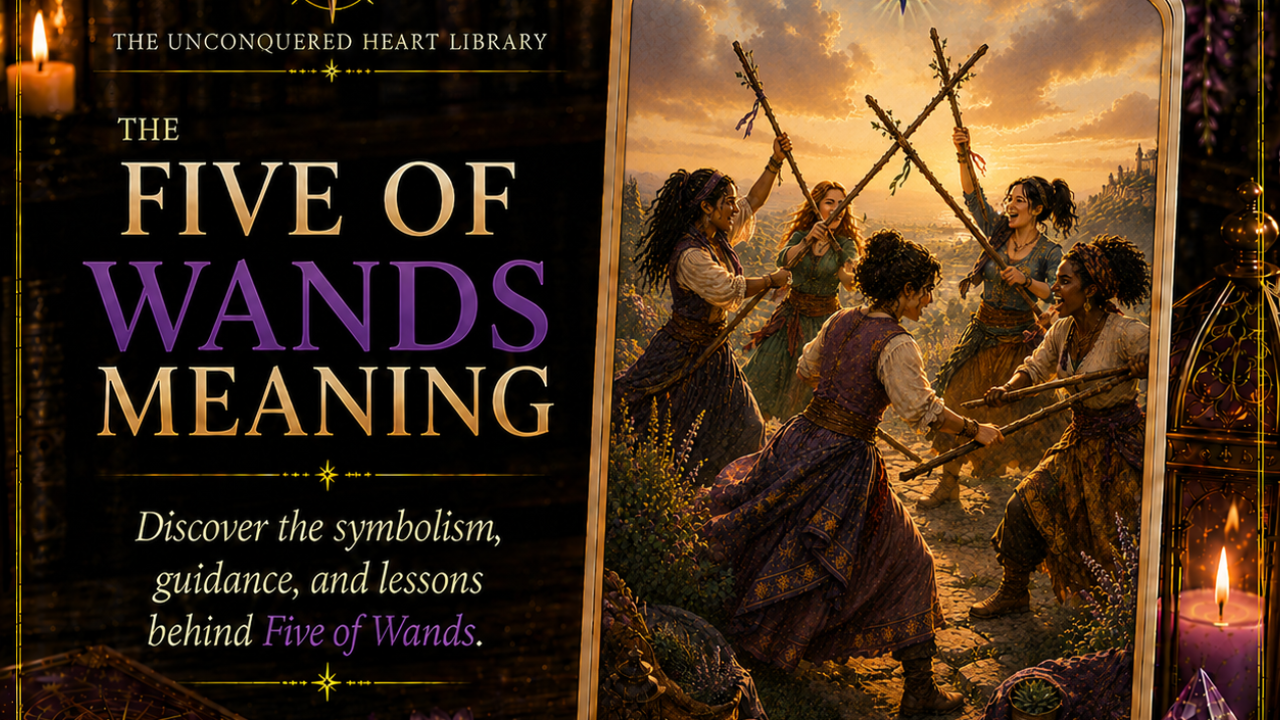
Five of Wands Tarot card showing five women laughing as they playfully cross tall wooden wands in a friendly mock battle beneath a warm golden sky. They wear colorful dresses in shades of purple, cream, green, and blue with embroidered details, scarves, and leather belts. Three women raise their wands overhead while two cross theirs at chest height, creating a circle of movement and energy. Flowering plants line the stone path where they stand, while a lantern, lit candle, potted succulent, and purple crystal rest nearby. Rolling hills, a distant castle, and a broad valley stretch across the landscape beneath soft golden light.
The Five of Wands
The Five of Wands represents competition, disagreement, conflicting ideas, challenges, and the energy that emerges when different people or priorities come together. It often appears when there are competing opinions, multiple approaches to a situation, or circumstances that require us to assert ourselves while navigating the interests of others. Although the card is frequently associated with conflict, that conflict does not necessarily have to be hostile or destructive.
Following the celebration and stability of the Four of Wands, the Five introduces movement, friction, and the possibility of change. Even within supportive relationships and successful communities, people have different personalities, goals, perspectives, and ways of approaching problems. The Five of Wands encourages us to consider how we respond to these differences and whether competition or disagreement might create opportunities for learning, growth, creativity, or improvement.
The Five of Wands in the Rider-Waite-Smith Tarot
In the Rider-Waite-Smith Tarot, five young men stand together in an open landscape, each holding a long wooden wand. Their wands cross at different angles, creating a chaotic arrangement that suggests competition, disagreement, or a struggle to establish control. The figures wear different colors and appear to be moving independently, with little indication that they are coordinating their actions toward a shared objective.
Despite the apparent conflict, the scene does not clearly depict a violent confrontation. The figures are not visibly injured, and their movements could represent a competition, practice exercise, or spirited disagreement rather than an actual battle. The ambiguity is important because it suggests that conflict exists along a spectrum. What appears chaotic or confrontational from the outside may be a relatively harmless exchange of energy, ideas, or abilities.
The crossed wands emphasize the difficulty of bringing different intentions together. Each person has something to contribute, but their individual actions create interference rather than a unified direction. The card can therefore represent the challenges of teamwork, competition for recognition, conflicting priorities, or disagreements about how something should be accomplished. At the same time, the energy of the scene suggests that these challenges may provide opportunities to develop skills, clarify positions, and discover more effective ways of working with others.
Upright Meaning
The Five of Wands is a card of competition, disagreement, conflicting priorities, and the challenges that arise when different people or perspectives interact. It may appear when you are involved in a spirited discussion, competing for an opportunity, working with people who have different ideas, or trying to navigate a situation in which several interests are competing for attention. The card can also reflect internal conflict when you are considering multiple possibilities or struggling to decide which direction deserves your energy.
When the Five of Wands appears upright, it encourages you to distinguish between conflict that creates problems and challenges that encourage growth. Competition can motivate us to develop our abilities, improve our performance, and explore possibilities we might otherwise overlook. Disagreement can introduce new information, reveal assumptions, and help us understand perspectives different from our own. However, these benefits depend partly on how we participate. Competition that encourages improvement is very different from competition driven by insecurity, hostility, or a desire to undermine someone else.
This card invites you to consider what you are trying to accomplish and whether the current exchange is helping you move toward that goal. You may need to speak up, defend an idea, establish a boundary, or participate more actively in a challenging situation. Alternatively, you may discover that not every disagreement requires your involvement. The Five of Wands reminds us that we can engage confidently with different perspectives without treating every difference as a personal threat or every competition as something we must win.
Reversed Meaning
Reversed, the Five of Wands can suggest unresolved tension, avoidance of necessary disagreements, unproductive competition, or exhaustion from ongoing conflict. You may feel overwhelmed by competing demands, frustrated by people who refuse to cooperate, or tired of situations in which every decision becomes an argument. In some cases, the reversed card reflects an environment where people are more interested in proving themselves right than in finding workable solutions.
The reversed Five of Wands can also appear when you are reluctant to participate in competition or disagreement, even when doing so might be beneficial. You may hesitate to share an opinion, challenge an assumption, pursue an opportunity, or advocate for your needs because you want to avoid tension. While choosing not to engage can sometimes be wise, consistently avoiding conflict may prevent important issues from being addressed or leave you feeling that your perspective does not matter.
Rather than assuming that all conflict should be eliminated, the reversed Five of Wands encourages you to examine how disagreements are being handled. Some situations may benefit from clearer communication, better boundaries, or a willingness to consider different approaches. Others may require stepping away from competition that has become unnecessarily draining or harmful. The goal is not to agree with everyone or avoid every challenge, but to recognize which interactions are productive and which are consuming energy without creating meaningful progress.
The Five of Wands in The Unconquered Heart Tarot
In the Rider-Waite-Smith Tarot, five young men cross their wooden wands in a scene that suggests competition, disagreement, and chaotic activity. Their individual movements create an atmosphere of confusion, leaving us uncertain whether they are fighting, practicing, or simply struggling to coordinate their efforts. The Unconquered Heart Tarot preserves the energetic interaction between five people while making the playful possibilities of the scene much more apparent.
Here, five women gather on a stone path overlooking a beautiful valley beneath a warm golden sky. Each holds a wooden wand, and together they create a lively arrangement of crossed branches as they participate in what appears to be a friendly mock battle. Their colorful clothing, animated expressions, and enthusiastic movements give the scene a sense of excitement rather than hostility. They are challenging one another, but they also appear to be enjoying the experience.
This distinction is central to the card's interpretation. Competition is often presented as a situation in which one person's success requires another person's failure. Yet competition can also provide an opportunity to practice skills, discover abilities, experiment with strategies, and become more capable. People who compete in sports, games, creative activities, or professional settings may genuinely enjoy the challenge while respecting and appreciating their competitors.
The women in this card demonstrate that disagreement and competition do not automatically threaten connection. We can have different opinions, pursue different goals, or challenge one another's ideas while continuing to value the people involved. In fact, relationships can sometimes become more interesting and rewarding when people feel comfortable expressing themselves rather than constantly trying to maintain agreement.
Their crossed wands also suggest the energy created when multiple perspectives interact. Each woman brings her own movements, timing, and approach to the activity. No single participant appears to be directing the entire group, and the resulting arrangement is lively, unpredictable, and somewhat chaotic. Yet that unpredictability is part of what makes the experience engaging. If everyone moved in exactly the same way, there would be very little challenge.
This can be particularly relevant when we encounter people whose ideas differ from our own. It is easy to assume that disagreement indicates someone is mistaken, unreasonable, or deliberately difficult. Sometimes that may be true, but often people simply have different experiences, priorities, information, or ways of interpreting a situation. Encountering those differences can encourage us to examine our own assumptions, articulate our ideas more clearly, and consider possibilities we had not previously recognized.
The Five of Wands also raises questions about the difference between cooperation and conformity. Working well with others does not require everyone to think alike or approach every situation in the same way. A group can benefit from people who ask challenging questions, suggest alternatives, identify potential problems, or introduce unconventional ideas. What matters is whether those differences are handled in ways that contribute to the shared experience rather than undermining the people involved.
The women's expressions suggest that they understand the nature of their activity. They appear to be participating willingly, and the challenge is part of the enjoyment. This introduces an important distinction between healthy competition and situations where people are pressured, intimidated, or treated unfairly. A playful challenge depends on a shared understanding of what is happening and a reasonable degree of respect for everyone involved. When those conditions disappear, the same activity can become unpleasant or harmful.
The setting reinforces the possibility that challenges can take place within an otherwise enjoyable life. The women are surrounded by flowers, warm sunlight, and a beautiful landscape. Their competition is not presented as evidence that something has gone terribly wrong. Instead, it is one of the activities through which they are interacting with the world and one another. Challenges and disagreements are ordinary parts of human experience, and they do not have to overshadow everything else that is going well.
The card also encourages us to reconsider our relationship with winning and losing. Winning can be satisfying, and there is nothing inherently wrong with wanting to succeed. However, competition can provide value even when we do not achieve the outcome we hoped for. We may develop a skill, learn something useful, discover a new strategy, or simply enjoy participating. If our only measure of success is whether we defeated someone else, we may overlook much of what the experience has to offer.
There is also room here for friendly rivalry. Many people enjoy relationships in which they can challenge one another through games, debates, shared interests, or personal goals. A little competition can introduce humor, motivation, and excitement into familiar activities. The important question is whether everyone involved continues to find the interaction rewarding. What feels playful to one person may feel uncomfortable to another, making communication and mutual respect essential.
The Five of Wands in The Unconquered Heart Tarot reminds us that we do not have to eliminate differences in order to enjoy one another, and we do not have to turn every challenge into a battle. Competition can be stimulating, disagreement can be informative, and conflicting perspectives can lead to creative solutions. Sometimes the most valuable outcome is not proving that we were right, but discovering what becomes possible when different people bring their energy and ideas into the same space.
Tarot Therapy Perspective
In Tarot Therapy, the Five of Wands provides an opportunity to explore our relationship with competition, disagreement, self-expression, and the ways we respond when other people's priorities or perspectives differ from our own. Conflict is a normal part of relationships, communities, and personal development, but our experiences can strongly influence whether we approach it with curiosity, confidence, anxiety, defensiveness, or avoidance.
One useful area of reflection involves the meanings we assign to disagreement. Some people experience differences of opinion as interesting opportunities for discussion, while others interpret them as signs of rejection, disrespect, or impending conflict. These responses may develop through earlier relationships, family expectations, cultural influences, or previous experiences with competition. The Five invites us to examine whether our current reactions reflect what is actually happening or whether we are responding partly to expectations developed in other circumstances.
The card can also help us distinguish between healthy competition and interactions that have become unnecessarily adversarial. Competition may encourage learning, improvement, and motivation when participants have reasonable opportunities to succeed and understand the expectations involved. However, it can become destructive when people feel compelled to undermine others, conceal information, or measure their personal worth entirely through comparison. The Five encourages us to consider whether a competitive situation is helping us develop or creating pressures that interfere with our well-being.
Another important area involves our willingness to express different opinions. We may hesitate to disagree with people we care about because we fear damaging the relationship or creating discomfort. Alternatively, we may become so invested in defending our perspective that we struggle to consider what someone else is saying. The Five provides an opportunity to explore how we can communicate clearly, remain open to new information, and maintain respect without abandoning our own judgment.
The card is particularly useful when examining group dynamics. Families, workplaces, friendships, and communities often include people with different personalities, interests, priorities, and communication styles. These differences can enrich the group, but they can also create frustration when expectations are unclear or individuals feel unheard. The Five invites us to consider whether the people involved are working toward compatible goals, whether everyone has an opportunity to contribute, and whether disagreements are being addressed constructively.
The Five of Wands can also represent competing priorities within ourselves. We may want several things that cannot all receive equal attention, or we may feel torn between different responsibilities, interests, and possibilities. These internal disagreements do not necessarily indicate that something is wrong. They may simply reflect the complexity of our needs and values. The card encourages us to identify the different considerations involved and determine whether they can coexist, be balanced, or require a conscious choice.
Another area of reflection involves our expectations about winning, losing, and personal achievement. We may have learned to measure success through comparison, believing that being the best, finishing first, or outperforming others determines our value. This perspective can make ordinary challenges feel much more threatening than they need to be. The Five invites us to consider whether competition could become more enjoyable and useful if we also recognized learning, participation, improvement, and personal satisfaction as meaningful outcomes.
The playful quality of the Unconquered Heart Tarot image also creates an opportunity to examine whether we allow ourselves to enjoy challenges. Not every difficult task needs to be approached with seriousness or anxiety. Games, friendly debates, creative experiments, and shared problem-solving can provide opportunities to develop skills while having fun. The card encourages us to consider whether humor, curiosity, or a willingness to experiment might change our experience of a situation that currently feels frustrating.
At the same time, the Five reminds us that we have choices about where to invest our energy. Some disagreements deserve attention because they involve important values, practical consequences, or relationships we want to maintain. Others may be little more than distractions. We can participate in challenges that interest us, advocate for ourselves when necessary, and choose not to engage in conflicts that offer little possibility of a useful outcome.
Ultimately, the Five of Wands invites us to develop a more flexible relationship with competition and disagreement. We do not need to seek conflict for its own sake, but neither must we interpret every challenge as something to fear or avoid. By approaching differences with curiosity, discernment, and respect, we may discover that the energy created by competing perspectives can become a source of learning, creativity, confidence, and connection.
Want to learn how to use Tarot as a practical tool for insight and change - for yourself and others? Become a Certified Tarot Therapy Practitioner here.
Reflection Question
How might I approach a current disagreement or challenge with more curiosity and less concern about winning?
Consider a situation involving competition, conflicting opinions, or different priorities. Reflect on what you hope to accomplish, what you might learn from the other people involved, and whether there is an approach that allows you to express yourself confidently while remaining open to new possibilities.
Continue Your Journey
This page introduces the core meaning of The Five of Wands and the symbolism of the Rider-Waite-Smith Tarot.
If you'd like to explore this card in greater depth, including advanced symbolism, colors, love and relationship readings, career and business interpretations, timing, associated crystals, and practical reading techniques, those topics are covered in Tarot Symbols & Meanings.