Five of Swords Tarot Card Meaning
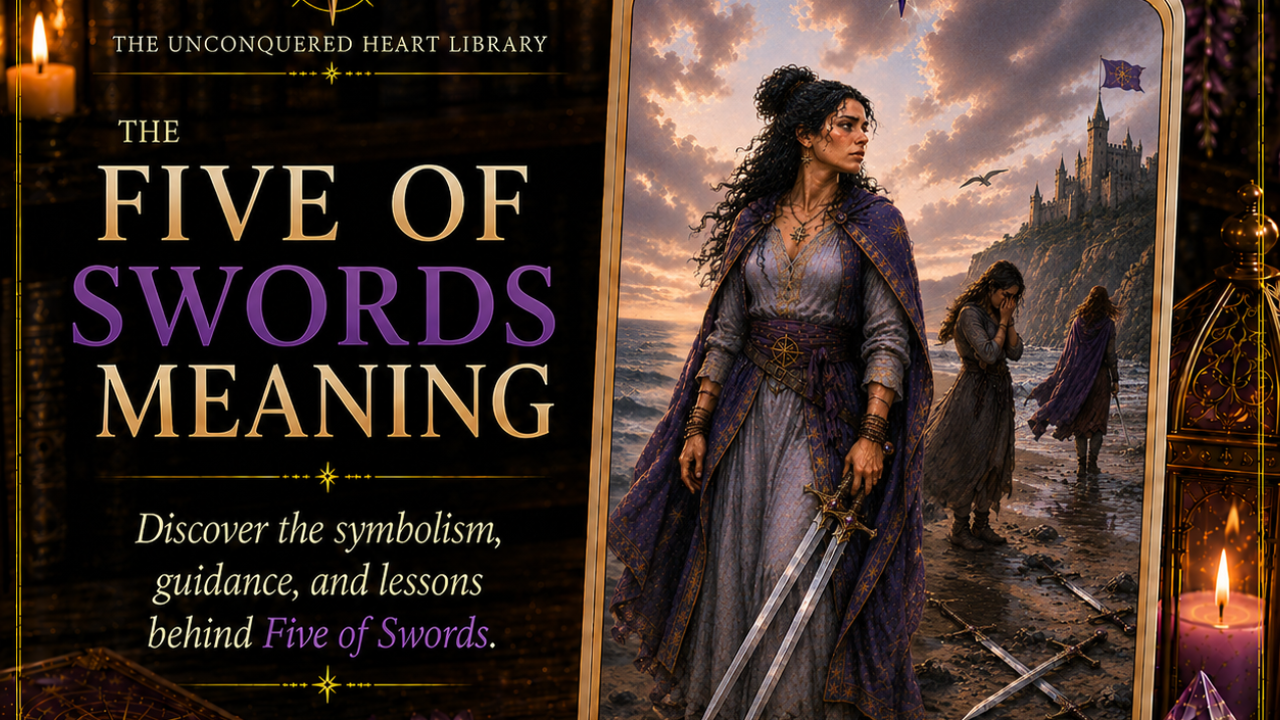
Image Description from the Unconquered Heart Tarot Card Above
Five of Swords Tarot card showing a woman with long curly dark hair wearing a gray dress and a flowing purple cloak as she stands on a rocky shoreline holding two swords in one hand. She looks off into the distance while her cloak drapes around her and the waves roll onto the beach beside her.
Behind her, another woman stands with her face buried in her hands, while a third woman walks away along the shoreline with a purple cloak flowing behind her and a sword hanging at her side. Three swords lie crossed on the sand near their feet.
A castle rises on the cliffs overlooking the sea, with a flag bearing an eight-pointed compass flying from one of its towers. A bird glides through the sky beneath layered clouds as sunlight breaks through clouds above the coastline.
The Five of Swords
The Five of Swords represents conflict, competition, disagreements, difficult victories, and the consequences of how we pursue our goals. As part of the suit of Swords, it explores the ways our thoughts, words, beliefs, and decisions can bring us into conflict with other people. The card often appears when competing interests or perspectives have created tension, particularly when the desire to win, defend a position, or prove a point has become an important part of the situation.
Whether you are navigating a disagreement, dealing with a competitive environment, defending a boundary, or reconsidering the outcome of a recent conflict, the Five of Swords encourages you to look beyond the immediate question of who won. It asks you to consider what the conflict was actually about, what was gained or lost, and whether the outcome supports the things that matter most to you. Not every disagreement can end with everyone satisfied, but understanding the consequences of our choices can help us decide how we want to approach conflict in the future.
The Five of Swords in the Rider-Waite-Smith Tarot
In the Rider-Waite-Smith Tarot, a man stands in the foreground holding three swords while two additional swords lie on the ground. He looks back toward two figures who are walking away, one of whom appears distressed. His expression suggests satisfaction or smugness, while the figures in the background seem defeated or unwilling to continue the confrontation. Behind them, the sea stretches beneath an unsettled sky filled with jagged clouds.
The swords represent the intellectual and verbal aspects of conflict, including arguments, competing beliefs, strategic decisions, and the ways people attempt to establish an advantage over one another. The central figure has gathered more swords than the others, suggesting that he has gained something from the encounter. Yet the reactions of the departing figures complicate the meaning of that success. He may have won the confrontation, but the image raises questions about the methods used and the consequences for everyone involved.
The card's setting also emphasizes that the conflict has reached a turning point. The confrontation itself appears to be over, leaving the participants to respond to what happened. The central figure must decide what his victory means, while the others are choosing to leave rather than continue engaging. The Five of Swords reminds us that winning an argument, gaining an advantage, or forcing a particular outcome does not necessarily resolve the underlying problem. Sometimes the consequences of a conflict become clearer only after the immediate struggle has ended.
Upright Meaning
The Five of Swords is a card of conflict, competition, disagreements, strategic thinking, and the consequences of pursuing victory. It often appears when you are involved in an argument, facing opposition, navigating workplace politics, or dealing with someone whose goals or priorities conflict with your own. The card may represent a situation in which one person is determined to win regardless of the consequences, but it can also describe a legitimate disagreement where the participants have different needs and no solution will satisfy everyone completely.
When the Five of Swords appears upright, it encourages you to examine what you are trying to accomplish through the conflict. Are you protecting something important, establishing a necessary boundary, seeking a fair outcome, or attempting to resolve a genuine problem? Or has the disagreement become more about proving yourself right, maintaining control, or preventing someone else from succeeding? The distinction matters because conflict can be constructive when it serves a meaningful purpose, but it can become unnecessarily destructive when winning becomes more important than the original issue.
The Five also reminds us that avoiding conflict is not always the wisest or most compassionate choice. There are situations in which standing up for yourself, challenging unfair treatment, or refusing to cooperate with harmful behavior will create tension. Someone else's disappointment or anger does not automatically mean you have acted incorrectly. The card encourages you to consider both your methods and your priorities, recognizing that a worthwhile outcome may still involve difficult conversations, uncomfortable decisions, or consequences you cannot completely prevent.
Reversed Meaning
Reversed, the Five of Swords can suggest unresolved conflict, lingering resentment, difficulty moving beyond a disagreement, or a changing attitude toward competition and confrontation. You may be replaying an argument in your mind, struggling to accept an outcome, or continuing to invest energy in a dispute that no longer serves a useful purpose. In other situations, the reversed card may indicate that you are beginning to reconsider how you approach conflict and whether your usual strategies are producing the results you want.
The reversed Five can also appear when someone is avoiding necessary confrontation because they fear disagreement, rejection, or the possibility of damaging a relationship. You may be giving up something important simply to maintain peace, accepting an unfair arrangement, or allowing another person's preferences to determine decisions that affect you. Conversely, you may be trying to repair a relationship after a conflict without fully addressing the circumstances that created it. Reconciliation can be valuable, but it does not require ignoring legitimate concerns or pretending that everyone contributed equally to the problem.
Rather than assuming that every disagreement must be resolved through compromise or that every conflict requires a winner, the reversed Five of Swords invites you to reconsider what a satisfactory outcome would actually look like. You may need to communicate more clearly, establish firmer boundaries, acknowledge a mistake, disengage from an unproductive dispute, or accept that another person will not agree with your decision. The goal is to respond intentionally rather than allowing pride, resentment, fear, or the desire for approval to determine your next move.
The Five of Swords in The Unconquered Heart Tarot
In the Rider-Waite-Smith Tarot, the Five of Swords presents a figure who appears pleased with his victory while two others retreat from the confrontation. The Unconquered Heart Tarot preserves the aftermath of conflict but changes the emotional emphasis. Here, the woman holding the swords looks toward the distance with a serious expression, while one woman is visibly distressed and another walks away. The scene invites us to consider not simply who won, but what the encounter meant to each person involved.
The central woman's expression is particularly important because it leaves room for several interpretations. She may have achieved something she wanted but discovered that the outcome feels less satisfying than she expected. She may be questioning whether the disagreement was worth its consequences. Alternatively, she may have defended something important and now be accepting the fact that doing so has upset other people. The card does not tell us whether her actions were justified, and that uncertainty encourages us to examine the circumstances rather than immediately assigning blame.
The two women behind her also remind us that people can experience the same conflict very differently. One appears overwhelmed by what happened, while the other has chosen to leave. Their responses do not necessarily tell us who was right or wrong. Someone can be deeply upset by a fair decision, just as someone can walk away from an unfair situation because continuing the argument would accomplish nothing. Emotional reactions are important information, but they do not automatically establish the moral or practical merits of a disagreement.
The swords left on the ground introduce another dimension to the idea of victory. Not every available weapon needs to be picked up, and not every opportunity to continue a conflict deserves our attention. We can choose which arguments are worth pursuing, which points need to be made, and when further confrontation is unlikely to produce anything useful. Knowing when to stop can be a form of strategic judgment rather than surrender.
The castle overlooking the shoreline adds a broader perspective to the scene. Whatever happened between these women, their conflict exists within a larger world of relationships, responsibilities, opportunities, and ongoing concerns. A disagreement that feels all-consuming in the moment may eventually become one experience among many. This does not diminish its importance, but it encourages us to consider whether the energy we are investing in a particular conflict is proportionate to what is actually at stake.
The Five of Swords also raises questions about the relationship between winning and being right. We can win an argument through superior reasoning, but we can also win because we are more persistent, more aggressive, better prepared, or simply in a position of greater power. Likewise, losing a confrontation does not necessarily mean that our position lacked merit. The outcome of a conflict and the validity of the ideas involved are two different things, and confusing them can lead us to draw conclusions that the experience does not support.
In The Unconquered Heart Tarot, the Five of Swords encourages us to develop a more thoughtful relationship with conflict. We do not have to avoid every disagreement, surrender important boundaries, or make everyone happy in order to act with integrity. We can stand up for ourselves, pursue meaningful goals, and accept that some conflicts will have uncomfortable consequences. What matters is understanding why we are fighting, how we are choosing to fight, and whether the outcome is worth what we are giving to achieve it.
Tarot Therapy Perspective
In Tarot Therapy, the Five of Swords invites us to examine our beliefs about conflict, competition, and the need to be right. Our responses to disagreement are often shaped by earlier experiences, including how conflict was handled in our families, relationships, workplaces, and communities. Some people learn that disagreement is dangerous and should be avoided whenever possible, while others come to associate winning arguments with competence, respect, or personal worth. The Five encourages us to consider how these patterns influence our present decisions.
One useful area of exploration involves distinguishing between defending a position and defending our identity. We may become so attached to being correct that acknowledging another person's perspective feels like admitting personal failure. In other situations, we may abandon a reasonable position because disagreement makes us feel rejected or unsafe. The Five of Swords encourages us to recognize that our worth does not depend upon winning every argument, and that changing our minds when presented with better information can be a demonstration of sound judgment rather than weakness.
The card can also help us examine how we determine whether a conflict is worthwhile. Before engaging in a difficult conversation, we might consider what we hope to accomplish, what outcomes are realistically possible, and what consequences we are willing to accept. Sometimes the goal is to reach an agreement or repair a misunderstanding. At other times, it may be to communicate a boundary, challenge unfair treatment, or make a decision that another person will not support. Recognizing the purpose of the conflict can help us choose an approach that reflects our actual priorities.
Another important consideration is the difference between responsibility and blame. When a disagreement ends badly, we may feel pressure to identify one person as entirely right and another as entirely wrong. Yet conflicts can involve misunderstandings, competing needs, unequal power, poor communication, or genuinely incompatible goals. Examining these factors does not require pretending that everyone behaved equally well or contributed equally to the outcome. It simply allows us to understand the situation more accurately and decide what responsibility belongs to whom.
Ultimately, the Five of Swords encourages us to become more intentional about the conflicts we choose to engage in and the methods we use to pursue our goals. We can disagree without treating another person's perspective as a threat, stand firm without becoming unnecessarily cruel, and recognize when continuing an argument would accomplish little. We can also accept that some worthwhile decisions will disappoint others. The goal is not to eliminate conflict from our lives, but to approach it with greater awareness of what matters, what is at stake, and what we genuinely hope to accomplish.
Want to learn how to use Tarot as a practical tool for insight and change - for yourself and others? Become a Certified Tarot Therapy Practitioner here.
Reflection Question
What am I trying to accomplish in a current disagreement or conflict, and is the way I am approaching it helping me achieve that goal?
Consider a situation in which you are experiencing opposition, frustration, or competing priorities. Reflect on what matters most to you, what you are willing to compromise, what you are not willing to surrender, and whether continuing the conflict is likely to produce an outcome worth pursuing.
Continue Your Journey
This page introduces the core meaning of The Five of Swords and the symbolism of the Rider-Waite-Smith Tarot.
If you'd like to explore this card in greater depth including advanced symbolism, colors, love and relationship readings, career and business interpretations, timing, associated crystals, and practical reading techniques, those topics are covered in Tarot Symbols & Meanings.