Ace of Wands Tarot Card Meaning
Image Description from the Unconquered Heart Tarot Card Above
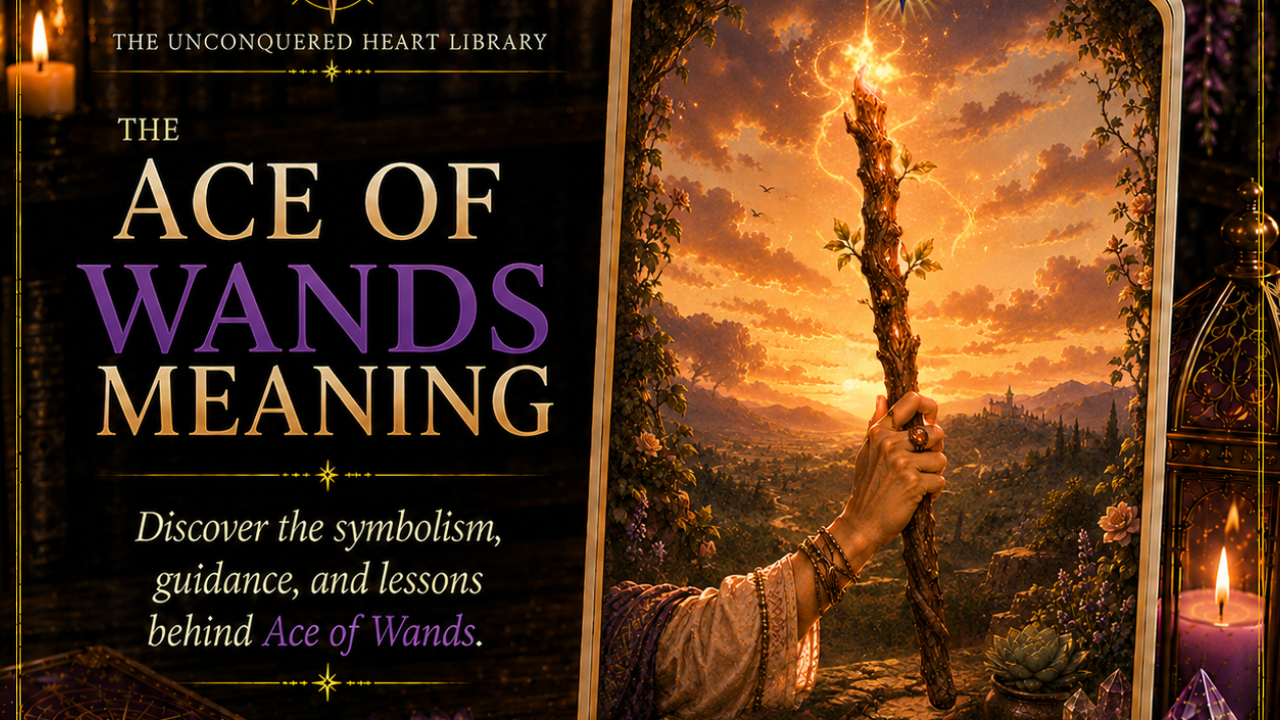
Ace of Wands Tarot card showing a hand emerging from the lower edge of the card wearing a flowing cream-colored sleeve trimmed with gold and a purple cloak as it raises a living wooden wand toward the sky. Fresh green leaves sprout from the twisting branch while flames and glowing golden light swirl around its tip.
Flowering vines frame both sides of the scene, overlooking a broad valley with winding rivers, distant villages, rolling hills, and a hilltop castle beneath a brilliant golden sunrise sky filled with glowing clouds.
A potted succulent and a cluster of purple, clear, and golden crystal points rest on a stone ledge in the foreground, while birds soar through the sky in the distance.
The Ace of Wands
The Ace of Wands represents inspiration, creativity, enthusiasm, initiative, and the excitement of discovering something new that you want to explore. As the first card in the suit of Wands, it introduces the element of Fire and the energy that encourages us to experiment, create, pursue our interests, and turn possibilities into action. The Ace often appears when an idea captures your attention, an opportunity sparks your curiosity, or you begin feeling excited about a direction you had not previously considered.
This card encourages you to pay attention to what interests and energizes you, even when you do not yet know exactly where it might lead. Inspiration does not always arrive with a complete plan or a guarantee of success. Sometimes it begins with a question, an unexpected opportunity, or the simple desire to try something because it sounds interesting. The Ace of Wands reminds us that enthusiasm can be a valuable starting point, and that exploring a possibility is often how we discover what it might become.
The Ace of Wands in the Rider-Waite-Smith Tarot
In the Rider-Waite-Smith Tarot, a hand emerges from a cloud holding a large wooden wand upright. Small green leaves sprout from the branch, suggesting vitality, growth, and the potential for something new to develop. The hand appears without a visible person attached to it, emphasizing the arrival of an opportunity or creative impulse before we know who will act upon it or what the outcome might be.
Below the wand stretches a fertile landscape of green fields, trees, and distant mountains. A castle stands on a hill, suggesting the possibility of achievement or something substantial that might eventually be built. The winding landscape also reminds us that there is a considerable distance between the first spark of inspiration and the completion of a project or goal. The Ace represents the beginning of that journey rather than its finished result.
As a symbol of Fire, the wand represents creative energy, passion, initiative, and the desire to engage actively with life. The leaves indicate that this energy has the potential to produce growth, but growth is not automatic. A promising idea still requires attention, exploration, and action if it is going to develop into something meaningful. The Ace of Wands offers the possibility of a beginning and invites us to decide what we might like to do with it.
Upright Meaning
The Ace of Wands is a card of inspiration, creativity, enthusiasm, opportunity, and new beginnings. It often appears when you discover an idea that excites you, feel motivated to begin a project, encounter a promising opportunity, or experience renewed interest in something that matters to you. This could involve artistic expression, business, education, relationships, travel, personal development, or any activity that awakens your curiosity and makes you eager to explore what might be possible.
When the Ace of Wands appears upright, it encourages you to recognize the value of that initial excitement without expecting yourself to have everything figured out immediately. You may have a general direction in mind but still need to investigate the details, develop your skills, gather resources, or experiment with different approaches. The card does not suggest that every exciting idea will become a successful venture. Instead, it reminds us that meaningful discoveries often begin because someone was interested enough to explore a possibility before knowing exactly what would happen.
This card also encourages initiative. Inspiration can be enjoyable on its own, but taking even a small step can help you determine whether an idea deserves further attention. You might research a subject, sketch out a concept, start a conversation, enroll in a class, or try something on a small scale. The Ace of Wands invites you to follow your curiosity and allow experience to inform what happens next, rather than waiting until you can predict every outcome before beginning.
Reversed Meaning
Reversed, the Ace of Wands can suggest difficulty finding inspiration, uncertainty about where to begin, or a creative impulse that has not yet developed into action. You may have several interesting ideas but struggle to choose one, feel enthusiastic about a possibility without knowing how to pursue it, or experience frustration because circumstances are preventing you from moving forward as quickly as you would like.
The reversed Ace can also appear when you are trying to force enthusiasm for something that no longer interests you. An opportunity may look promising on paper, or a project may once have excited you, but your feelings about it have changed. In other situations, you may be putting pressure on yourself to turn every interest into something productive, profitable, or impressive. That expectation can make exploration feel like another obligation rather than an opportunity to discover something enjoyable or meaningful.
Rather than assuming that you need greater motivation or discipline, the reversed Ace of Wands invites you to examine what is affecting your enthusiasm. You may need more information, a smaller starting point, additional resources, or permission to experiment without committing to a particular outcome. You may also discover that an idea is simply not right for you at this time. The card reminds us that inspiration cannot always be summoned on command, and that allowing our interests to evolve can be just as valuable as pursuing the first exciting possibility that appears.
The Ace of Wands in The Unconquered Heart Tarot
In the Rider-Waite-Smith Tarot, a hand emerges from a cloud holding a sprouting wand above a fertile landscape. The image represents the arrival of inspiration and the potential for creative energy to develop into something tangible. The Unconquered Heart Tarot preserves this central symbolism while bringing the energy of Fire more visibly into the scene.
Here, a hand raises a living wooden wand toward a brilliant golden sky. Fresh green leaves grow from its twisting branches, while flames and luminous trails of energy swirl around the upper portion of the wand. The combination of living wood and fire creates an important relationship between two qualities that are sometimes treated separately: the vitality that allows something to grow and the excitement that encourages us to begin.
The wand is not a finished object carved into a permanent shape. It remains a branch, irregular and alive, with new growth emerging from different points along its length. This suggests that inspiration does not need to arrive in a polished or fully developed form to be valuable. An idea may begin as something incomplete, unconventional, or difficult to explain. Its potential becomes clearer as we experiment with it, discover what works, and allow it to develop through experience.
The flames surrounding the wand emphasize the enthusiasm that can accompany a new discovery. There are moments when an idea seems to capture our attention almost immediately, when curiosity becomes excitement and we begin imagining possibilities we had not previously considered. That excitement can encourage us to learn, create, explore, and take risks we might otherwise avoid. Fire gives us the energy to move beyond thinking about something and begin engaging with it.
Yet fire is also an energy that changes depending on how it is used. A small flame can provide warmth and light, while an uncontrolled fire can consume resources faster than they can be replaced. The Ace of Wands does not ask us to pursue every exciting idea with unlimited intensity. It encourages us to recognize inspiration as something worth exploring while remaining attentive to the time, energy, and resources available to us. Enthusiasm can begin a journey, but it does not have to determine the pace of everything that follows.
The landscape beneath the wand is filled with possibilities. A winding river moves through the valley, villages dot the hills, and a castle rises in the distance. There is no single obvious destination that the hand must choose. Instead, the world opens outward, suggesting that one spark of inspiration can lead to many different experiences. An interest might become a hobby, a friendship, a new skill, a professional opportunity, or simply an enjoyable experience that enriches our lives. Its value does not depend entirely on whether it eventually produces something impressive.
This is one of the important distinctions in The Unconquered Heart Tarot. We often evaluate new ideas according to what they might accomplish. Could this become a business? Will it improve my skills? Could I turn it into something useful? Those questions can be worthwhile, but they are not the only reasons to pursue an interest. Sometimes we explore something because it fascinates us, makes us happy, or allows us to experience the world in a different way. Curiosity and enjoyment do not need an additional justification to have value.
The flowering vines framing the scene reinforce the idea that creativity and growth are not limited to one particular form. Some interests develop into substantial commitments, while others remain brief experiments or occasional pleasures. We may discover something we love and pursue it for years, or we may try an activity once and decide we have experienced everything we wanted from it. Neither outcome makes the original inspiration meaningless. Exploration helps us learn about the world and about ourselves, including what genuinely interests us and what does not.
The Ace of Wands in The Unconquered Heart Tarot represents the freedom to follow inspiration, explore possibilities, and discover what brings us alive without needing to know the outcome in advance. It invites us to remain curious about what we might create, experience, or become, while recognizing that the excitement of discovery can be valuable in its own right.
Tarot Therapy Perspective
In Tarot Therapy, the Ace of Wands invites us to explore our relationship with inspiration, curiosity, creativity, and the willingness to begin something new. People often develop complicated expectations about how their time and energy should be used. We may believe that an activity needs to be productive, profitable, educational, or otherwise useful to justify pursuing it. The Ace encourages us to consider whether these expectations are limiting our willingness to explore interests simply because they appeal to us.
One useful area of reflection involves noticing what genuinely captures our attention. We may have become so accustomed to responding to responsibilities, expectations, and other people's needs that we rarely ask ourselves what we would enjoy exploring. Sometimes inspiration is easy to recognize because we feel excited and immediately begin imagining possibilities. At other times, it appears as a quieter curiosity about something unfamiliar. The Ace invites us to notice these interests without immediately evaluating whether they are practical or worth pursuing.
The card can also help us examine what happens between having an idea and taking action. Some people are comfortable experimenting and learning through experience, while others feel they must understand every detail before they begin. We may fear making mistakes, wasting resources, appearing inexperienced, or discovering that something we were excited about is more difficult than we expected. These concerns can be reasonable, especially when a decision involves significant commitments. However, not every new interest requires a major investment or permanent decision. The Ace encourages us to consider whether there is a manageable way to explore a possibility and gather information through experience.
Another important area involves the expectations we place on creativity. Creative expression is sometimes treated as something reserved for people with exceptional talent or professional ambitions. Yet creativity also appears in problem-solving, communication, cooking, decorating, organizing, learning, storytelling, and the countless ways we adapt ideas to our circumstances. The Ace of Wands invites us to recognize creativity as a capacity that can be explored and developed rather than a special qualification that must be demonstrated before we are allowed to participate.
The Ace can also help us distinguish between inspiration and obligation. An idea may be exciting when it first occurs to us, but that does not mean we are required to pursue it indefinitely. We are allowed to experiment, change direction, set something aside, or discover that an interest was temporary. Sometimes people continue projects long after their enthusiasm has disappeared because they believe stopping would mean they failed or wasted their time. The Ace invites us to consider whether exploration itself provided something valuable, even when the experience did not lead to the outcome we originally imagined.
For people who have experienced long periods of stress, exhaustion, or overwhelming responsibilities, reconnecting with curiosity can be particularly meaningful. It may be difficult to identify what sounds enjoyable when so much attention has been directed toward managing circumstances or meeting obligations. In these situations, the Ace does not need to represent a dramatic new beginning. It might involve trying a different book, learning about an interesting subject, experimenting with a creative activity, or making room for a small experience that feels personally satisfying. Inspiration does not have to be intense to matter.
This card also encourages us to consider how we respond to our own enthusiasm. Do we welcome it, question it, dismiss it, or immediately turn it into another responsibility? Are there interests we avoid because we believe we are too old, too inexperienced, too busy, or not talented enough to pursue them? The Ace of Wands offers an opportunity to examine these assumptions and consider whether they reflect genuine limitations or expectations that no longer serve us.
Ultimately, the Ace of Wands reminds us that curiosity, creativity, and enthusiasm are meaningful parts of being alive. We do not have to transform every interest into an achievement or justify every enjoyable experience according to what it produces. Sometimes the most valuable thing we can do with inspiration is give ourselves permission to explore it and discover where it leads.
Want to learn how to use Tarot as a practical tool for insight and change - for yourself and others? Become a Certified Tarot Therapy Practitioner here.
Reflection Question
What idea, interest, or possibility has been capturing my attention lately, and what might happen if I gave myself permission to explore it?
Consider something that has sparked your curiosity or enthusiasm, even if you have not yet decided whether to pursue it. Reflect on what interests you about the possibility, whether you have been placing expectations on what it should become, and what small step might help you discover more about it.
Continue Your Journey
This page introduces the core meaning of The Ace of Wands and the symbolism of the Rider-Waite-Smith Tarot.
If you'd like to explore this card in greater depth including advanced symbolism, colors, love and relationship readings, career and business interpretations, timing, associated crystals, and practical reading techniques, those topics are covered in Tarot Symbols & Meanings.