10 Proven Tips For Smart Tarot Readers
Learning Tarot can feel much more complicated than it needs to be.
There are 78 cards, hundreds of possible meanings, countless spreads, reversals, symbolism, intuition - and an impressive number of people on the internet waiting to tell you that you're doing something wrong.
You're probably not.
The goal isn't to memorize every possible Tarot meaning or follow somebody else's rules perfectly. It's to become comfortable enough with the cards that you can look at a reading, explore what you're seeing, and decide what makes sense in the context of the question you're asking.
Here are 10 ways to make that easier.
1. Stop Looking for the One “Right” Way to Read Tarot
There isn't one.
Different Tarot readers use different spreads, meanings, decks, rituals, techniques, and approaches. Some read reversals. Some don't. Some use elaborate spreads. Others rarely pull more than a few cards.
Pay attention to what helps you understand your cards and get useful information from your readings.
You don't need to read Tarot exactly like someone else in order to read it well.
2. Start with One to Three Cards
You don't need to begin with a Celtic Cross.
In fact, when you're learning, a large spread can give you so much information that it becomes harder to see what the cards are actually saying.
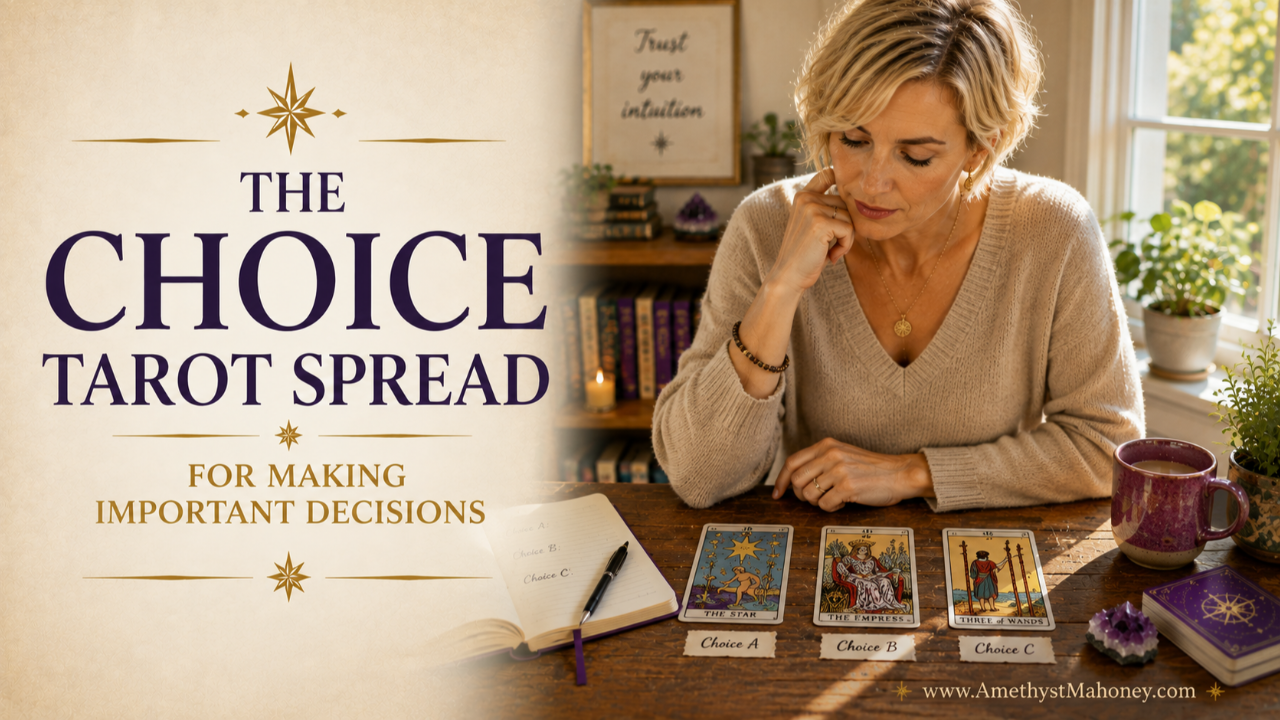
Start with one card or a simple three-card spread. Fewer cards give you more room to examine each one, think about how the cards relate to each other, and practice interpreting them without becoming overwhelmed.
And three cards don't have to mean Past, Present, Future. If you want to try something different, check out The 10 Best 3-Card Tarot Spreads Every Reader Should Know.
You can use three-card spreads for relationships, decisions, personal growth, problem-solving, daily reflection, and much more.
3. Spend Time with Your Cards Regularly
You don't have to study Tarot for hours every day.
Pull a card when you have a few minutes. Look at it before you reach for the guidebook. Ask yourself what you notice and what you think might be happening.
You might ask:
What do I need to pay attention to today?
Then write down the card and a few thoughts about it.
Look for synchronicities throughout the day and signs of what your card might mean. Take a few minutes later in the day to write down what you noticed, how it related to your initial thoughts, and whether or not you changed your mind about the card meaning.
4. Don't Panic When Your Brain Goes Blank
One of the strangest things about learning Tarot is that you can study the cards, know their meanings, and then completely forget everything the second you actually draw one in a reading.
Suddenly your brain goes blank, and you think,
"I don't know what this means!"
This happens to a lot of Tarot readers, especially when they're still building confidence. You're trying to remember the card meanings, think about the question, consider the other cards, find the “right” interpretation, and somehow turn all of that information into an actual reading.
No wonder your brain occasionally short-circuits.
The solution isn't necessarily to memorize more meanings. Sometimes you need a reliable way to move forward when you don't immediately know what to say.
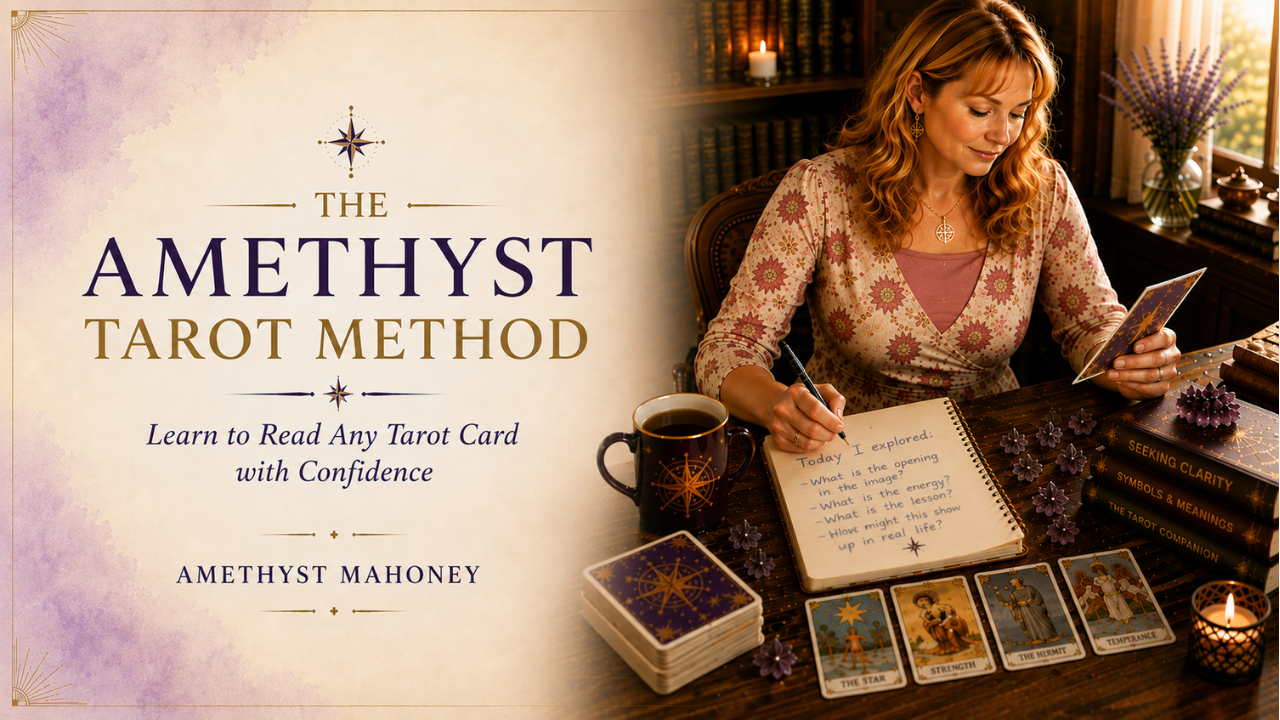
That's one of the reasons I created the Amethyst Tarot Method. It gives you a simple process you can follow when you're looking at a card and your brain suddenly decides it has never heard of Tarot.
5. Pay Attention to Your Intuition
Intuition doesn't have to arrive as a booming psychic message from the Universe.
Sometimes it's much quieter.
A particular part of the card catches your attention. One possible interpretation feels more relevant than another. You suddenly think about a conversation you had yesterday. A card you've seen dozens of times feels completely different in this particular reading.
Pay attention to those reactions.
You can still use books, card meanings, symbolism, and everything else you've learned. Intuition doesn't have to replace knowledge.
Let them work together.
6. Create Sacred Space for Your Reading
Ritual can help you shift out of everyday life and into a more intentional space for your Tarot reading.
That might mean lighting candles or incense, saying a prayer, calling on your Guides or Deities, working with crystals, grounding and centering yourself, cleansing your space, or creating an entire Tarot ritual that is uniquely yours.
There are a multitude of ways to prepare for a reading. What matters is creating practices that help you feel present, connected, and ready to work with your cards.
And yes, if your sacred space involves seventeen candles, a silk tablecloth, crystals everywhere, and waiting for the full moon because that's how you like to do things, have at it.
We are all about achieving your comfort level of Woo around here. You can pull a card at the kitchen table while eating toast or cleanse the room, invoke Hera, light seven candles, arrange your crystals according to planetary correspondences, and make the entire thing an Event.
The criterion isn't how Woo is too Woo.
It's does this practice have meaning and work for you?
If you'd like to make your readings more intentional, How to Create Sacred Space for Your Tarot Readings will help you explore ways to create a practice that feels meaningful to you.
7. Read Tarot for Yourself
Yes, you can read your own Tarot cards.
Reading for yourself can actually be one of the best ways to learn because you already know the context surrounding the question.
The challenge is that you also have opinions, hopes, fears, expectations, and approximately seventeen reasons you'd prefer one answer over another.
That's useful to recognize.
Instead of expecting yourself to become perfectly objective, notice when you may be trying to make the cards say what you want them to say.
Write your reading down. Come back to it later. See what you notice with a little distance.
Learning to read yourself is also an opportunity to learn how you interpret Tarot.
8. Learn a Few Meanings - Not Every Meaning
You need some basic knowledge of the cards.
You do not need to memorize an encyclopedia before you're allowed to read them.
Start with a few useful meanings for each card. Then let your understanding expand through actual readings.
The Three of Cups might suggest celebration in one reading, friendship in another, community somewhere else, or something completely different depending on the card, question, position, imagery, and surrounding cards.
Meanings give you possibilities.
Your job as a reader is to figure out which possibility fits here.
9. Ask Better Questions
Tarot can be used for prediction, but prediction is only one thing you can do with it.
Instead of only asking:
What is going to happen?
try asking:
What do I need to understand about this situation?
What am I overlooking?
What choices do I have?
What might happen if I continue on my current path?
What can I do to influence the outcome?
A predictive reading can show you where things appear to be heading based on current circumstances and choices.
But asking different questions can help you go deeper into the reading, see more opportunities, and decide what you're going to do about the future the cards predicted.
10. Forget the Tarot “Rules”
These myths commonly keep people from reading the Tarot, so it’s important to recognize and acknowledge them to get them out of your way:
You do not have to wait for someone to give you your first Tarot deck.
Your cards don't have to be wrapped in silk.
Other people can touch your deck if you're comfortable with that.
You don't have to read reversals.
You don't have to cleanse your cards every time somebody looks at them funny.
You don't have to perform a particular ritual before you read.
The Tarot police are not coming, even though there are many people online who are happy to give you their opinion on what you should or should not be doing.
But Tarot is better experienced, and the only way to do that is to practice with the cards.
Learn the techniques. Experiment with them. Keep what helps you read better.
Let go of what doesn't.
The More You Read, the More You'll Learn
Confidence with Tarot doesn't come from finally memorizing enough information that you're officially ready to begin.
It comes from reading.
Look at the cards. Explore the possibilities. Pay attention to your intuition. Ask better questions. Make an interpretation, and occasionally discover later that you were completely wrong.
That's part of learning, too.
The goal isn't to become a reader who always knows the “correct” answer.
It's to become a reader who knows how to work with a card when the answer isn't immediately obvious.
If you want help on how to do that, I walk you through the entire process in the Amethyst Tarot Method.