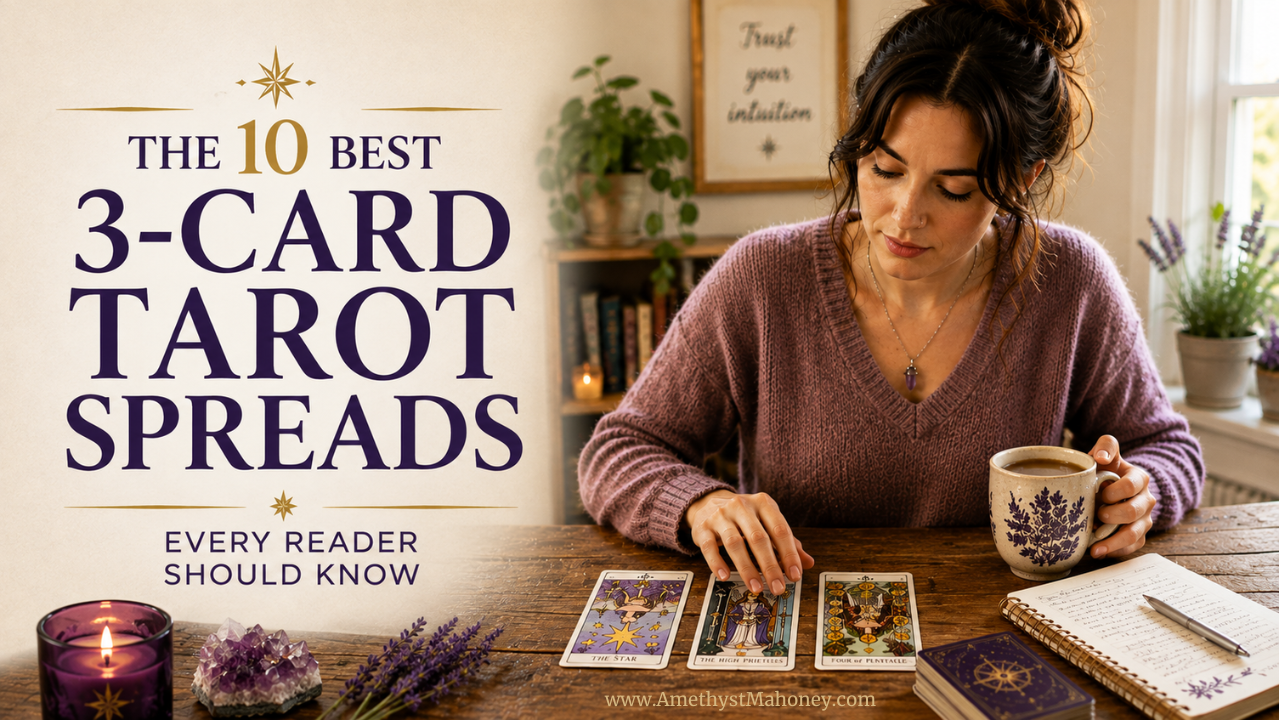
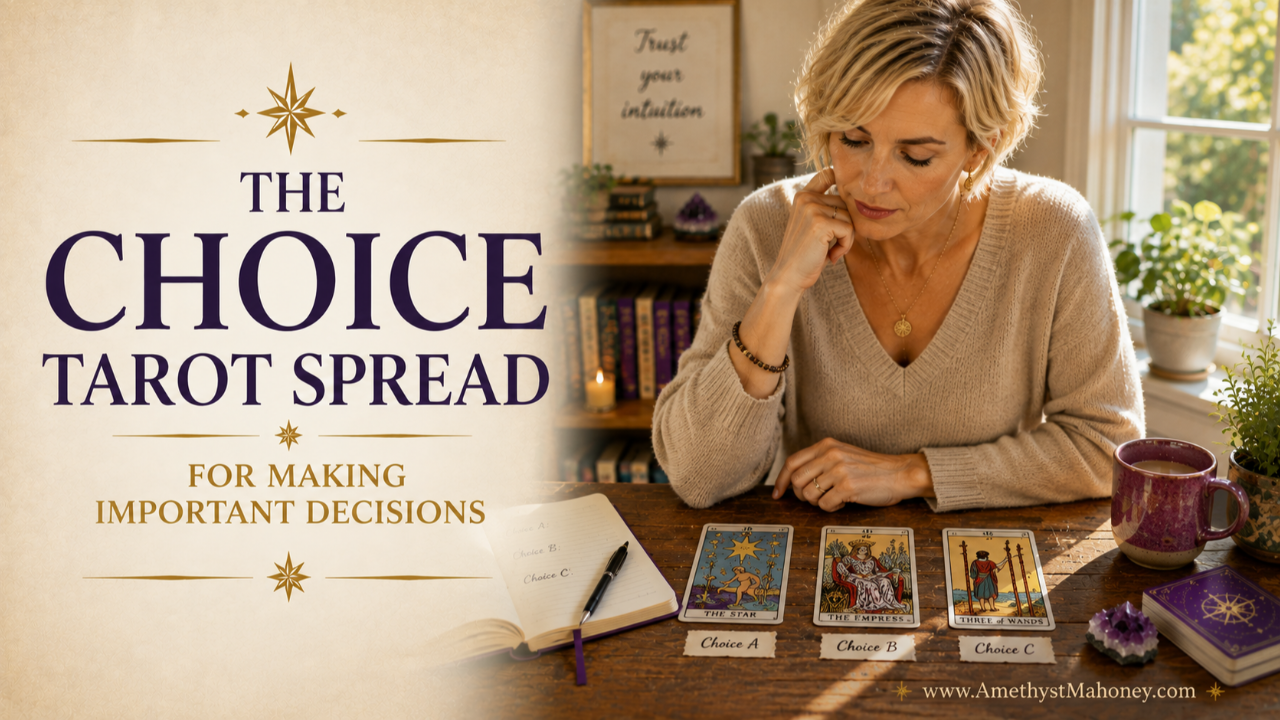
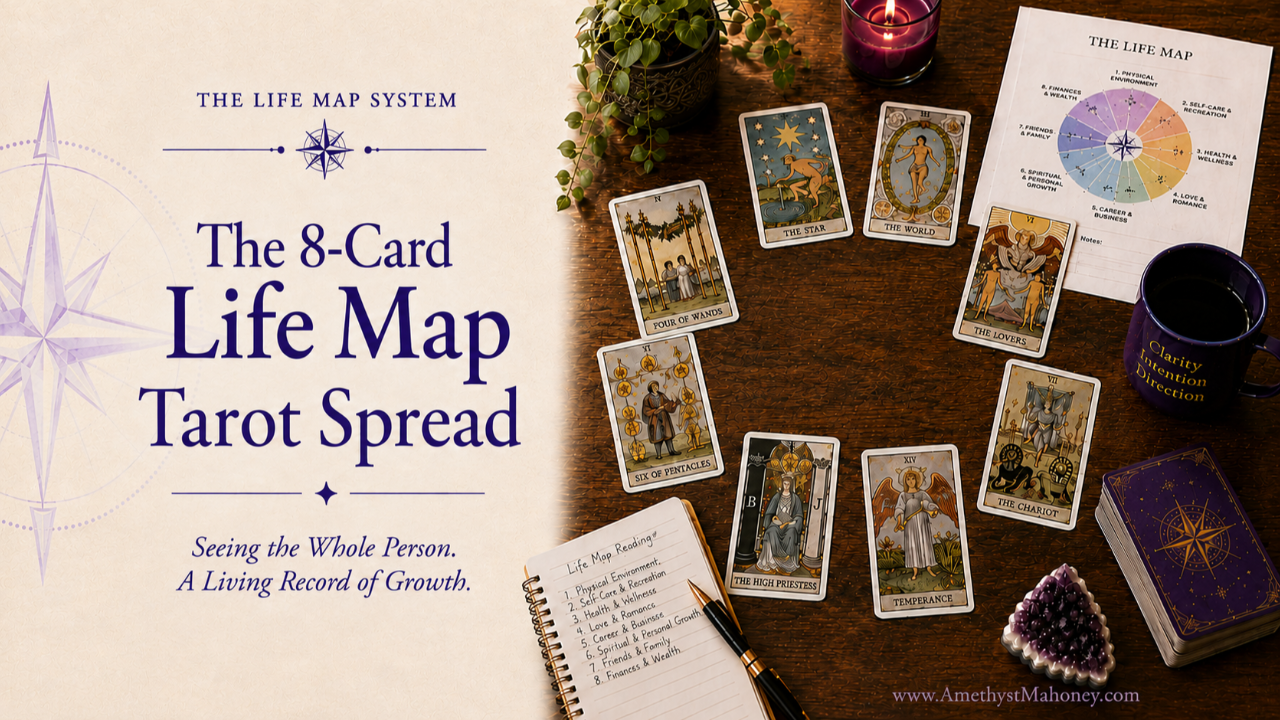
Reading Tarot regularly is one of the best ways to become more comfortable with your cards and confident in your own interpretations. But after a while, the same Past, Present, Future spread can get a little boring.
Here are 10 simple three-card Tarot spreads for daily reflection, growth, and making decisions.
1. Mind, Body, Spirit
This is one of my favorite go-to spreads for a quick check-in with yourself.
Pull one card for your Mind, one for your Body, and one for your Spirit. Ask what you most need to know, notice, or focus on in each area right now.
Pay attention to which cards seem more positive, and which areas might calling for your attention. Sometimes this spread isn't about fixing anything. It's simply a way to notice where you are.
2. The Nature of Your Problem, Cause, Solution
Use this spread when you want to understand a problem before deciding what to do about it.
The first card explores the nature of the problem - which may or may not be exactly what you originally thought the problem was. The second looks at a possible cause or contributing factor. The third explores a potential solution or way forward.
And don't be surprised if your cards point back at you somewhere along the way. Tarot can be annoyingly good at that. 🤣
That doesn't mean everything is your fault. It means your own choices, assumptions, reactions, or patterns may be one part of a larger situation. Other people and circumstances matter, too.
The goal isn't blame. It's understanding the situation well enough to see where you actually have choices.
3. Situation, Most Likely Outcome, Action to Take
This is one of my favorite spreads when you're trying to make a decision or figure out whether you want to continue on your current path.
The Situation card gives you another perspective on what's happening now. The Most Likely Outcome shows you where things appear to be heading if the current circumstances and choices continue.
That's important. Tarot doesn't have to describe an inevitable future carved into stone. An outcome card can show you where the road you're currently traveling is likely to lead.
Then comes Action to Take.
If you like where things appear to be going, what could help you continue in that direction? If you don't like the likely outcome, what could you change?
The point isn't simply to find out what happens next. It's to decide what you want to do with that information.
4. Where You Stand Now, What You Aspire To, How to Get There
This spread is similar to the previous one, but instead of asking where you're already headed, you're deliberately exploring where you want to go.
The first card looks at where you stand now. The second explores what you aspire to. The third asks how you might get there.
The middle card can be especially interesting.
Sometimes we know exactly what we want. Other times, our choices, habits, and priorities reveal desires we haven't fully admitted to ourselves yet. Your card may confirm what you already know - or point toward something you hadn't seriously considered.
You don't have to accept the card's suggestion as some Divine Command From Above. Use it as an invitation to ask yourself: Do I actually want this?
5. What Will Help You, What Will Hinder You, Your Hidden Potential
Use this spread when you feel stuck or when you suspect there are factors affecting a situation that you haven't fully considered.
What Will Help You can point toward resources, strengths, opportunities, people, or circumstances that could support you.
What Will Hinder You can reveal obstacles worth paying attention to. Those might be internal patterns, external circumstances, another person's behavior, or something you've simply underestimated.
Finally, Your Hidden Potential asks you to consider what you may be capable of that you aren't fully recognizing or using yet.
Don't assume every answer has to be about you. Sometimes the most useful message in a Tarot reading is that you don't have to do everything by yourself.
6. What You Can Change, What You Cannot Change, Hidden Factors
There are situations where you have enormous influence over what happens next.
There are others where you don't.
Most of life is somewhere in between.
This spread can help you separate those things.
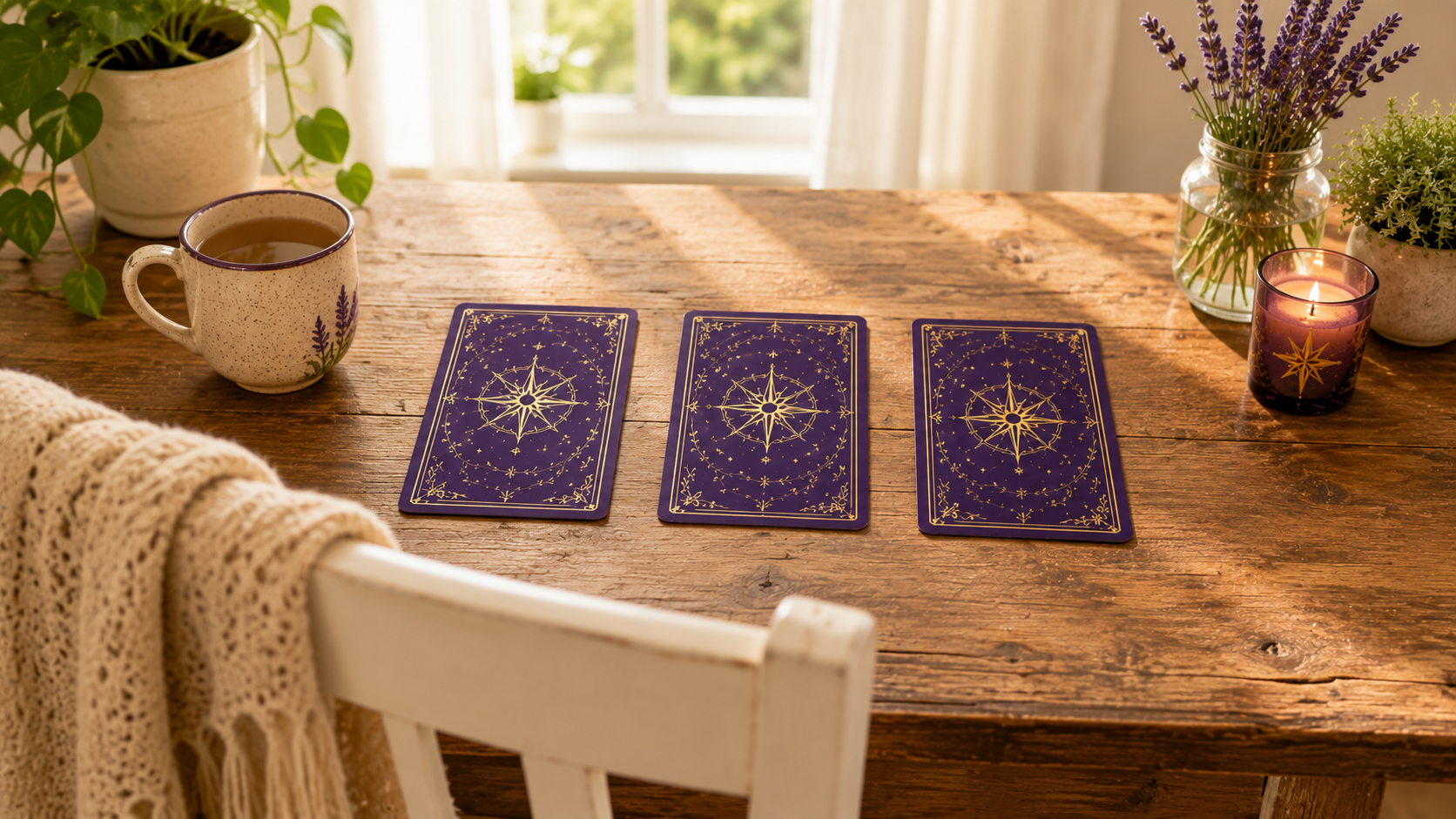
The first card explores what you can change or influence. The second looks at what you cannot control. The third reveals hidden factors that may be affecting the situation without being immediately obvious.
That last card can be particularly useful because sometimes what looks like a simple question of What should I do? becomes much clearer once you recognize something you've been overlooking.
The goal isn't to become passive about things you can't control. It's to stop spending all of your energy fighting the wrong battle so you can make more intentional choices about the parts that actually belong to you.
7. Challenges, Benefits, Lessons
Not every difficult situation has a secret cosmic reason for happening. Sometimes shitty things happen because shitty things happen.
But we can still ask what we can learn from them.
The first card explores the challenges you're facing. The second asks whether there are any benefits, opportunities, or unexpected positives within the situation. The third explores what you might learn from the experience.
That doesn't mean you have to be grateful for something painful or pretend that every terrible experience was secretly a blessing.
It simply gives you a way to ask:
Given that this is happening, what can I understand or take from it?
That puts the emphasis on what you do with an experience - not on pretending you were somehow supposed to suffer through it.
8. What Happened, What I Can Learn, What I Need to Move Forward
Sometimes a relationship ends and your brain does not receive the memo.
You can spend an enormous amount of time asking Tarot whether someone will come back, whether they'll call, whether they still love you, or what they're doing now.
Sometimes the more useful questions are about you.
The first card asks you to explore what happened from another perspective. The second looks at what you can learn from the relationship or its ending. The third asks what you need in order to move forward.
And “moving forward” doesn't have to mean immediately finding somebody new. It may mean grieving, understanding a pattern, rebuilding trust in yourself, establishing a boundary, rediscovering something you lost in the relationship, or simply giving yourself time.
This spread isn't about getting the other person back.
It's about getting yourself back.
9. What You Want, What They Want, Where the Relationship Is Headed
Although people naturally use this spread for romantic relationships, don't stop there.
Try it with friendships, family relationships, professional relationships, creative partnerships, or any connection where you're trying to understand why two people don't seem to be moving in quite the same direction.
The first card explores what you want from the relationship. The second explores what the other person appears to want. The third looks at where the relationship is currently headed.
One important caution: Tarot can't climb inside another person's head and give you unquestionable access to their private thoughts.
Instead, use that second card to explore the dynamics you're observing. What might this card suggest about their priorities, behavior, expectations, or what they appear to be bringing to the relationship?
Then compare the first two cards.
Sometimes the problem isn't that either person is wrong. They're simply trying to have two different relationships.
10. Overview, Career or Business, Love and Relationships
This is a simple way to get a quick snapshot of several major areas of your life.
The first card gives you an overall view of what's happening right now. The second focuses specifically on career or business. The third explores love and relationships.
You can also customize those positions. If relationships aren't particularly important to you right now but health, creativity, family, spirituality, or another area is, change the position.
It's your reading. The Tarot police will not come.
This spread is also a great way to notice how much context matters when you're interpreting Tarot. The same card can tell a very different story depending on the question you've asked and the position it occupies.
Instead of asking only, “What does this card mean?” pay attention to the larger question:
“What does this card mean here?”
Make These Spreads Your Own
These spreads aren't rules. They're starting points.
Change the wording. Replace a position. Combine ideas from two different spreads. Use one every day for a week and see what you notice. Pull an additional card when something genuinely needs clarification.
Most importantly, pay attention to what actually works for you.
Write down your readings when you can, especially when a card gives you an interpretation you haven't considered before. If you don't already have a system for keeping track of your readings, How to Start Your Tarot Journal will help you create one that actually works for you.
When you return to those readings later, you may begin noticing patterns in the way particular cards, decks, questions, and spreads speak to you.
The more you experiment, the more Tarot becomes something you can actually use instead of a collection of meanings you're trying to remember.
Keep Exploring