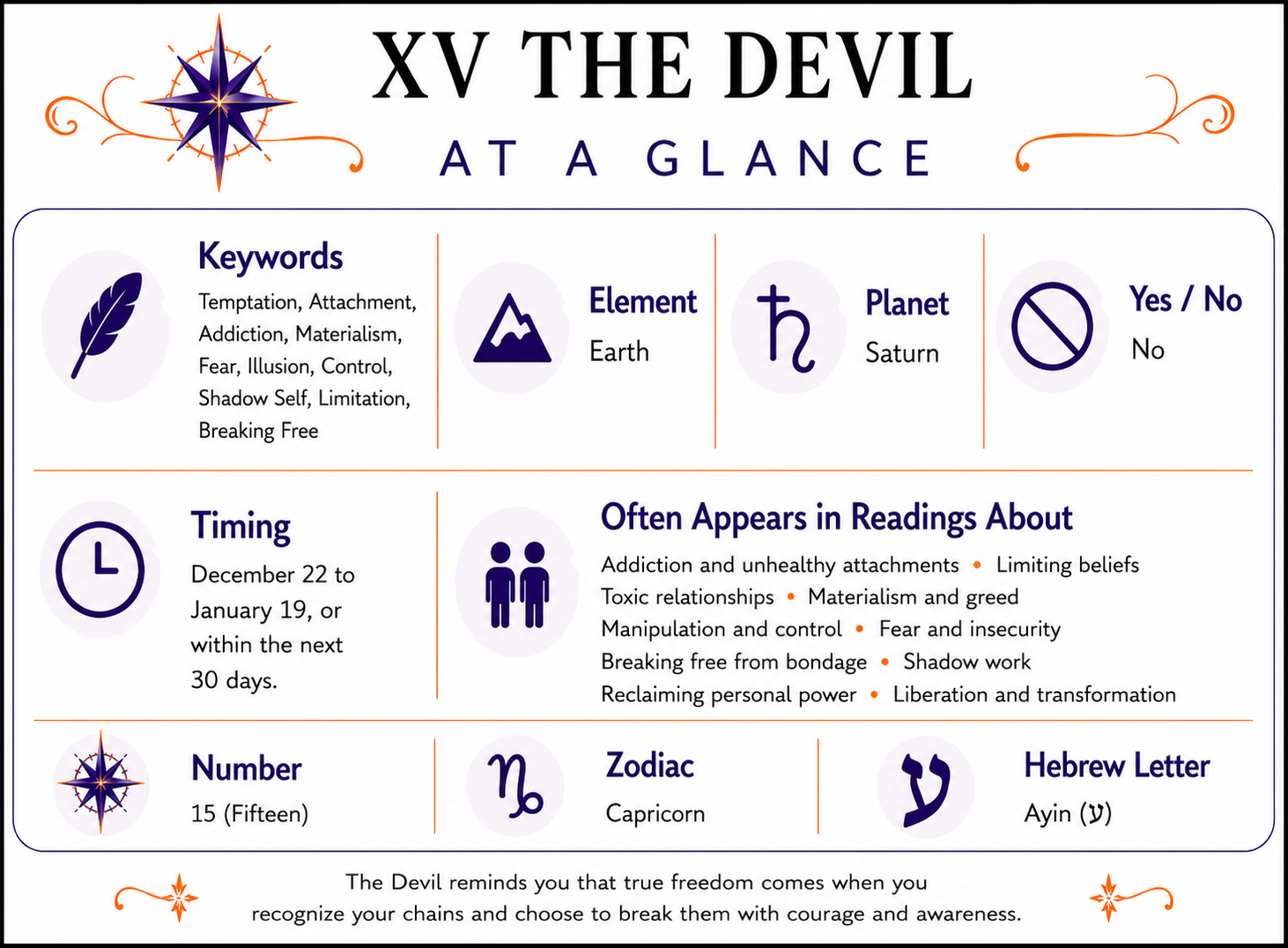
Accessible Text Version: The Devil At a Glance
Keywords: Temptation, Attachment, Addiction, Materialism, Fear, Illusion, Control, Shadow Self, Limitation, Breaking Free.
Element: Earth.
Planet: Saturn.
Yes / No: No.
Timing: December 22 to January 19, or within the next 30 days.
Number: 15
Zodiac: Capricorn.
Hebrew Letter: Ayin.
Often Appears in Readings About: Addiction and unhealthy attachments, limiting beliefs, toxic relationships, materialism and greed, manipulation and control, fear and insecurity, breaking free from bondage, shadow work, reclaiming personal power, liberation and transformation.
Summary: The Devil reminds you that true freedom comes when you recognize your chains and choose to break them with courage and awareness.
The Devil Tarot Card Meaning
The Devil is one of the most misunderstood cards in the Tarot.
For many people, simply seeing this card brings feelings of fear, guilt, or anxiety. Centuries of religious and cultural influence have taught us to associate a horned figure with evil, temptation, punishment, and eternal damnation. It's understandable that many people assume the Devil predicts something terrible.
In practice, it rarely does.
The Devil represents attachment, limitation, temptation, and the beliefs that quietly keep us feeling trapped. Rather than warning that an outside force has power over you, this card asks you to notice the stories, fears, habits, and assumptions that may be influencing your choices without your realizing it.
Although the Devil can feel uncomfortable, it is ultimately one of the most liberating cards in the Tarot. The moment we recognize what has been holding us captive is the moment we begin to reclaim our freedom.
The Devil in the Rider-Waite-Smith Tarot
In the Rider-Waite-Smith Tarot, the Devil is traditionally depicted as a horned figure seated upon a pedestal above a loosely chained man and woman. Although the chains around their necks appear intimidating, they are loose enough to be removed, suggesting that much of their bondage is maintained through fear, habit, or illusion rather than force.
Although many modern readers immediately associate this figure with the Christian Devil, the Tarot is not intended to teach theology or predict eternal punishment, even though Pamela Coleman Smith did use an abundance of Christian iconography in the Rider-Waite-Smith images.
Instead, the Devil functions as an archetype, a symbolic representation of attachment, temptation, limitation, and the unconscious beliefs that can quietly shape our lives.
The Devil combines human and animal characteristics, symbolizing our instinctive desires, impulses, and attachments. The inverted pentagram upon his forehead represents the elevation of material concerns over spiritual awareness, while the dark cavern emphasizes ignorance, limitation, and unconscious patterns.
Despite its unsettling imagery, the card carries an important message: the chains are not permanent. Freedom becomes possible once we recognize the beliefs or attachments that have been quietly controlling us.
Upright Meaning
The Devil is a card of awareness. It often appears when something in your life has begun to exercise more influence than you realize.
This may involve unhealthy relationships, addictive behaviors, perfectionism, fear of failure, people-pleasing, limiting beliefs, or the pursuit of external validation. Sometimes the chains are obvious. More often, they appear as familiar thoughts that have become so automatic we no longer question them.
The Devil invites you to examine what you believe you "have to" do, what you fear losing, or what you've accepted as impossible without ever asking whether it is actually true.
When the Devil appears upright, it reminds us that awareness is the first step toward freedom.
Reversed Meaning
Reversed, the Devil often signals the beginning of liberation. You may be recognizing an unhealthy pattern, questioning a long-held belief, or discovering that you possess more freedom than you once imagined.
Sometimes this card reflects breaking an addiction, setting healthier boundaries, or choosing authenticity over approval. At other times, it represents the slow process of untangling yourself from thoughts or relationships that no longer serve you.
The reversed Devil reminds us that freedom rarely arrives all at once. It is often built through many small choices that gradually loosen the chains we once believed could never be removed.
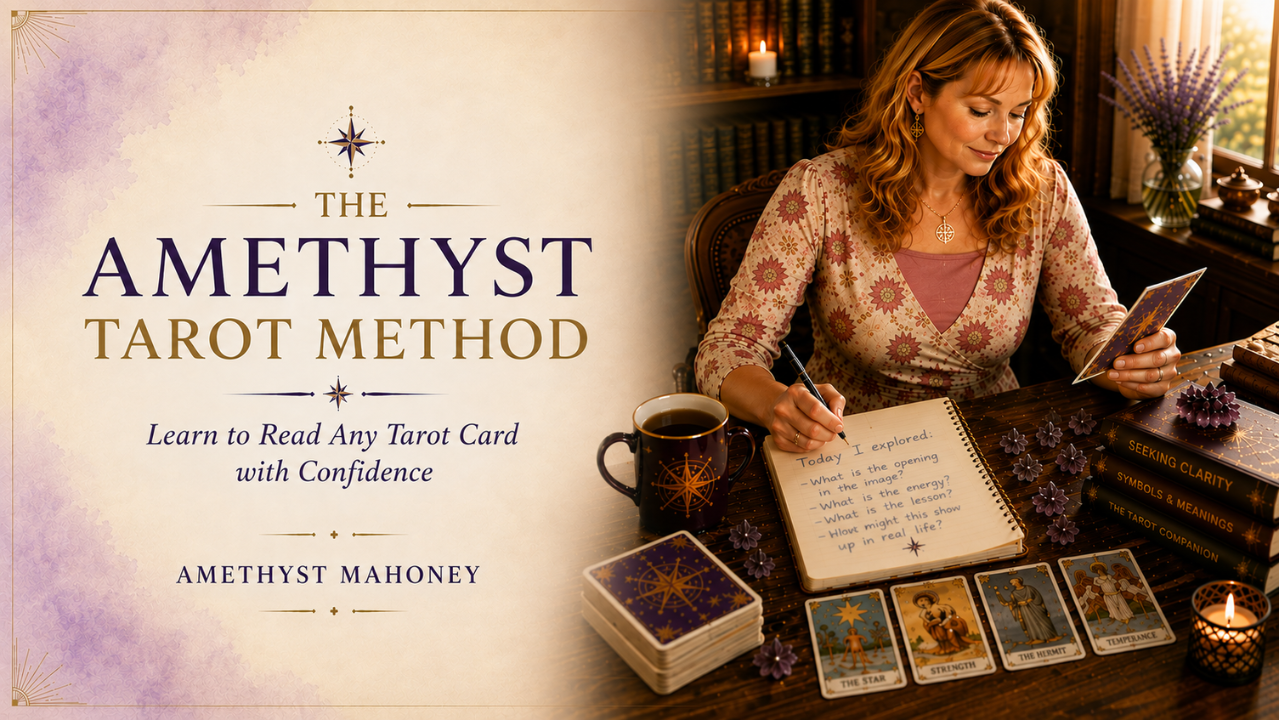
The Devil in the Unconquered Heart Tarot
In the Rider-Waite-Smith Tarot, the Devil is traditionally portrayed as a horned figure seated above a chained man and woman. Although the chains appear intimidating, they are loose enough to be removed, reminding us that much of our bondage comes not from physical force but from fear, attachment, and the beliefs we continue to accept without question.
The Unconquered Heart Tarot preserves these same themes while shifting the focus from an external tempter to the internal stories that quietly keep us imprisoned. The Devil still presides over two chained figures, but the emphasis is no longer on a supernatural force controlling them. Instead, the artwork invites us to examine the beliefs, desires, and assumptions that convince us we cannot choose differently.
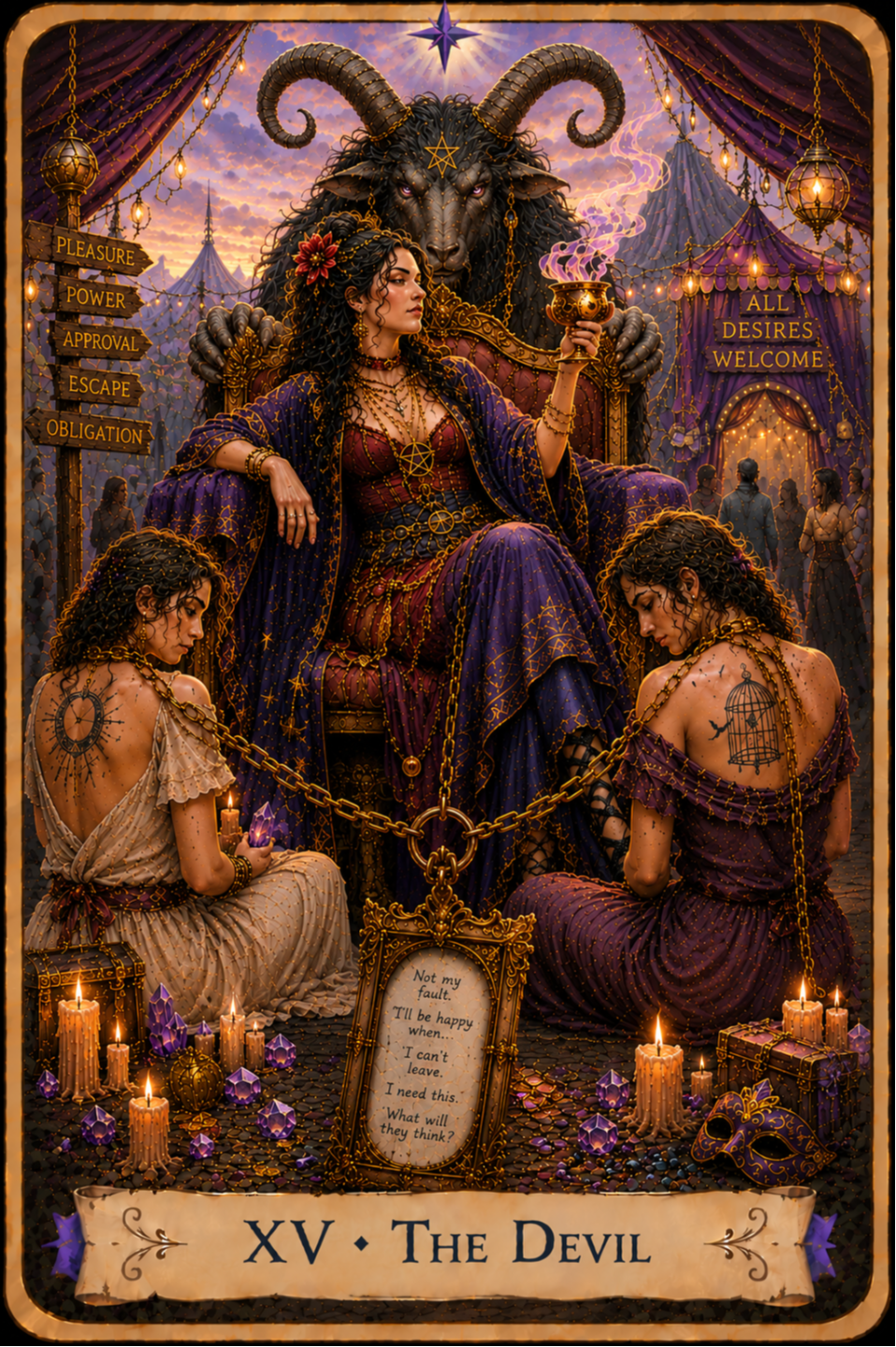
The environment becomes an essential part of the story. Signposts point toward pleasure, power, approval, escape, and obligation, while the carnival tent proclaims, "All Desires Welcome." At the feet of the chained women, a small plaque reveals the thoughts that often become invisible prisons: Not my fault. I'll be happy when... I can't leave. I need this. What will they think? These are not merely decorations. They are the psychological chains that so often keep us from recognizing our own freedom.
Perhaps the greatest difference is where the card places responsibility. Rather than asking us to fear an outside force, this artwork encourages us to become curious about the narratives we have accepted as truth. The Devil reminds us that while we may not choose every circumstance we face, we can begin questioning the beliefs that determine how we respond to them.
That spirit lies at the heart of The Unconquered Heart Tarot: the strongest chains are often the ones we cannot see, and freedom begins the moment we become willing to ask whether they were ever locked in the first place.
About This Artwork
In the Rider-Waite-Smith Tarot, the Devil presides over two chained figures who appear bound to the pedestal beneath him. Although the chains seem frightening, they hang loosely enough to be removed, reminding us that much of our captivity comes not from physical force but from unconscious attachment and limiting beliefs.
The Unconquered Heart Tarot preserves this essential symbolism while bringing those invisible chains into plain sight. Rather than leaving the source of bondage open to interpretation, the artwork surrounds the figures with the beliefs and desires that so often keep us trapped. The signposts promise pleasure, power, approval, escape, and obligation, while the carnival tent invites us with the words, "All Desires Welcome."
Most revealing of all is the small plaque resting between the chained women. Written upon it are the quiet thoughts that often become prisons of our own making: Not my fault. I'll be happy when... I can't leave. I need this. What will they think? These are not literal chains, yet they often prove stronger than iron.
Perhaps the greatest difference is where the card places responsibility. Rather than presenting the Devil primarily as an external tempter, this artwork asks us to notice the stories we continue believing about ourselves and our lives. The greatest prison is often the one we have unknowingly helped build.
That spirit lies at the heart of The Unconquered Heart Tarot: freedom begins the moment we become curious enough to question the beliefs that have quietly been making our decisions for us.
Tarot Therapy Perspective
In Tarot Therapy, the Devil is less concerned with asking, "What is controlling me?" and more interested in asking, "Who taught me this?"
Many of the beliefs that limit us did not begin with us. They were learned from families, religions, schools, relationships, workplaces, or cultures that taught us what was acceptable, shameful, dangerous, or worthy of love.
Some of those beliefs have served us well.
Others quietly became chains.
The Devil invites us to become curious rather than judgmental. Not every belief deserves to be abandoned, but every belief deserves to be examined. Freedom begins when we become willing to ask whether the voice in our head is truly our own.
Reflection Question
What belief, assumption, or story have I been treating as an unquestionable truth, and what might become possible if I challenged it?
Spend a few moments considering whether the strongest chains in your life are external...or whether some may exist only because they've never been questioned.
Continue Your Journey
This page introduces the core meaning of The Devil and the symbolism of the Rider-Waite-Smith Tarot.
If you'd like to explore this card in greater depth including advanced symbolism, colors, love and relationship readings, career and business interpretations, timing, associated crystals, and practical reading techniques, those topics are covered in Tarot Symbols & Meanings.


Welcome to Tarot Therapy & the Unconquered Heart Library
A place to explore Tarot with curiosity, wisdom, and hope. Every card is an invitation to better understand yourself and the life you're creating.
Discover
Tarot gives you possibilities.
It is up to you to choose which path to take.
©Amethyst Mahoney & Limitless Abundance, LLC.