Why Tarot Feels Confusing (Even When You Know the Meanings)
Why Tarot Feels Confusing (Even When You Know the Meaning)
There’s a particular kind of frustration that happens when you’ve been studying Tarot for a while. You recognize the cards. You know many of the common meanings. You may even have pages of notes, favorite guidebooks, and enough keywords floating around in your head to fill a very strange dictionary.
And then you sit down to actually do a reading, and suddenly none of that knowledge seems to help.
You pull a card you know perfectly well, but several different meanings could apply. You pull a second card, and instead of clarifying the first one, it gives you even more possibilities. By the time you have a full spread in front of you, you may find yourself bouncing between interpretations, trying to figure out which combination of meanings is the “right” one.
That experience can make you wonder whether you simply need to study more. Maybe there are meanings you haven’t memorized yet, symbols you’ve overlooked, or some advanced Tarot technique everyone else seems to understand.
But the problem may not be how much you know.
It may be that knowing Tarot card meanings and knowing how to read Tarot cards are two different skills.
Knowing the Meaning Is Only the Beginning
Learning established Tarot meanings is useful. I certainly don’t think we need to throw away guidebooks, keywords, symbolism, numerology, astrology, or the many other systems people have developed for understanding the cards.
The problem comes when we expect those meanings to automatically produce an interpretation.
Consider the Three of Cups. You might associate it with friendship, celebration, community, connection, reunion, collaboration, or emotional support. Depending on the deck, the question, and the context, any of those ideas could be relevant.
Knowing that list gives you possibilities. It doesn’t necessarily tell you which possibility belongs in the reading you’re doing right now.
This becomes even more obvious when you start combining cards. If every card has several possible meanings, a three-card spread can quickly become a choose-your-own-adventure novel with an alarming number of endings.
That’s why memorizing more and more information can sometimes make Tarot feel more confusing rather than less. You aren't necessarily missing knowledge. You may simply be missing a way to move from everything a card could mean to what it appears to be saying here.
Tarot Cards Are More Than Containers for Keywords
One of the easiest habits to develop when learning Tarot is looking away from the card almost as soon as you draw it.
You see the card, recognize it, and immediately begin searching your memory for the information attached to its name. If nothing comes quickly enough, you reach for a guidebook or search online. Before long, most of your attention is on what other people have told you about the card rather than the card sitting in front of you.
There’s nothing inherently wrong with looking things up. The problem is that it can become so automatic that we skip over one of the richest sources of information available to us: the artwork itself.
A Tarot card is a visual scene. People are doing things. Objects have been placed in particular locations. Figures are looking toward something—or deliberately looking away. Some elements feel prominent while others almost disappear into the background.
And, interestingly, you won't necessarily notice the same thing every time you see the same card.
That matters.
Pay Attention to What You Notice
The next time you pull a card, give yourself a few seconds before deciding what it means.
Instead of immediately asking, What is the definition of this card?, notice where your attention goes first.
Perhaps you’ve seen the Rider-Waite-Smith Five of Pentacles dozens of times, but today you’re unusually interested in the illuminated window rather than the two people walking through the snow. Maybe you pull the Hermit and, instead of focusing on solitude, you can’t stop looking at the lantern. Or perhaps there’s something about a figure’s posture that suddenly feels important.
You don't have to immediately explain why you noticed it.
For now, the important part is simply recognizing that you did.
This is where reading Tarot begins to become different from recalling Tarot information. You aren't abandoning what you've learned. You're allowing the actual card in front of you to participate in the reading.
The Question Changes the Reading
Context matters just as much.
Imagine pulling the same card while asking about a relationship, a career decision, and a personal goal. The artwork hasn't changed. The established meanings haven't changed. But the question has, and that changes which aspects of the card are useful.
This is one reason the question “What does this card mean?” can become surprisingly unhelpful.
The answer is often: a lot of things.
A better reading requires you to move beyond everything the card can mean and begin exploring how it relates to the particular situation you're asking about.
That ability isn't something you develop by memorizing one more definition. It's a different part of learning to read Tarot.
And once you understand that distinction, a lot of the confusion starts making sense.
You Probably Don't Need Another List of Meanings
If you already know the basic meanings of the cards but still struggle to put them together in a reading, you may have assumed you're simply not ready yet.
You need another book. Another course. Another set of keywords. Another six months of studying before you're finally qualified to shuffle the cards and trust yourself to say something useful.
But more information isn't always the answer.
There comes a point when you need to practice reading, not just studying.
That means learning how to work with what catches your attention, how to develop an interpretation, how to determine which possibilities fit the question, and how to recognize when an interpretation actually makes sense.
Those are skills. And skills are developed through practice.
Learning to Read Tarot Differently
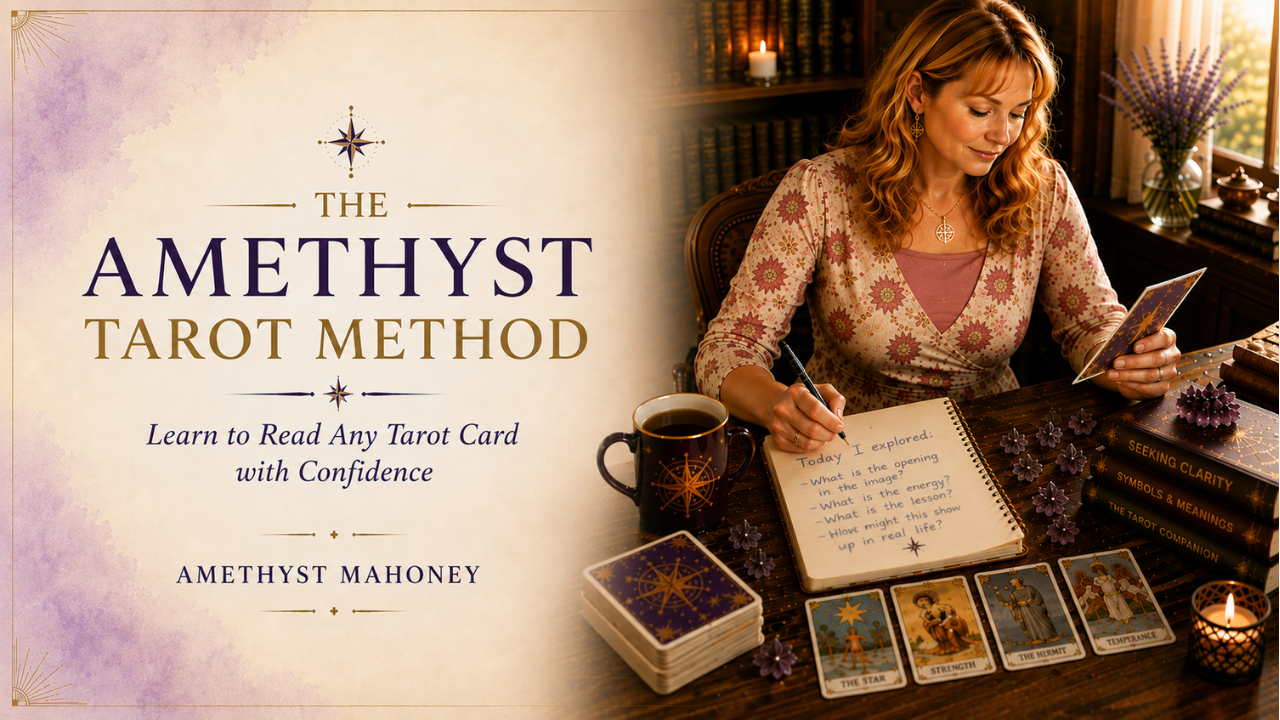
This distinction - between memorizing Tarot and actually reading it - is one of the reasons I created the Amethyst Tarot Method.
I wanted a practical framework that could help you sit down with a card and have somewhere to begin, without requiring you to memorize 78 perfect definitions before you were allowed to read.
The Amethyst Tarot Method teaches you a five-step process for moving through a card and developing your own interpretation. It also goes beyond the individual card into some of the places where Tarot readers commonly get stuck: deciding which interpretation fits, asking questions that produce useful readings, working with reversals, and practicing with AI without turning your reading over to it.
Most importantly, you actually read Tarot as you learn.
Because reading isn't the reward for finishing your studies.
Reading is how you learn Tarot.