What Is Tarot Therapy?
Tarot Therapy is a different way of working with Tarot.
It is an intentional, reflective approach to Tarot that uses the cards to support insight, meaningful conversation, self-understanding, personal growth, and intentional choice. It combines the symbolism and wisdom of Tarot with thoughtful communication, ethical practice, and a professional framework for working with other people.
At its heart, Tarot Therapy represents a shift in how we approach the cards and the people who come to us for readings. Rather than concentrating on predicting what will happen, we explore what someone can understand, consider, choose, or change. The cards offer information, perspectives, and possibilities that become more meaningful through conversation and reflection.
Tarot Therapy is more than a technique for interpreting cards. It is a philosophy of practice built around the belief that Tarot can help people understand their experiences, recognize patterns, consider alternatives, and make more informed decisions about their lives.
From Prediction to Possibility
Tarot has evolved through centuries of changing traditions, interpretations, and uses. Predictive readings remain one of its most recognizable forms, but Tarot also offers a rich symbolic language for exploring human experience.
Tarot Therapy builds on that potential by shifting the focus from prediction toward possibility.
Instead of asking only what the future holds, Tarot Therapy explores the circumstances, choices, beliefs, and patterns influencing the present. The cards help us consider what is happening, why it matters, and what possibilities exist for moving forward.
This changes the questions we ask during a reading. Rather than concentrating exclusively on whether someone will get a particular job, for example, we can explore their goals, qualifications, expectations, concerns, and available opportunities. We can examine what success means to them, what may be standing in their way, and which choices could help them move toward the future they want.
The purpose is not to predict a fixed outcome. It is to develop the understanding that allows someone to participate more intentionally in creating their future.
What Makes Tarot Therapeutic?
The therapeutic potential of Tarot comes from how we use the cards.
Tarot contains images, symbols, archetypes, and stories that represent an extraordinary range of human experiences. Love, conflict, achievement, disappointment, security, loss, transformation, creativity, and joy all appear throughout the deck. These images give us a way to examine situations that may otherwise feel complicated, confusing, or difficult to describe.
A Tarot card can bring attention to something we've overlooked, introduce an unfamiliar perspective, or help us recognize a pattern in our thoughts, relationships, or behavior. The meaning becomes especially valuable when we explore how it connects to the circumstances of our lives.
Tarot Therapy brings these elements together through reflection, thoughtful questions, interpretation, and conversation. The practitioner contributes knowledge of Tarot and the skills needed to guide the discussion. The client contributes their experiences, understanding, and perspective.
Together, they explore what the cards reveal and how those insights relate to the client's life.
This collaboration is essential. Tarot Therapy is not simply a reader delivering information while another person listens. It is an active exchange in which symbolism, interpretation, personal experience, and conversation work together to create understanding.
How Is Tarot Therapy Different From a Conventional Tarot Reading?
In many conventional Tarot readings, the reader interprets the cards and explains what they reveal about a question or situation. The reader's knowledge, intuition, and interpretation provide the central direction of the reading.
Tarot Therapy uses those same skills within a broader process of exploration. The practitioner interprets the cards, identifies connections, offers possibilities, and asks questions that help the client understand how the information relates to their circumstances.
The client also has an opportunity to participate in the reading, interpretation, and how they view the card through their own personal life lens.
Consider someone who draws the Eight of Cups while exploring dissatisfaction with their career.
The Eight of Cups is associated with leaving something behind, searching for greater fulfillment, and recognizing when a situation no longer provides what we need. These meanings offer a useful starting point.
A Tarot Therapy practitioner might ask:
-
What stands out to you in this image?
-
Does anything about the scene remind you of your current situation?
-
What feels missing or unfulfilled?
-
Are you considering leaving, or are you looking for a different way to engage with what you already have?
-
What would help you understand your options more clearly?
As the conversation develops, the practitioner may introduce additional interpretations, explain relevant symbolism, or identify connections with other cards in the reading.
Perhaps the client discovers that they don't actually want to leave their career. They want more meaningful responsibilities, better working conditions, or opportunities that reflect their changing priorities. Another person may recognize that they've been postponing a decision they already want to make.
The Eight of Cups provides a starting point, but the conversation reveals which possibilities matter.
The practitioner can offer interpretations and discuss options without deciding what the client should do. The reading becomes an opportunity to examine the situation more thoroughly and consider the choices available.
Tarot Therapy moves beyond interpreting the cards to exploring what those interpretations mean for the person receiving the reading.
The Client Is the Expert on Their Own Life
One of the foundational principles of Tarot Therapy is that the client is the expert on their own life.
A practitioner may have extensive knowledge of Tarot, symbolism, mythology, communication, and reflective techniques. They may recognize patterns, offer interpretations, and introduce perspectives the client has never considered.
That expertise is valuable. It is one of the reasons someone seeks out a Tarot practitioner.
But the client possesses something the practitioner does not: their lived experience. They understand their history, relationships, responsibilities, values, desires, and circumstances in ways that no outside observer can fully know.
Tarot Therapy respects both forms of knowledge.
The practitioner brings expertise in Tarot and the process of exploration. The client brings expertise in their own experience. The conversation connects those perspectives to create a fuller understanding of the situation.
This also establishes an important boundary. Practitioners can offer information, guidance, interpretations, and possibilities, but they do not decide what another person must believe or do.
A client may consider an interpretation and recognize that it fits their experience. They may also disagree, question it, or discover that a different meaning is more relevant.
Those responses are part of the exploration. The purpose is to help people understand their circumstances and make their own informed choices, not to replace their judgment with the practitioner's.
The Role of the Tarot Therapy Practitioner
Working with Tarot Therapy requires more than memorizing card meanings or developing intuitive interpretations. First we learn how to interpret the cards and build a strong Tarot foundations. But practitioners also need to understand how to work effectively and responsibly with people.
A Tarot Therapy practitioner helps establish the focus of a session, interprets the cards, asks thoughtful questions, recognizes emerging themes, and facilitates conversations that support insight and understanding.
This requires presence, curiosity, communication skills, professional boundaries, attention to affect and body language, and the ability to recognize when an interpretation or question could help the conversation move forward.
Sometimes the practitioner offers a detailed explanation of a card. Sometimes they recognize an important connection between several cards. Sometimes they ask a question that changes how the client sees the situation. And sometimes the most useful response is simply to invite the client to explain something further.
The practitioner remains actively involved throughout the session, using their knowledge and judgment to support the exploration without directing the client's life.
This balance between professional expertise and respect for client autonomy is one of the defining characteristics of Tarot Therapy.
An Interdisciplinary Approach to Tarot
Human experiences are complex. Understanding how people think, communicate, make decisions, develop relationships, and create meaning requires more than a single field of knowledge.
Tarot Therapy is intentionally interdisciplinary, drawing from multiple areas to inform the way practitioners understand Tarot and work with clients.
Psychology offers perspectives on thought, behavior, and human experience. Counseling and communication skills inform how practitioners listen, ask questions, and engage in meaningful conversations. Coaching contributes approaches to exploring goals, choices, and action. Ethics provides a framework for considering responsibility, boundaries, and the effects our work can have on others.
Symbolism, mythology, numerology, Qabalah, and related disciplines can help deepen our understanding of the cards themselves. Narrative approaches help us recognize the stories people use to understand their experiences, while education and adult learning inform how people encounter, question, integrate, and apply new ideas.
These disciplines contribute knowledge and useful perspectives without changing Tarot Therapy into psychotherapy, counseling, or another profession.
The purpose is to develop better-informed Tarot practitioners who understand both the symbolic tools they use and the responsibilities involved in working with people.
From Insight to Meaningful Change
Understanding something about ourselves can change how we approach our lives, but insight becomes especially valuable when we begin applying what we've learned.
A Tarot Therapy session may reveal a recurring pattern, an overlooked possibility, a conflict between important values, or an assumption that deserves reconsideration.
Someone exploring a difficult relationship may recognize that their frustration comes from repeatedly agreeing to things they don't want to do. A person considering a career change may discover that they value flexibility more than advancement. Another client may realize that what they've described as indecision is actually a conflict between two equally important priorities.
These discoveries create opportunities to think differently and make more intentional choices.
The next step may involve changing a habit, setting a boundary, having a conversation, pursuing an opportunity, or continuing to explore a question before making a decision.
Tarot Therapy connects reflection with practical possibilities. It encourages people to consider how new understanding can influence their choices, relationships, goals, and actions.
Meaningful change often begins with seeing something differently. The cards help us explore those new perspectives, while the conversation helps us understand what they mean and how we might use them.
Ethics and Professional Responsibility
Tarot readings frequently involve deeply personal subjects. People bring questions about relationships, careers, finances, grief, uncertainty, identity, and major life decisions. They may share information they have not discussed with anyone else.
That trust deserves to be taken seriously.
Tarot Therapy places ethical responsibility at the center of professional practice. Practitioners must consider confidentiality, informed consent, competence, professional boundaries, client autonomy, inclusion, and the potential consequences of their words and actions.
Ethical practice also requires understanding the limits of our knowledge and qualifications. A practitioner needs to recognize when a situation falls outside their role and when a client may need support from another type of professional.
These responsibilities do not diminish intuition, spirituality, or personal reading style. They provide a professional framework within which those qualities can be used thoughtfully and responsibly.
Professionalism asks us to consider not only what we can do, but what we should do, whether we are qualified to do it, and how our actions may affect the person who has placed their trust in us.
Is Tarot Therapy the Same as Psychotherapy?
Tarot Therapy is not psychotherapy, counseling, or mental health treatment. It is an intentional, reflective approach to Tarot designed to support self-awareness, insight, personal growth, and well-being.
The word therapy has a broader history than its use in clinical mental health settings. It comes from the Greek therapeia, associated with care, service, and support. Today, the word appears across many different practices and disciplines, each with its own methods, training requirements, and professional boundaries.
There are many types of therapeutic treatments, including:
- Physical therapy
- Massage therapy
- Journaling therapy
- Drama therapy
- Sound therapy
- Art therapy
- Dance therapy
- Nature therapy
and more.
Within Tarot Therapy, the term describes the intentional use of Tarot to support reflection, understanding, and meaningful personal exploration.
It does not grant practitioners the qualifications to diagnose mental health conditions, provide psychotherapy or medical treatments, or practice outside their training and professional scope.
Tarot Therapy practitioners are responsible for understanding these distinctions, maintaining appropriate boundaries, and recognizing when a client's needs require a different form of professional support.
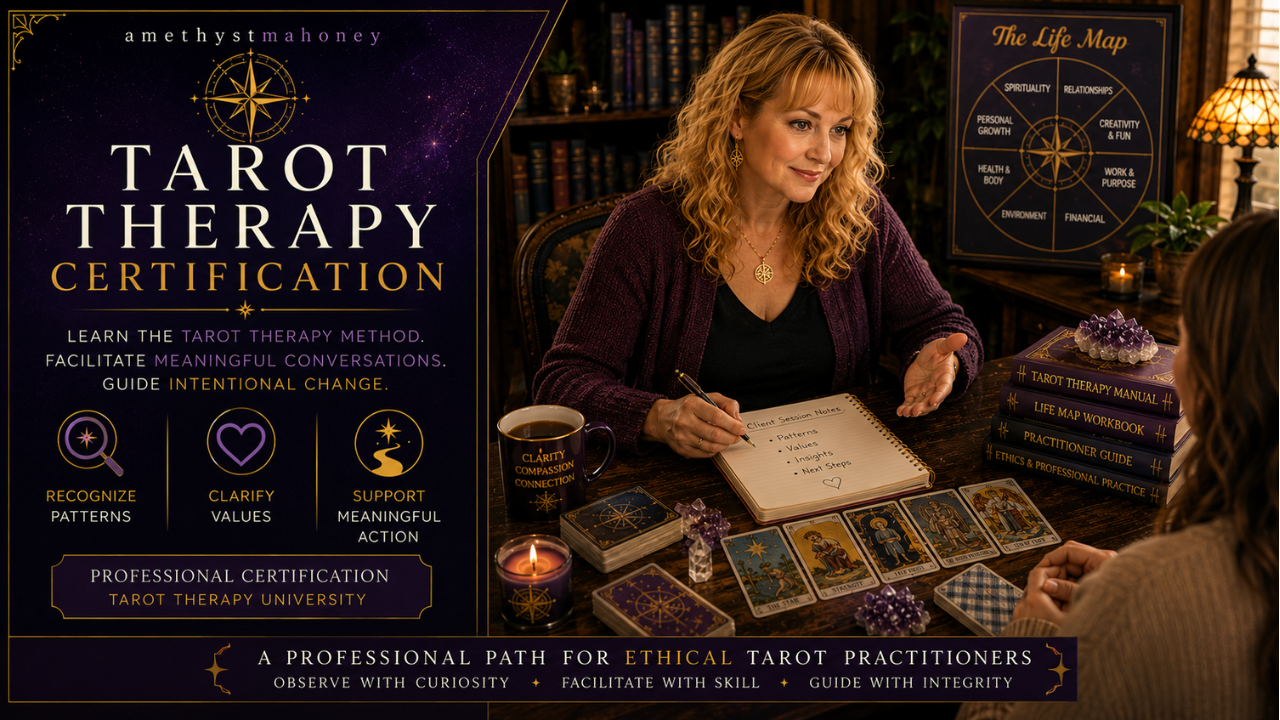
Ethics and scope of practice are essential parts of Tarot Therapy education, not subjects reserved for unusual or difficult situations. We explore them deeply inside the Tarot Therapy Certification course.
Learning Tarot Therapy
Learning the meanings of Tarot cards and learning to work responsibly with people are two different accomplishments.
Tarot knowledge provides an essential foundation, but effective practice also requires communication skills, ethical judgment, thoughtful questioning, reflection, and the ability to apply knowledge in real conversations.
Tarot Therapy University approaches professional development as a process that moves from knowledge through reflection, insight, integration, and practice.
Students encounter new ideas and frameworks, examine how those ideas relate to their existing beliefs and experiences, and learn to apply them in readings and conversations. Through practice, feedback, and continued learning, they develop the skills and judgment needed to work more effectively with clients.
The goal is not to produce practitioners who memorize the same interpretations or conduct identical readings. Tarot Therapy provides a professional framework within which each practitioner can continue developing their own experience, intuition, spirituality, personality, and reading style.
Professional competence develops through ongoing learning and application. The Certification establishes that foundation, while continuing education supports further growth throughout a practitioner's career.
A Different Way to Work With Tarot
Tarot Therapy combines the symbolic richness of Tarot with meaningful conversation, reflective practice, and professional responsibility. It recognizes the value of the practitioner's knowledge while respecting the client's understanding of their own life.
The cards provide images, meanings, stories, and possibilities. The practitioner brings interpretation, insight, and skill. The client brings personal experience, values, and the ability to make choices.
Together, these elements create opportunities for deeper understanding and intentional change.
The purpose of Tarot Therapy is not to tell people who they are or what they must do. It is to help them explore their experiences, understand their circumstances, recognize possibilities, and choose their own direction.
Tarot Therapy moves from prediction toward possibility, using the wisdom of Tarot to support insight, meaningful conversation, self-understanding, personal growth, and intentional choice.
Continue Your Journey
For a deeper introduction to the philosophy and professional framework behind this approach, explore Foundations of Tarot Therapy, a free introductory workshop from Tarot Therapy University.
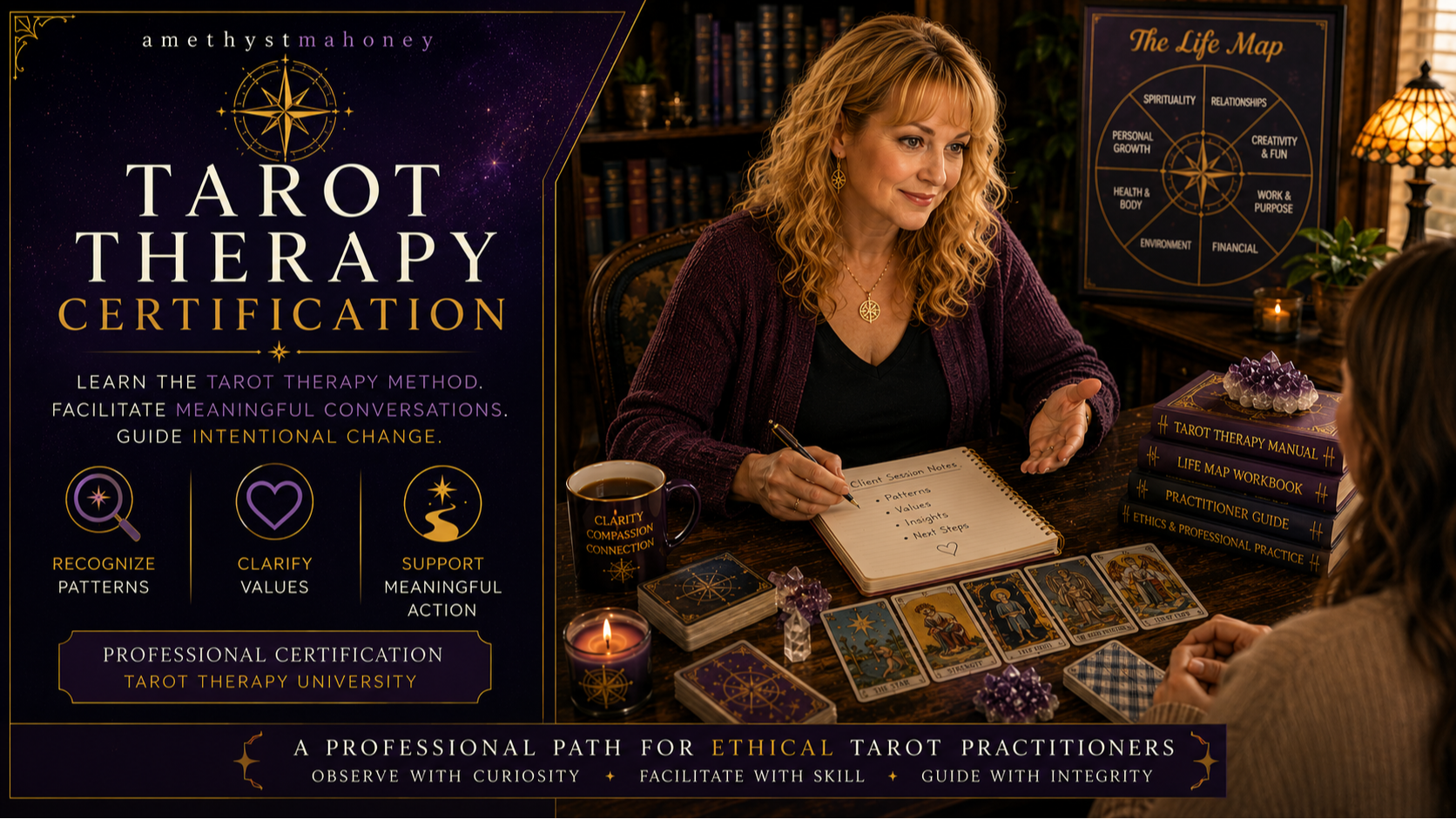
If you're ready to develop the knowledge, practical skills, and professional framework needed to work with others through Tarot Therapy, explore the Tarot Therapy Certification.