
5 Surprisingly Simple Ways to Connect with Your Intuition
5 Surprisingly Simple Ways to Connect With Your Intuition
Intuition can sound mysterious, as though some people were born with an extraordinary inner compass while everyone else is wandering around hoping the Universe eventually sends sufficiently obvious instructions. In reality, intuition is often much quieter and more ordinary than that. It can be the thought that keeps returning even though you've tried to dismiss it, the detail you notice before you understand why it matters, or the feeling that something deserves a closer look.
Everyone experiences intuition differently, which is one reason developing it isn't really about learning a universal set of rules. It's about becoming familiar with the way your intuition communicates with you. The goal isn't to unquestioningly trust every thought, feeling, coincidence, or impulse that crosses your path. It's to notice your responses, become curious about them, and gradually learn which ones deserve your attention.
Like most things, this gets easier with practice. You don't need an elaborate ritual or hours of meditation to begin. Some of the best opportunities to strengthen your intuition are already hiding inside your ordinary day.
1. Pay Attention to What Gets Your Attention
One of the easiest ways to strengthen your intuition is simply to become more curious about what you notice. Maybe you keep encountering the same idea in completely unrelated places, or a particular conversation stays with you long after it's over. You might repeatedly notice a symbol, animal, number, phrase, or opportunity. Sometimes something completely ordinary catches your attention for reasons you can't immediately explain.
You don't have to decide that every coincidence is a message from the Universe. Instead, you can treat these moments as invitations to pay attention. Ask yourself why you noticed something, what it makes you think about, and whether it connects with anything you're experiencing right now. The important part isn't immediately figuring out what something “means.” It's noticing that your attention went there in the first place.
If signs, synchronicities, Divine guidance, or communication with your Guides are already part of your spiritual practice, there's plenty of room to explore those possibilities too. A sign doesn't have to replace your own discernment; it can give you another piece of information to consider. And if repeating numbers are one of the things that keep catching your attention, you can explore my Angel Number meanings for another perspective.
2. Draw a Tarot Card and Come Back to It Later
Tarot can be a wonderful way to practice intuition because it gives your mind something concrete to respond to. Instead of waiting for an intuitive impression to appear out of nowhere, you have an image in front of you filled with people, expressions, colors, symbols, movement, relationships, and details. Something on that card is probably going to catch your attention.
Try drawing a card in the morning with a simple question such as, “What might be helpful for me to notice today?” Spend a little time looking at it, but don't worry about squeezing a complete interpretation out of it before you've finished breakfast. Notice your initial reaction and whatever seems interesting or important, then go live your day.
Later, return to the card and look again. Something that seemed insignificant that morning may suddenly make sense because of a conversation you had or an experience that occurred. Your original impression may feel surprisingly accurate, or you may realize you completely misunderstood what you were seeing. Either way, you've learned something.
That last part matters because intuition needs feedback if you want to get better at recognizing it. Over time, you're not merely collecting Tarot meanings. You're learning how you notice, interpret, question, and understand information.
3. Follow Your Curiosity
We tend to make intuition terribly dramatic. We imagine an unmistakable inner voice announcing that it's time to quit a job, move across the country, end a relationship, start a business, or otherwise blow up Tuesday afternoon with a major life decision.
Sometimes intuition may show up around something enormous, but it can also be much simpler. It can be the urge to pick up a particular book, take a class, talk to someone, try a different restaurant, drive home another way, research a subject you've never cared about before, or investigate something for no better reason than Huh. That's interesting.
Those smaller moments of curiosity are excellent places to practice because the stakes are low. You don't have to rearrange your entire life every time something catches your attention. Follow one small curiosity and see where it goes. Maybe you discover something important. Maybe you have an interesting afternoon. Maybe absolutely nothing happens.
None of those outcomes means you did it wrong. You're practicing the much more useful skill of noticing what calls to you, choosing when it's worth following, and paying attention to what happens afterward.
4. Notice Your Responses to Other People
Other people give us endless opportunities to practice intuition and discernment. Sometimes you meet someone and immediately want to know more about them. A conversation unexpectedly energizes you, or someone says one sentence that sticks in your mind for the next three days. You may not immediately know why the interaction mattered, only that something about it did.
The opposite happens too. You may become unusually guarded around someone, feel uncomfortable during a conversation, or notice that you're exhausted every time you interact with a particular person. Those reactions are worth noticing, but they don't automatically tell you the truth about the other person.
Your response is information, not a verdict.
Instead of immediately deciding that someone has terrible energy or that your intuition has definitively exposed their secret villainy, get curious about what you're experiencing. What specifically are you responding to? Does this person remind you of someone? Did something about the interaction cross one of your boundaries? Are you picking up on a genuine inconsistency, or are you filling in information you don't actually have?
Intuition becomes much more useful when it's paired with curiosity and discernment rather than certainty.
5. Keep Track of What Happens
This may be one of the least glamorous intuition practices imaginable, but it's also one of the most useful: write things down. If you have a strong intuitive impression, record it. If you think a Tarot card is pointing toward something, write down what you think before you know what happens. If you believe you've received a sign, make a note of what you thought it meant at the time.
Then come back later and see what actually happened.
Maybe you were exactly right. Maybe you picked up on something real but interpreted it incorrectly. Maybe what felt like intuition turned out to be fear, hope, assumption, pattern recognition, or good old-fashioned wishful thinking. Those aren't failures. They're how you begin learning the differences between the various internal signals that can feel remarkably similar in the moment.
Without that feedback, it's incredibly easy to remember the spectacular intuitive hits while conveniently forgetting the seventeen times we were absolutely certain the Universe had spoken and the Universe apparently had no idea what we were talking about.
Keeping track isn't about proving that you're psychic enough. It's about developing something much more useful: discernment. You're building your own body of evidence about how your intuition works rather than relying on somebody else's rules for how intuition is supposed to feel.
Your Intuition Doesn't Need to Be Perfect to Be Useful
Developing your intuition doesn't mean reaching a point where you never question yourself again. Questioning yourself can be useful. Curiosity can be useful. Changing your mind when you receive new information can be extremely useful.
What you're developing is a stronger relationship with your own internal signals. You learn to recognize them, explore them, test them against reality, and decide what deserves your trust. With enough practice, you begin to understand not only when your intuition is speaking, but also how you tend to interpret what it's telling you.
Tarot can be particularly helpful for developing that relationship because the cards give you a place to practice. You're looking at something, noticing your response, considering possibilities, and discovering what happens when you follow those observations further.
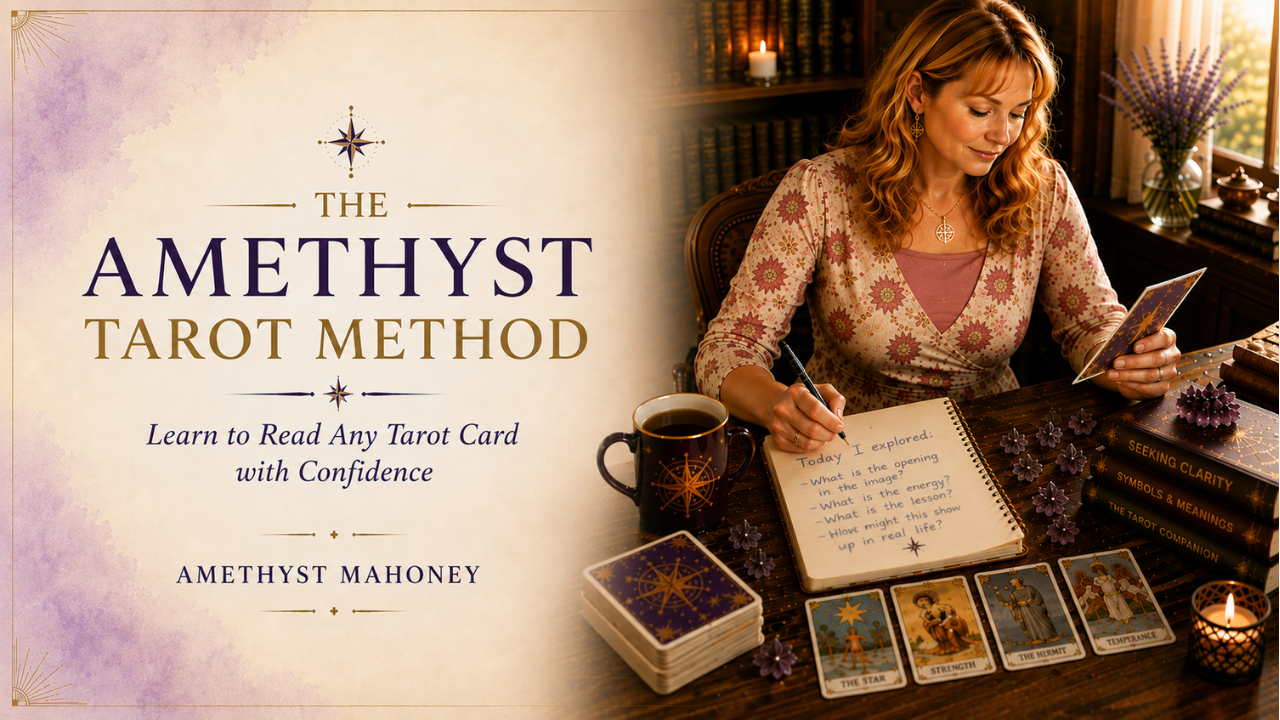
If you'd like a structured way to develop that skill with the cards, The Amethyst Tarot Method teaches you how to approach a Tarot card without depending entirely on memorized definitions. Instead of giving you another enormous collection of meanings to remember, it helps you develop a repeatable process for working with what you see and building a reading from there.
Explore The Amethyst Tarot Method